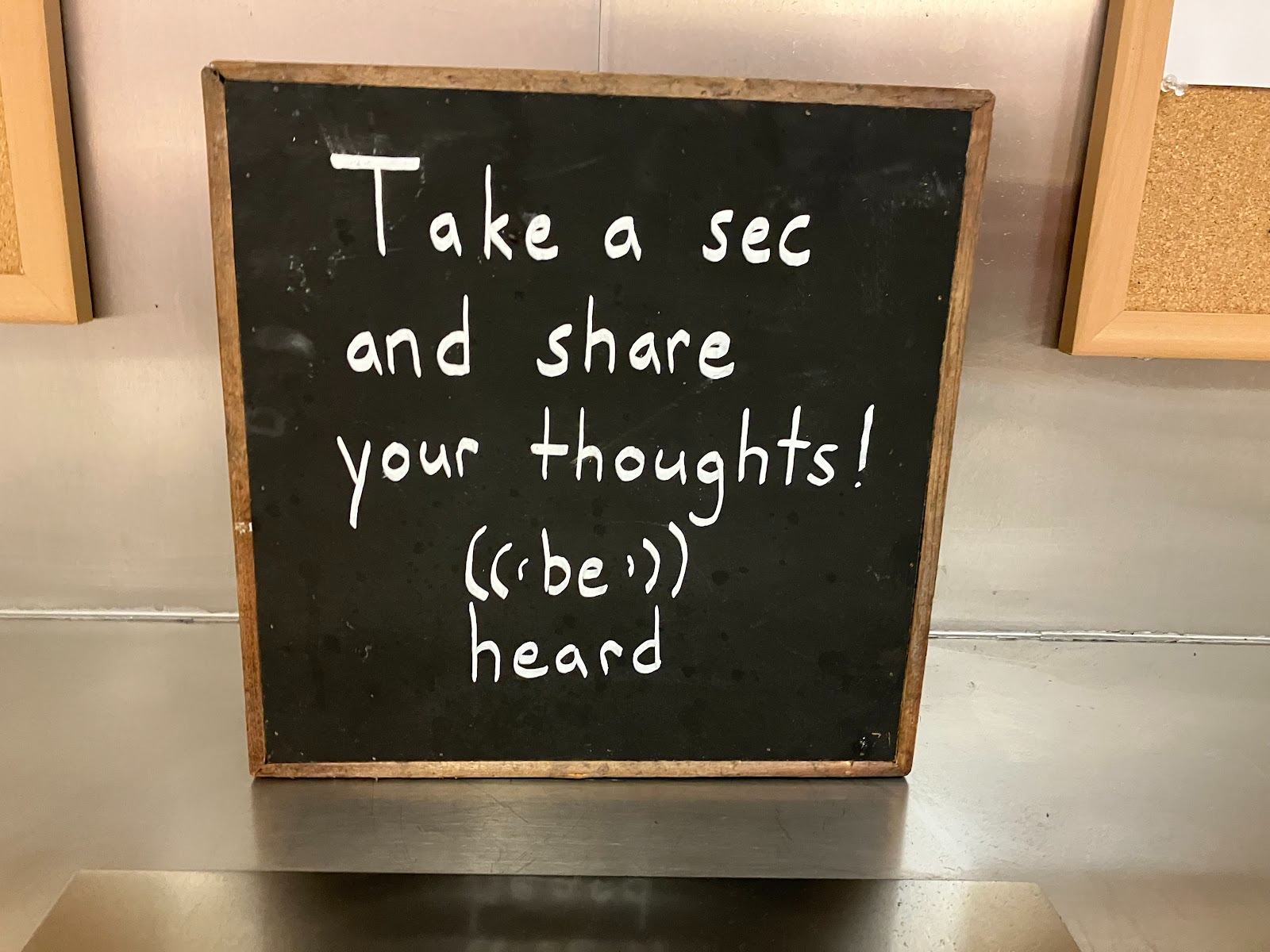
Anyone who has eaten at Danforth Dining in recent weeks (months? years? æ o n s ?) has likely seen this sign. You, dear reader, have likely seen this sign. I, dear reader, have most certainly seen this sign.
I dislike it very much.
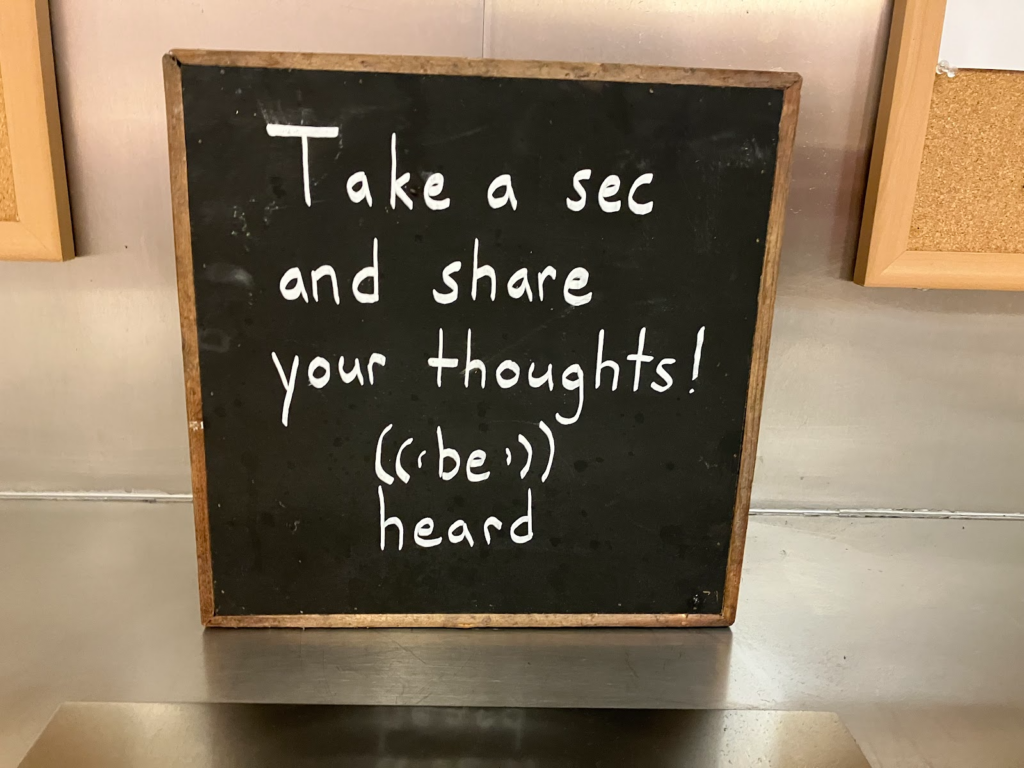
Observe the sign. Take it in. Allow it to meld into your very being. Notice what it says: “Take a sec and share your thoughts! (((be))) heard”
If that wasn’t in quotes, the editors would crucify me.
Where is the consistent punctuation? Where is the consistent capitalization? What in the blazes is up with “(((be)))”?
I know what you’re thinking. Caden, those aren’t parentheses. Those are little curves drawn to represent the concept of sound emitting from the word “be” in neat little waves! No. Stop. You are wrong.
Why would there be sound emitting from the word “be”? The word “be” has nothing to do with sound! If anything, there should be sound emitting into, not from, the word “heard,” not “be.” Even sound emitting from “share” would be acceptable. But sound emitting from “be”? Preposterous!
I’ve heard other theories. Perhaps “(((be)))” is meant to give the impression that the word “be” has wings, and therefore is a visual pun on the word “bee.” This is not only wrong, but downright un-American. I refuse to elaborate on how.
If the curves around “be” are not meant to represent sound or bees, however, then the only feasible interpretation is that they are indeed parentheses. But if that is the case, what sort of message are we meant to take away from this sign? That our voices don’t matter? The use of not one, not two, but three sets of parentheses puts an enormous de-emphasis on the word “be,” as if to say “Go ahead, share your thoughts. We love the cronkly sound they make as we toss them in the wastepaper basket.” Expecting to be heard? Ha! I bet this sign is what lawmakers smile at in Florida, Missouri, Tennessee, Florida again, Kentucky, etc. whenever they get an email from a queer person pointing out the increasingly despicable (read: genocidal) nature of their legislation and rhetoric. No, I’m not bitter. Why do you ask?
In any case, assuming that Danforth Dining does not wish to deliberately mock the voice of the students, there is one last option: despair. Any attempt at interpreting the message of this sign clearly results in a loss of meaning. As a result, I now subscribe to the philosophy of Sign-Nihilism, which states that all things are meaningless (but more specifically just this sign). Join me, comrades, and together we can revel in our newfound freedom from the constraints of human morality.
But more specifically just this sign.