Associate Dean for Diversity Dr. Jessica Guzmán-Rea announced Monday that work is beginning on the College’s 2020-2022 “Bias-Related Incident Report,” which she says is set to be ready around December.
Guzmán-Rea, among her other responsibilities, heads the executive team that responds to submissions to the Bias-Related Incident Report form on the CARE Network website, which can be used to inform administration about harmful incidents motivated by the targeted individual or group’s “age, disability, ethnicity, gender, gender identity, gender expression, national origin, race, religion, or sexual orientation,” according to the CARE site.
The new publication will be the third of such reports, which have been put out every two years since 2018 to give public summaries of the data collected through the reporting system. The form itself was created in 2015.
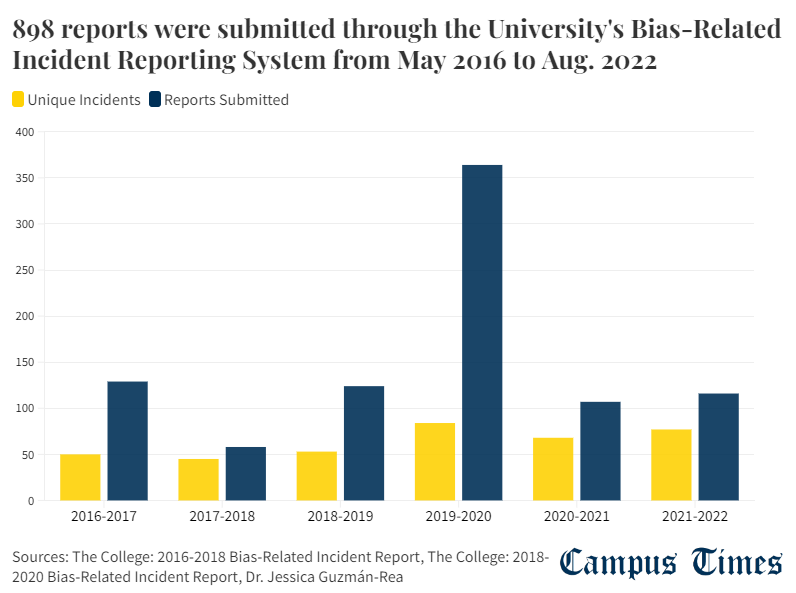
According to the 2018 and 2020 publications, the form took in a total of 675 reports concerning 232 unique incidents from May 2016 to Aug. 2020. Around 43% of the reports during that period were about alleged incidents where the bias in question concerned “Race/Ethnicity,” while the second and third most-reported bias categories were “National Origin” and “Religion/Creed,” respectively coming in at around 13% and 11%.
While the full data is not prepared yet, she did share the updated unique incident and overall report totals. In 2020-2021, there were 107 total reports for 68 unique incidents, and in 2021-2022 there were 116 overall reports for 77 unique incidents.
Guzmán-Rea attributed the reporting spike during the 2019-2020 school year to multiple social justice movements, like Black Lives Matter and Stop Asian Hate, coming to a head around the same time. She also said there is no clear baseline for what a “normal” reporting year looks like—and such a thing may not exist in the first place.
In 2016-2017, for instance, many reports related to the 2016 American presidential election, she said, and she thinks 2017-2018 reports were suppressed because students were more focused on the controversy surrounding Brain and Cognitive Sciences and Computer Science Professor Tim Florian Jaeger. The new 2020-2021 numbers were also complicated by the COVID-19 pandemic.
She intends on adding this additional context into the new report to frame the figures. The new publication will also include information about incidents concerning multiple forms of bias, whereas prior reporting years only allowed the reporter to discern the primary motivation for an incident. Guzmán-Rea said these changes were the result of input from the Bias Response Team.
She hopes that students will note that reports submitted through the form do lead to actions taken and do enter into institutional policy discussions, and the publications note a number of steps taken in response to reported incidents.
“I understand when people don’t have trust in the process because perhaps it didn’t work for them or they heard it didn’t work for an individual,” she said. “My caution is that that could be a stock story. That could be one individual that told a lot of people that it didn’t work for them. But for a majority of people who don’t say anything, the process works for them, which I’ve seen in the past and I can’t say anything because it’s confidential. […] Not every process is perfect, but we’re making a concerted effort to make sure it’s timely, effective, efficient, and that we really hear the concerns of the students.”
Guzmán-Rea said a draft of the report will be presented to the College Diversity Roundtable for input before its final publication, likely at their next meeting on Oct. 24.