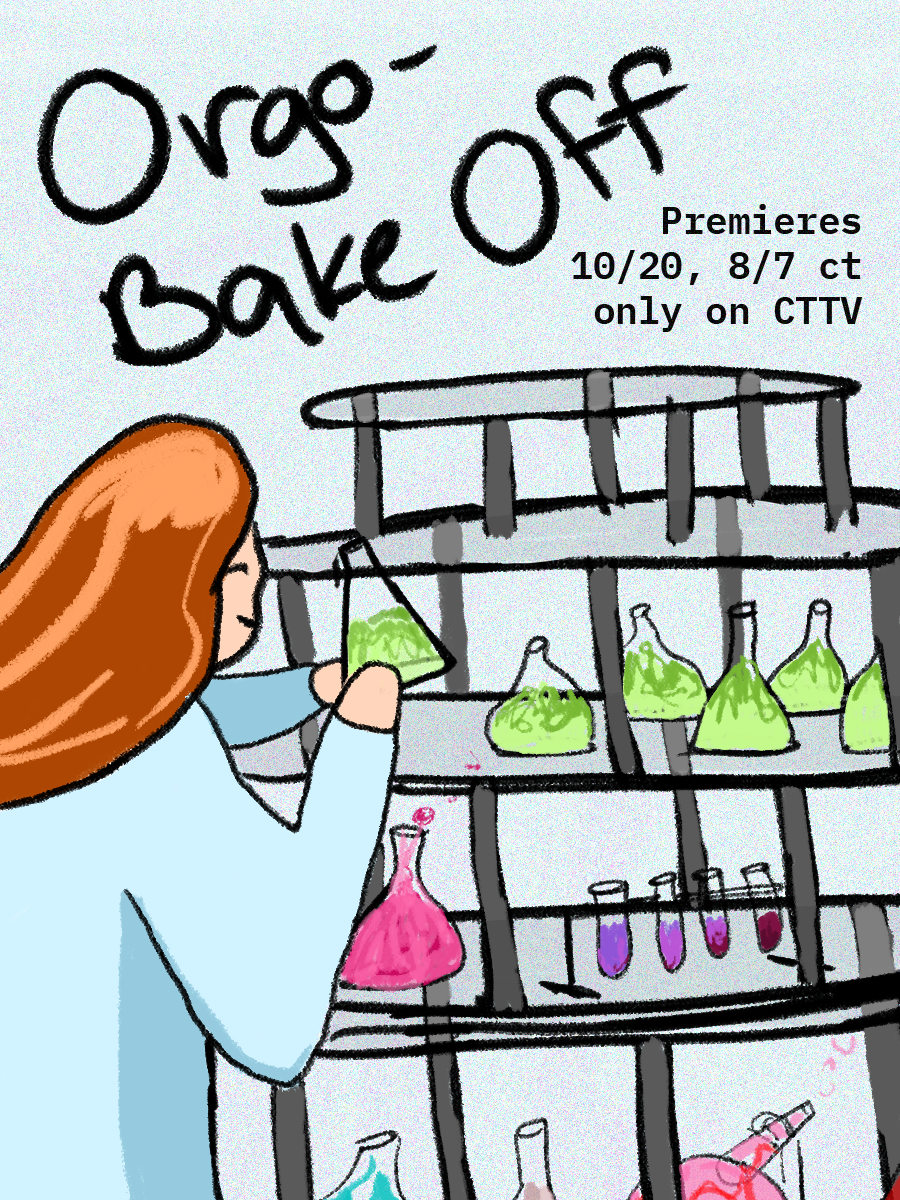
Three hours. 20 students. One lab. On your marks. Get set. Bake.
Lab off has begun. So put on your lab coat and don your goggles. It’s go time.
Glassware is collected and dumped onto benches. Lines have formed in front of the fume hoods for chemicals. Students peer over their manuals. TAs float around, haggled by students asking them how to do the entire lab.
The stress is high, the stakes are high. And I forgot to weigh my glassware. Again.
I’ve always compared chemistry labs to the technical challenges in the reality TV show, “The Great British Baking Show.” The directions are vague, the mistakes are many.
“Do a suction filtration.”
“Bake.”
Peering anxiously at my melting point apparatus, waiting for a miniscule amount of white powder to boil, I imagine I’m staring at an oven, willing my sourdough to rise in the idyllic British countryside. Lab coats, aprons, same difference really.
The precision needed to perform chemical experiments or bake edible foodstuffs, the patience required to wait for things to boil or cook, the dazed feeling after doing a lab for three hours or baking in the tent.
Technical challenges are meant to test the limits of an amateur baker’s skills through the making of baked goods with a pared down recipe. In reality, it makes for good TV. To any of you who have taken a chemistry lab, this concept might sound familiar. The waiting, the stress, and the surprising collaboration. (This isn’t “Cutthroat Kitchen.”) There is always an element of uncertainty. Which glassware do I use? 100ml? 250ml? How much flour? Is the solution supposed to be yellow? Why did Paul Hollywood spit out my biscuit sandwich??
But labs can be fun when you mostly know what you’re doing; there are moments of exhilaration (“wow, that filtration actually worked!”), mild concern (“isn’t this gas poisonous?”) and collaboration (“can I use your IR spectrum? I accidentally threw my compound out…”). Labs challenge your multitasking skills, test your patience, and would make an amazing British reality TV show.