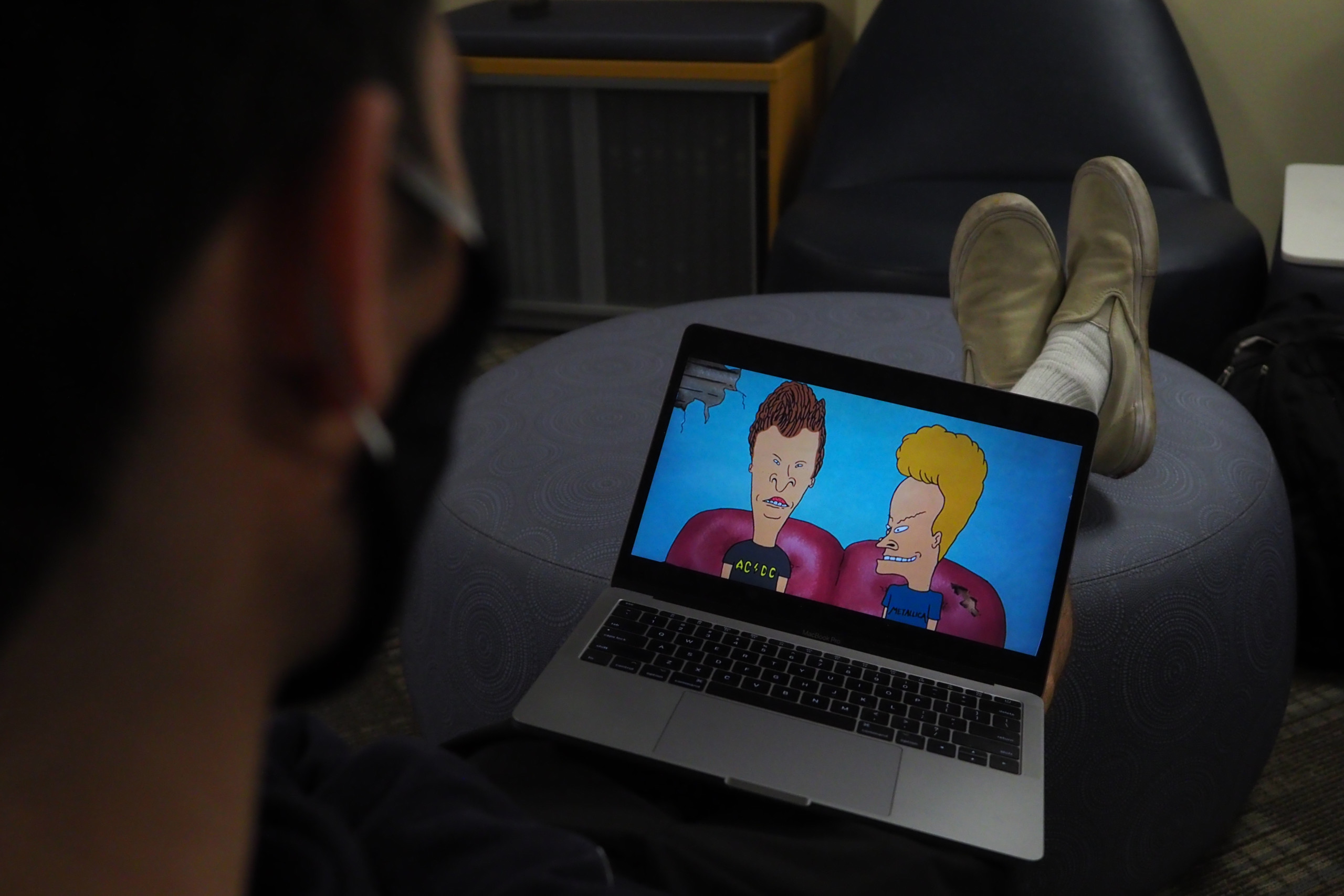
“Beavis and Butthead” might be one of the stupidest shows to ever exist. But somehow, I can’t pull myself away from it. For anyone who isn’t already familiar with this integral piece of ’90s MTV culture, the show follows two impressively idiotic teenage boys who are obsessed with TV, rock ‘n’ roll, crude jokes, the opposite sex, and anything they deem “cool.”
Each episode, the duo’s lack of brain cells always seems to land them in all sorts of unpredictable and often chaotic situations — such as causing a massive pile-up on the highway, accidentally blowing up their friend’s kitchen while trying to inhale stove gas to “get a killer buzz,” and tearing up their neighborhood’s septic system in an attempt to mine for “oil,” just to name a few.
Despite the fact that it’s a comedy show, I rarely ever find myself even cracking a smile while watching it. And still, there’s just something that keeps me coming back for more. It’s not the low-brow, brainless, IQ-destroying comic relief that makes the show compelling. Nor is it the barely-there punchlines of constant and unrelentingly crude references to male genitalia. What makes the show great is its subtle commentary on the meaningless pursuit of superficial pleasure that is glorified by Western civilization.
Pretty much every single one of Beavis and Butthead’s adventures can be traced back to their two core motivations: watching TV and “picking up chicks.” However, quite predictably, these adventures never end well for the duo. Whether they’re hijacking a steamroller to impress said “chicks” or trying to get hit by a car so that they can sue and get $2 for TV remote batteries, the show demonstrates the great lengths the pair will go to just to get their next rush. This is perhaps best demonstrated in the full-length film, “Beavis and Butthead Do America,” where the two literally travel all across the country just to “score” (spoiler: they don’t score). They are locked in a never ending dopamine-chase, where they never truly are satisfied or fully achieve their goals, no matter how superficial they may be. The next episode always comes, and the next dead-end adventure always follows.
This cycle is no doubt fueled by their constant intake of television — a medium that glorifies sex, violence, and anything intensely stimulating. In fact, one could argue that Beavis and Butthead serve as a hyperbolic representation of how humans would act if they were exposed solely to Western media: sex-crazed, crude, violence-obsessed, and constantly seeking the next thrill. It’s no coincidence, then, that Beavis and Butthead are also portrayed as the pinnacle of stupidity, as the show seems to make a statement on how mainstream media can deteriorate the mind with its glorification of constant stimulation.
Beavis and Butthead’s antics are so painfully ridiculous that it’s easy to look down upon and laugh at them — but don’t they represent a flaw that is inherent to us all? Even if we are grateful for the things in life that are truly fulfilling, it is far too common for our focus on those things to take a backseat to the next thrill we can have. Instead of deriving joy from meaningful elements of life, it can be easy to slip into dependence on the stimulation that is offered by fleeting day-to-day pleasures — the next time we can go out, the next thing we can buy, the next plan for the weekend. As in Beavis and Butthead’s case, this is a flaw that is no doubt exacerbated by contemporary media, which encourages the relentless pursuit of this superficial stimulation. For this reason, “Beavis and Butthead” might be one of the most cleverly subtle comments on modern culture and its often destructive effects on the human psyche.
Or maybe it’s just toilet jokes.