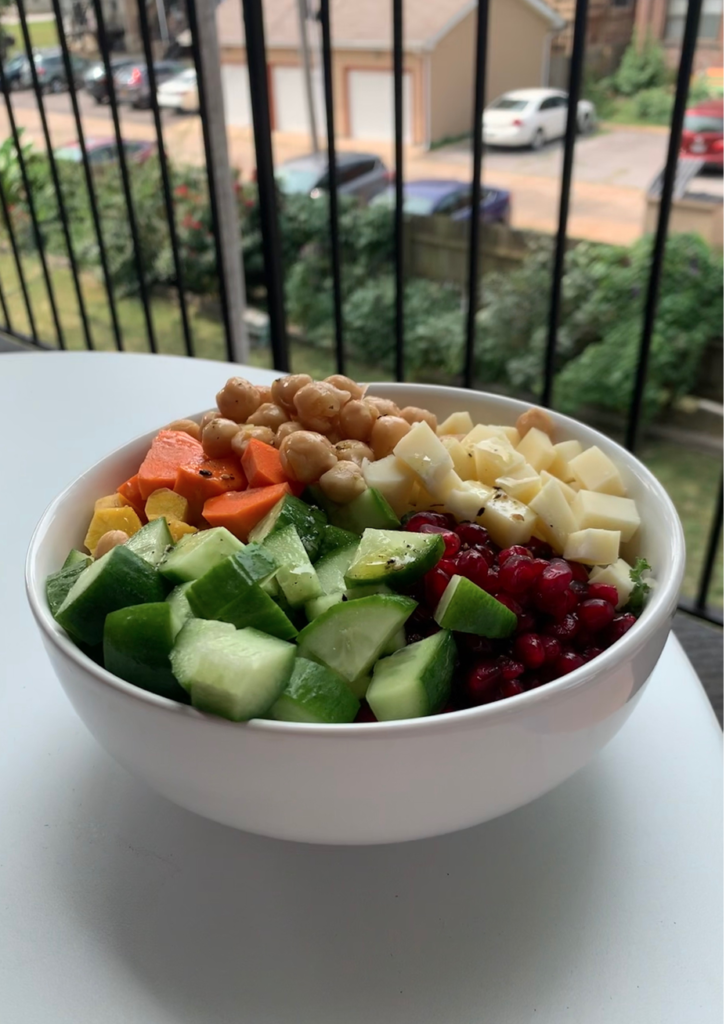
Sophie’s Salad

We have all been there: studying our butts off, cramming like no one has ever crammed before, kicking ourselves for all the “I’ll wake up early and do it tomorrows” we promised ourselves. Eventually, angry sounds start to come from your stomach, and you think, “Holy crap, if I don’t eat right now, I am going to flip out.” Boy, do I have the salad for you. Sophie’s salad is super fast to make and chock-full of high-quality protein to help you power through your study sesh.

Ingredients

For salad 

  • 1/4 cup cheddar cheese 
  • 1/2 cup cucumbers 
  • 1/4 cup pomegranate seeds or dried cranberries 
  • 1/3 cup thinly sliced carrots 
  • 1/3 cup chickpeas 
  • Enough lettuce or mixed greens to fill 3/4 of a medium bowl

For dressing 

  • 1 tbsp white wine vinegar 
  • 1 tbsp olive oil 
  • Salt 
  • Pepper 
  • Dijon mustard (optional) 

Directions 

  • Cut cheese into small cubes, and if applicable, slice lettuce to the desired size. Fill the bowl with lettuce and arrange the rest of the salad ingredients on top. 
  • In a small dish, whisk the vinegar and olive oil until combined. Season with salt and pepper to taste. Add a little squirt of Dijon mustard if desired. Then drizzle over the salad.




CT Cooks: Power through your studying with Sophie’s salad

The Gorbunova-Seluanov Lab, led by URochester’s Doris Johns Cherry Professor of Biology and Medicine Vera Gorbunova, as well as Dean’s Professor of Biology and Medicine Andrei Seluanov, studies the molecular and genetic processes behind aging in different mammals, as this class of animals provides more insight on human aging and health.  Read More

CT Cooks: Power through your studying with Sophie’s salad

Chat, did I make a mistake? I went on a date with the voices in my head and I liked it. It was a bit of an unplanned date, but what else are you supposed to do when none of your friends will have dinner with you? Read More

CT Cooks: Power through your studying with Sophie’s salad

We teach the Dust Bowl as a cautionary tale. In every American history class, we learn how farmers in the 1920s and 1930s tore up millions of acres of native grassland across the Great Plains to plant wheat, how the deep-rooted prairie grasses that held the soil and trapped moisture were replaced by shallow crops and bare fields, and, when drought came in 1930, how the exposed topsoil turned to dust. Read More
