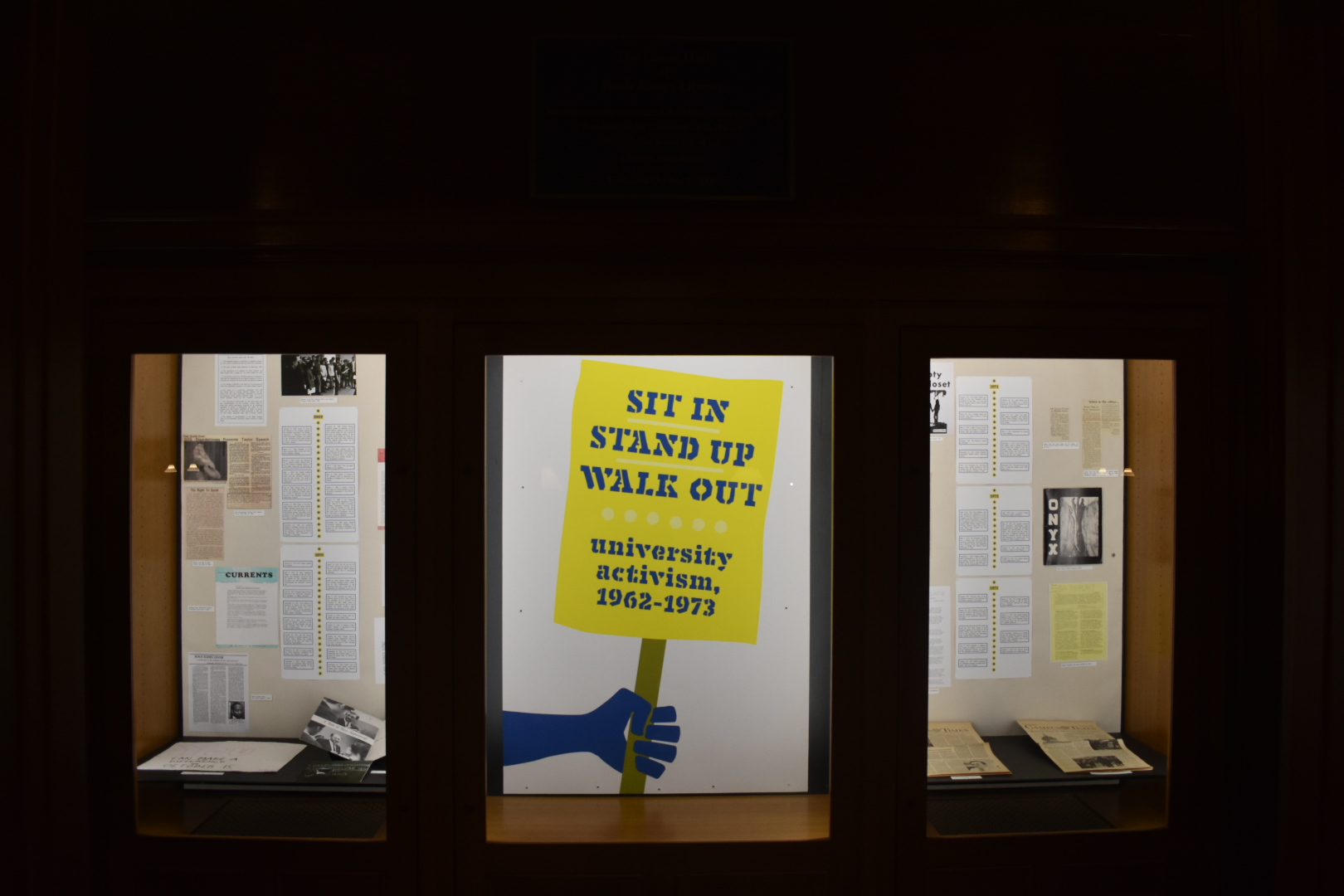
The decade of 1962 to 1973 “changed our University no less than other institutions,” says the title page of the “Sit In. Walk Out. Stand Up” exhibition. “Issues were both local and global. Policies were questioned and revised. Students and faculty protested directly and indirectly.”
The exhibition on the second floor of Rush Rhees shows instances of university activism during the most turbulent and traumatic years of its history. The decade began with a peace movement in 1962, led by the National Committee for a Sane Nuclear Policy in Washington, DC. The group later disbanded and reformed as UR Peace.
Within the same year, the University named W. Allen Wallis as the sixth president. Students wrote in response to the Cuban Missile Crisis, claiming that “morality ended in 1945.” Rochester students and faculty strongly voiced their concern over issues of race and violence in the US. In 1963, for example, the UR NAACP pushed Sigma Chi to welcome African Americans into their fraternity, while mathematics professor John A. Ernest gave a speech advocating strongly for peace.
During the years of assassinations and race riots, faculty and students of the university took an active role in political activism. In July 1964, Freedom Riders that included UR students went South to help African Americans register to vote. In December of 1966, Rochester community members marched on the Eastman Quadrangle every Tuesday to protest against the war in Vietnam.
1968 became a time for cooperation, the year for students and faculty to develop the consciousness of the institution. In the midst of the riots following Martin Luther King’s assassination, Rochester’s BSU was founded and later encouraged Vice Provost Dowd hire a black Assistant Provost.
In the same year, the University began an Educational Opportunity Program, and the BSU established an official Graduate Student Organization. On June 6, 1968, student representation was kicked into place on four major faculty committees: the Committee on Academic Policy, the Committee on Graduate Studies, the Administrative Committee, and the Committee on Committees. Both students and faculty united and took charge in changing the institution.
As a result, the first black students enrolled in the School of Business Administration (Simon School) in 1969. Soon after, the UR Chaplains’ Office sponsored services celebrating Ramadan at the Interfaith Chapel, while the Women’s Caucus was founded on campus. They later brought Betty Friedan to campus, a notable activist and the author of The Feminine Mystique.
The exhibit moves through the activism from 1962 to 1973 and displays the general trend of students’ and faculty powerful voice during this radical decade.
The exhibits ends by describing how on Oct. 1, 1973, as a cumulation of the community’s need for an expressive outlet, the Campus Times began publication on a daily basis.