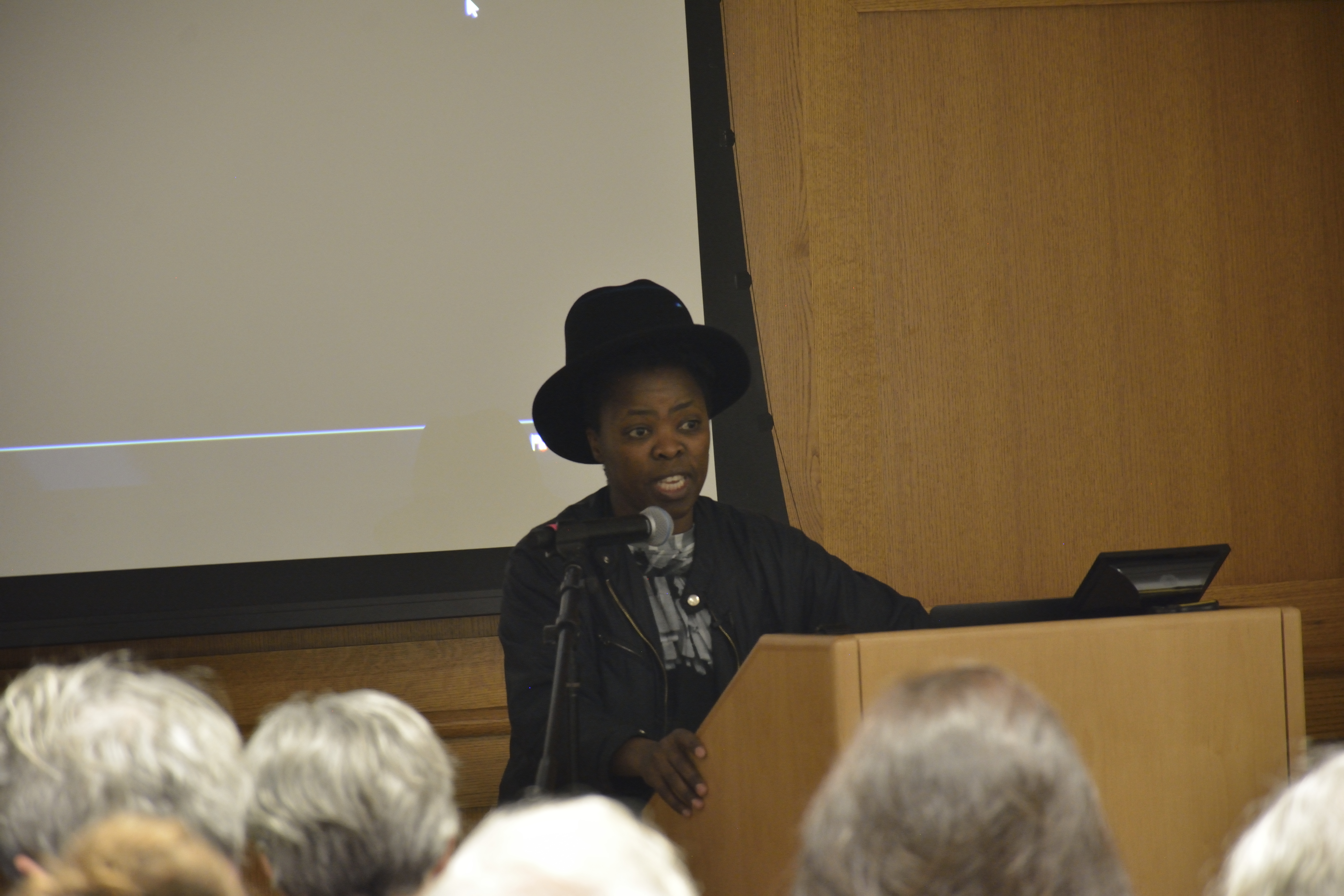
The Humanities Center was packed last Tuesday night with students and faculty eager to catch a glimpse of Zanele Muholi’s photographs.
Muholi, a South African visual artist, uses photography and video installations to increase the visibility of black lesbian, gay, transgender, and intersex people.
“My work is strictly black, and my work is queer,” said Muholi. “If someone is allergic to this, please step out of the room.”
Muholi was invited to UR as part of the annual Two Icons Lecture, which explores the intersection of race and gender, and honors the legacy of Susan B. Anthony and Frederick Douglass. Continuing their work of “critiquing Western concepts of progress and constitutional democracy,” Muholi’s work addresses what she sees as a disconnect between the equality being promoted by South Africa’s government and the hate crimes that continue to occur against the LGBT community there.
Muholi marks 1996 as a pivotal moment in South African history, the year the constitution was amended to offer protection for LGBT people. However, she is critical of the depth of protection that is afforded to queer individuals because of the increasing violence they continue to face.
“You cannot talk of a constitution and the freedom of the people if there are people who are not completely free simply because of the structures that have been put in place,” Muholi said.
Moving away from the usual presentation of negative or violent portrayals of queer black people, Muholi instead focuses on validating their right to exist by capturing them whole within their space.
“Since there is a lack of South African visual history that looks at specifically LGBTI individuals, most of my work is simply looking at spaces where we exist and are guaranteed by the South African constitution a right to live and express our identities,” she said.
Muholi’s work was praised by students in attendance.
“It’s telling that visibility doesn’t seem to exist for black queer people,” junior Sadyn Angeles said. “Muholi’s work breaks away from traditional narratives by incorporating stories and faces that are usually pushed aside.”