Christian Cieri, Illustrator
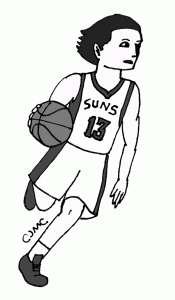
This past weekend, the NBA waved goodbye to one of its truly unique players as virtuoso point guard Steve Nash announced his retirement after 18 seasons.
Drafted by the Phoenix Suns out of West Coast Conference (WCC), from Santa Clara, Nash played sparingly his first few seasons before being traded to the Dallas Mavericks. After a few years, Nash and fellow Maverick Dirk Nowitzki became one of the most formidable shooting duos in the league, and, at this point, Nash regularly appeared on the All-Star and All-NBA roster.
After the ’03-’04 season, Nash returned to Phoenix, where he paired with Mike D’Antoni, Amar’e Stoudemire and Shawn Marion to form one of the most fluid, potent offenses in the history of the sport.
Nash’s skills as a passer and as a shooter were on full display every night for those Phoenix squads, and put up four 40/50/90 seasons while also leading the league in assists per game five times in seven years. Most impressively, Nash won back-to-back MVP awards in the ’04-’05 and ’05-’06 seasons.
Although Nash was experiencing his best years in his 30s, the Suns could never make it out of the stacked Western Conference, engaging in some memorable tangles with San Antonio and Los Angeles in the playoffs.
After a few down years, Nash was traded to the Los Angeles Lakers, where he spent a few injury-plagued years playing for some disappointing teams. He wasn’t even able to step on the court season, before retiring last Saturday.
Nash has compiled an impressive list of philanthropic projects, donating funds and time to causes in Uganda, Paraguay, Phoenix and his home country, Canada.
In 2007, Nash received the highest honor a Canadian citizen can receive, the Order of Canada, for his contributions in British Columbia.
“At the heart of this letter, I’m speaking to kids everywhere who have no idea what the future holds or how to take charge of their place in it,” Nash wrote in an essay for The Player’s Tribune. “When I think of my career, I can’t help but think of the kid with his ball, falling in love. That’s still what I identify with and did so throughout my entire story.”
Bernstein is a member of the class of 2018.