Alyssa Arre, Photo Editor
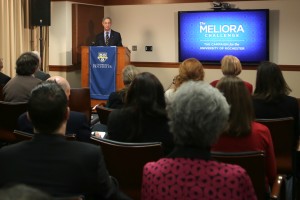
As of this week, the Meliora Challenge campaign has passed the $1 billion mark, University President Joel Seligman said at a press conference Wednesday. The announcement represents a significant milestone in the campaign’s ultimate goal of reaching $1.2 billion by June 2016.
“Thanks a billion,” Seligman said to donors.
As of Sept. 26, the campaign had accumulated $950 million, with over $50 million raised in the last two months.
The top individual donors to the campaign include Edmund Hajim, Georgia Gosnell, and Joseph and Janet Willets. Hajim has committed a total of $30 million, making him the campaign’s leading donor. Thirty-eight percent of faculty and staff have also contributed to the Meliora Challenge in some way.
The bulk of the donations will go toward funding student scholarships and fellowships, professorships, and physical campus development. So far, 66 professorships as well as the construction of LeChase and Rettner Halls have been funded through the Meliora Challenge.
“At a time when UR faces several daunting challenges, including dramatic changes in the provision of health care and cutbacks in federal funding for research, it is wonderful to be able to announce that we have passed the $1 billion milestone,” Seligman said.
Remus is a member of the class of 2016.