 Mock Trial president and senior Shalin Nohria talked about hosting the YellowJacket Invitational, placing fifth at a competition at the University of Pennsylvania last weekend, and his plans for the next five years.
CT: What is Mock Trial?
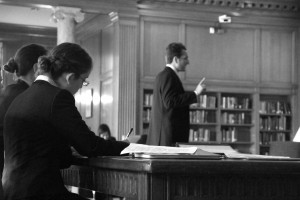
N: The goal of Mock Trial is to foster an introductory education of trial techniques and strategies. Mock Trial provides an opportunity for students to gain experience in a legal setting through the enactment of a trial, usually based on a real-life case, which students get to argue before a legal professional. If you need a visual, picture a mixture of “Suits,” “The Good Wife,” and “Gladiator.”
CT: What do you guys do?
N: First, we help our members develop their analytical, persuasive, and organizational skills. Second, we destroy any team unfortunate enough to be paired against us in a competition.
CT: Do you have to be a communications major to join?
N: Absolutely not. I’m actually a pre-med student, and we have members with majors ranging from history to chemical engineering. Mock Trial has such a wide variety of cases and develops so many professional skills that really anyone whose job involves speaking should consider joining.
CT: How do competitions work?
N: Each year we receive a case that typically ranges from about 150 to 200 pages. This case includes affidavits for a variety of witnesses, different evidential exhibits, scientific publications, résumés for the experts, and sometimes even audio files of the crime itself. We go through each piece of evidence carefully as a team and then split off into pairs where an attorney will direct a specific witness who helps their side of the case and then cross an opposing sides witness to damage their credibility.
US is ranked among the top 50 mock trial teams in the country, and as such, we do receive invitations to the top competitions. Every year, we compete at UPenn, Columbia University, Yale University, Cornell University, with our actual elimination invitationals starting in the spring at Buffalo State College.
CT: How have you fared in the past?
N: Every year, our team has gotten stronger. We typically send one team to Opening Round Championship Series, which is a significant achievement in and of itself.
Last year, our organization sent two teams to ORCS for the first time in UR history. During my sophomore year, our team qualified for the nationals bracket, which includes only the top 50 teams from over 500 mock trial teams around the country.
CT: Mock Trial hosted the YellowJacket Invitational from Nov. 2-3. How did it go?
N: Our fourth-annual YellowJacket Invitational brought in 14 teams from around the country, including many that were nationally ranked. Additionally, we secured rooms in LeChase Hall and the Welles-Brown Room to showcase our beautiful campus. We even received help from over 30 prestigious legal professionals like Joanne Winslow, a Monroe County Supreme Court judge. Special thanks must be given to the Monroe County Public Defender’s Office, Nixon Peabody, and our alumni for supporting us so much.
CT: What’s up next?
N: We just competed at Columbia, where our team ranked sixth out of 22 teams. Our next competition will be this weekend at UPenn, where our new members will join our old to ensure the continuity of our group. Part of our team will also travel to Yale to compete at an invitational on Saturday, Dec. 7.
CT: Where would you like to see Mock Trial in five years?
N: I see us winning the national championship for the fifth year in a row.
CT: What is the craziest thing that has happened at a tournament?
N: I’m afraid I’m going to have to take the Fifth. What happens at mock trial tournaments stays at mock trial tournaments.
Brady is a member of the class of 2015.