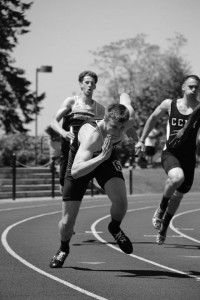
Alyssa Arre, Photo Editor
On Friday, March 22 and Saturday, March 23, UR men’s track and field opened its season against Washington and Lee College and the Virginia Military Institute in Lexington, Va. The meet hosted 20 schools and some 2,000 athletes. Even with the impressive attendance, UR earned two qualifying times for the Eastern College Athletic Conference (ECAC).
One of these times was awarded to junior Adam Pacheck, who came in third in the 5000-meter with a time of 14 minutes, 55.5 seconds. The second ECAC time came from a group effort by the team of junior Eugene O’Hanlon, freshman Jeff Hrebenach, sophomore Max Sims, and junior Anthony Paschke, which finished seventh in the 4-by-100 meter with a time of 43.62 seconds.
The Yellowjackets excelled in other events, garnering two top-ten spots in the 110-meter hurdles. Senior Jon Richardson ranked ninth with 16.28 seconds while freshman Ronald Morrow finished close behind in tenth place with 16.29 seconds.
The Pacheck brothers, Adam and sophomore Ethan, have proven a deft duo. While Adam earned an ECAC qualifying time at the meet, Ethan was 10th in the 800-meter with a time of 1 minute, 57.76 seconds. Also competing in the 800-meter was freshman Jeremy Hassett, who finished ninth place in 1 minute, 57.63 seconds.
Not only did the ’Jackets give solid performances in distance events, but in javelin, decathalon, long jump, and high jump as well.
Senior Jeff Benton placed ninth in the javelin with an impressive 47.63-meter throw. In the decathalon, Patrick Rice came in 11th, while fifth in the 400-meter and second in the long jump. Senior Ben Clifford, in his first year on the team, came in fourth in the high jump.
Kilbridge is a member of the class of 2015.