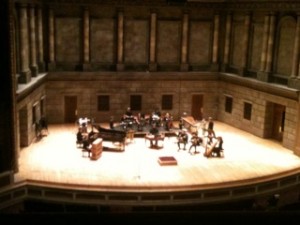
Courtesy of Rachael Sanguinetti
Every day, new music is written, performed and recorded by students and faculty at the Eastman School of Music. Many new-age music groups have formed on the Eastman campus to help bring this musical style to the general public. One such group, Musica Nova, has had particular success.
The performance group, under the direction of Associate Professor of Conducting and Ensembles Brad Lubman, was formed in the 1960s and has since been a strong force for new music at Eastman. The group performs new, contemporary music written within the last 100 years.
Musica Nova is a dynamic group and the pieces they perform include an ever-changing number of instruments. Some use a small set of string instruments whereas others require many strings, brass and percussion instruments, including harp and piano.
Cellist and senior Audrey Snyder joined Musica Nova a few years ago as a last-minute substitute just one week before a concert.
“It was some of the hardest music I’ve ever had to play,” she said.
Since then, Snyder has become a key member and active participant in Musica Nova.
For those not familiar with new-age music, it can be a challenge to describe, let alone perform, as it usually differs from your typical classical music.
Pieces often don’t have the usual melodic line or theme that listeners can easily follow. Instead, they try to create a more abstract feeling or mood for audience members or sometimes try to tell a story.
“I think it’s much more of a grey area [of music],” Snyder said. “It almost describes the complicated world we live in.”
Musica Nova’s latest concert, performed last Wednesday, Oct. 17 in Kodak Hall, was part of a month-long festival at Eastman dedicated to the life and music of composer Claude Debussy and entitled, “The Inspirational Debussy.”
Each piece picked for the performance was either chosen as a compliment to Debussy pieces or written by an Eastman composer and based on the Debussy piano sonata “Des pas sur la neige.” All four of the original pieces were written by faculty members and resembled the aforementioned Debussy sonata in a new way without copying any of the music exactly. This concert was a testament to the range and variety of new music that this group performs.
Composing new-age pieces, according to Lubman, is frequently not done in a traditional style. It often uses a complex “formula of sorts.”
“I’m not going to try and explain it because we’d be here all night,” Lubman said of the piece he composed for the last concert.
New music is growing in popularity, and this group does a wonderful job of preparing students to explore and pursue the style after their time at Eastman.
Many graduates of Musica Nova have gone on to perform in new music groups all across the country. They also write their own new-age music and send them back to Lubman so the piece can have its world premiere with the group.
“My plan is to definitely carve out a place for myself in new music,” Snyder said. “I want to stay away from the overly academic ivory tower of contemporary performance. I want to find a balance between new and old.”
Sanguinetti is a member of
the class of 2015.