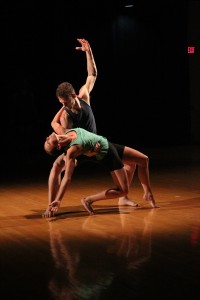
Photo courtesy of Junne Park– Photo Editor
UR got a taste of Lehrer Dance, a touring dance company based in Buffalo, N.Y. under the direction of Jon Lehrer, the founder, artistic director and choreographer of the company on Friday, Sept. 14 in Spurrier Dance Studio. And UR seemed to like what it saw.
Lehrer Dance is well known for showcasing Lehrer’s definitive style, displaying his extensive background in jazz and modern dance and combining the athleticism of modern dance with the purpose and fluidity of jazz. They tour nationally (and, starting in November, internationally) and rarely get the chance to perform locally — but they seemed excited about this mini-tour to colleges in the Western New York region. Performing five pieces, they wowed the audience with their athleticism and grace, seeming to impress even the least dance-savvy audience members with their clear skill.
The first piece they performed was called “The Alliance,” which Lehrer explained as a showcase of the dance troupe as a tribe, demonstrating how they work together and separately. The name itself comes from “Star Wars” — rejoice, nerds of UR, for Lehrer is one of you. The piece itself was impressively done, with several differentiated sections separated by music changes, and, at one point, a period of total silence. However, there were arm movements and a general tone that tied the whole thing together, making it seem more like a suite of dances rather than individual segments. A silent section was particularly powerful. There was something fascinating in hearing only the dancers themselves — the sounds of their footfalls and breathing created a musical background that was wholly natural.
The third piece could never be described as boring, to say the least. Though the program listed “Bridge and Tunnel” to be next, it was switched with “Morphic Slip.” It was the only piece performed in costume, for both aesthetic and technical reasons — a lot of the dance was based on slipping and sliding over the floor, something that can’t be accomplished with bare skin. Lehrer, in an attempt to prepare the audience for the somewhat bizarre piece, explained that it was basically “an alien love duet.” The costumes themselves were essentially flesh-colored, with blue stripes running all over them, resulting in a costume that looked a bit like a paler version of the costumes from the movie “Tron.”
Despite its oddities, the piece was quite endearing. The choreography was brilliantly done, taking full advantage of the costumes, allowing the dancers to slide without injury on the floor — it created odd movements that seemed bizarre and clearly defined these two creatures as alien to the viewers, but the dance itself felt like watching a relationship develop between the two. It was at times funny and often inexplicably sweet.
Another piece called “Murmur” was a special preview performance — the world premiere will be in October. It was very different from the first; a little bit slower, but still energetic. Lehrer explained the disparity by saying “. . . we’re very known for being extremely athletic, but this piece is more lyrical.” It was pretty, if less remarkable than the other performances of the night, but was slow enough that it could have been a tad boring for audience members who knew too little about dance to appreciate the more intimate details of the techniques.
“Bridge and Tunnel” marked a stark change. Lehrer grew up in Queens and explained that a “bridge and tunnel kid” was a derogatory statement used by the people living in Manhattan, and that, of course, he wanted to reclaim that term and use “I wanted to have an ode to Queens … albeit a highly edited version. I hope you get a vibe of the city … in its most innocent and vibrant form,” Lehrer said just before the piece began.
It’s possible that no single piece of dance has ever caused such a sense of homesickness and longing for youthful days gone by as this one did. The dancers skipped while holding hands, big smiles on their faces. They mimicked children’s games like rock-paper-scissors and dodgeball and showed a boy and girl falling in love, while their friends looked on disapprovingly, before returning to the playful atmosphere of childhood with a faux game of red rover. The piece was full of absurdity and fun — a true representation of youth.
The final piece, “A Ritual Dynamic,” fell a bit flat after “Bridge and Tunnel,” which had so much personality. Lehrer told the audience that it was the piece that had closed every single Lehrer Dance performance since the company was founded, which added a sense of history to the number, but it wasn’t as engaging or entertaining as the previous one.
The show also engaged the audience with tidbits about the pieces in the breaks between numbers, giving it another unique layer. This was especially helpful for those who didn’t know as much about dance, because it made it easier to follow what was happening, as well as learn about the history of the dance company. The show was impressive to watch and was one of the better external dance groups brought to UR in recent memory.
Howard is a member of the class of 2013.