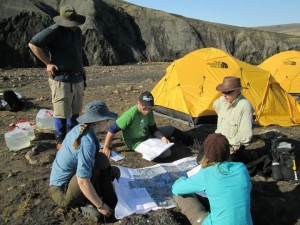
Researchers from UR’s Paleomagnetic Research Group look over an area map while collecting paleomagnetic samples in the Canadian Arctic this past summer.
In research, it is not uncommon for big ideas to come from tiny bits of data. There is perhaps no better example of this phenomenon than the current work being completed under Earth & Environmental Science Professor John Tarduno in the University’s Paleomagnetic Research Group, nicknamed “PMag”, in the department of geology.
Paleomagnetism is the study of the Earth’s magnetic field and its ancient record preserved in rocks. Records of magnetic fields are preserved in rocks by the alignment of magnetic minerals along the field present at the time of that rock’s formation. Researchers in the PMag group know that these small bits of minerals have big implications.
Under the direction of Tarduno, the PMag Research Group studies rocks from every corner of the globe, often traveling themselves to collect samples. Tarduno and members of the group have traveled to New Zealand, Australia, South Africa, Zimbabwe, the Sahara and the Arctic, all in search of rock samples and new data.
Once brought back to UR, paleomagnetic samples are cut to appropriate size and then analyzed in one of the group’s magnetometers in Hutchison Hall.
Most of these instruments are so sensitive that they have to be placed in a magnetically shielded room. In fact, they are so sensitive that a researcher cannot even carry his keys into the room.
Measuring an ancient magnetic field can yield more information than would seem.
Paleomagnetic data can have implications for plate tectonic movement and even magnetic pole reversals. In fact, reversals of our magnetic field are so universally recorded in the global rock record that they are often used as a means to date rocks.
In 2010, data obtained from the Barberton Mountains in South Africa yielded the oldest measurement of Earth’s magnetic field yet: 3.5 billion years old. The findings were published in “Science,” the world’s leading journal of original scientific research, and reported on in popular media worldwide.
Sometimes findings can even extend beyond the field of rock magnetism. In 1996, the group literally stumbled across a remarkable find: a fossilized turtle shell in the Arctic, dating back to the Cretaceous period.
Since this discovery, the group has dedicated time on each successive Arctic expedition to sample the fossil bed.
Ongoing research projects within the group are equally diverse. While one project works toward analyzing magnetic signatures in meteorites that date to the formation of the solar system, another tracks the motion of volcanic hotspots in the Pacific Ocean.
From hammering out their own samples, to performing precision magnetic analysis, from the most microscopic of measurements, the Paleomagnetic Research Group seeks to better understand some of the biggest concepts in geology.
Although this geological research seems to only analyze history, it can have huge implications for our modern world. Understanding the Earth’s past allows us to more accurately predict its future.
McKinley is a member of
the class of 2013.