Leah Buletti, News Editor
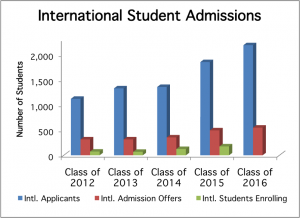
In the 2004 admissions cycle, the size of the international undergraduate population at UR hit a low point. With only 2.7 percent of the class of 2008 hailing from outside the United States, the University redoubled its recruitment efforts abroad.
In the years since, this change in focus has resulted in a complete turnaround in terms of international admissions. Sixteen percent of the current freshman class is from a foreign nation, and, at least for the class 2016, the trend is not slowing down. This year, UR experienced an 18 percent increase in applications from international students, and 11 percent more than last year were accepted.
Prospective students of one nationality, however, did not see an increase in acceptance letters from the University in 2012.
Approximately half of the international students in the class of 2015 are Chinese, and as a result, UR Admissions has curtailed the number of Chinese students accepted this year.
“One of our goals at this point is to make sure that we don’t have an international population that’s too much from one country,” Dean of Admissions Jonathan Burdick said. “We don’t want the Chinese student population to be more than, say, half of the [international] undergraduates.”
While this year saw a 27 percent increase in Chinese students applying to UR, the number accepted was less than one percent higher than last year. Yet, in spite of this, Burdick noted that applicants from China are becoming increasingly appealing to the University — a trend that might soon start coming at the expense of American students.
Due to a combination of China’s one child policy and their rapidly growing economy, an increasing number of Chinese families are willing to pay the full price for their child’s education — a concession that American families are much less likely to make.
“If I’ve got two students with comparable academic preparation … and one is coming from China and ready to pay the full price of a UR education … that’s not going to work out well for affluent Americans who are unwilling to sacrifice for the best education possible,” Burdick said. “We’ll always meet the needs for the students who actually need help, but … when we have to balance the budget, these are things we have to consider.”
While the University currently has no set restrictions in place in terms of accepting international students, Burdick indicated that he believes discussions about instituting such policies at UR might be on the horizon. For the time being, though, he emphasized that the University’s focus is to accept the most qualified students possible, taking into consideration their ability to pay tuition.
Chinese Students’ Association (CSA) president and senior Alexander Wei believes these decisions are centered on striking a balance between maintaining diversity and upholding academic standards.
“If the University wants to have top-notch academics, they should just admit whoever they feel are the best candidates,” Wei said. “But if they want diversity, then they’ll have to start putting policies in place.”
For Wei, the fact that a large percentage of the international student population is from China isn’t a detriment to the University community, but rather a “reflection of what’s happening in the real world.”
“China has become a bigger power, a wealthier nation, so they will become a bigger part of the global conversation,” he said. “I think it’s an advantage for [other] students on campus because they will have a first person view of what’s actually going on globally.”
In an address to the Faculty Senate on Tuesday, April 10, UR president Joel Seligman acknowledged the growth of the international population on campus and questioned whether current UR programs and services are sufficiently meeting the needs of these students. While this question is certainly an open one, several programs have been put in place in recent years to ensure that the transition for international students is as seamless as possible. According to Burdick, UR takes care of all visa and legal issues for international students, as well provides them with assistance learning English if needed.
For Chinese students though, the CSA plays perhaps the greatest role in making them feel comfortable in the American college environment, providing them with academic assistance, a familiar community and, through a new host family program, even a place to call home.
“The way the Chinese culture is, you don’t always reach out, so it can be uncomfortable for them to integrate into the campus society,” Wei said. “It’s always nice to have someone they can count on when they don’t know who to talk to.”
Fleming is a member of the class of 2013.