Courtesy of http://img.ibtimes.com/
How sad are the days when police unleash wanton violence upon those whom they are paid to protect!
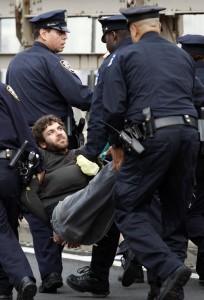
Down on Wall Street there’s pepper spraying, face punching, aggressive hand tying, etc. Upon first hearing of this, I was downright sick. After reading the published demands of the protest movement Occupy Wall Street, however, I realized that there was nothing more immoral happening here than there would be in a boxing ring.

Occupy Wall Street’s premise is that people have a right to things like forgiveness of debt, free healthcare, free college education, higher minimum wage and so on. More abstractly is the wish to ban corporate greed and end wealth inequality. These demands cannot be met without forcing new taxation, and they plan to target taxes toward the most productive — i.e. wealthiest — individuals and corporations of our society.
These demands will also necessitate intervention in the productive capabilities of corporations, ideally inhibiting their ability to push unfavorable transactions upon the unwitting.
These ideas are summed up in the following: We need people to work and think for us more, and we have the right to extract these services at the point of a gun. Legislation implies enforcement, and enforcement ultimately implies the threat and implementation of physical violence.
The occupiers are saying that it is OK to acquire means by authorized force, and, like boxers in a boxing match, once they’ve agreed to use fisticuffs it is no longer wrong to hit a person!
My standard is the following: If the government may box with the wealthy, it should be able to box with the not so wealthy as well. Therefore, when the government’s agents come to Wall Street and billy club a protestor in hopes of getting him to fall back in line, there’s nothing immoral transpiring!
At least, nothing wrong or immoral to someone who believes that it is OK to use force to acquire means. There is something very ill about this line of thinking.
Surely things can be better in this nation. We can be happier, wealthier and more peaceful. While the intentions of the occupiers may be for these things, the nature of their methodologies is far darker than I could hope for.
Eles is a Take Five Scholar.