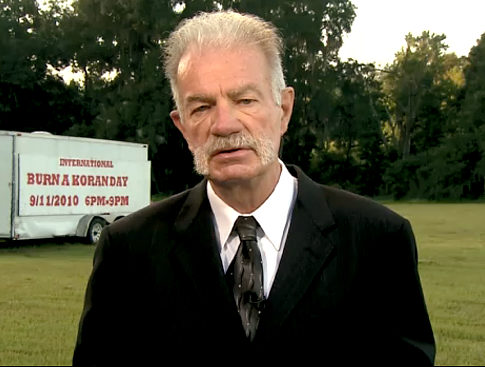
Courtesy of http://www.islamophobiatoday.com.
There are several reasons for which the Rev. Terry Jones’ burning of a Quran on March 20, while legally protected under the First Amendment, should cause question.
Was he thinking ahead about how his fellow Americans would react? Did he realize that people’s lives might be endangered? Most importantly, did burning the Quran mean more to him than being American or risking anyone’s safety?
The significance of the Quran, first of all, cannot be isolated outside the United States. Reverence of the Quran as the word of God is one of the few unifying characteristics of the world’s Muslims, including those that live in the U.S., many of whom are inspired by the Quran to serve their communities as soldiers, teachers and doctors. Thomas Jefferson owned a Quran. George Washington and John Adams both considered Muhammad (peace be unto him) to be admirable as a truth-seeker.
In burning the Quran, Jones alienates the peaceful people whose lives are guided by this book. It is not the action of someone who counts even a single Muslim amongst their friends. Literally eliminating the physical presence of the Quran by burning strongly suggests some feelings about Muslims that are at odds with the fact that American Muslims often are allies to the CIA and FBI.
Furthermore, anyone trying to incite violence against the West and the United States benefits hugely from an American publicly burning a Quran. This is abundantly clear in the violence of some of the protests in Afghanistan and there is no telling how many more times in the future from how many pulpits someone will be able to dick reference Jones while recruiting anti-American or anti-Western terrorists.
The UN staff that was killed had nothing to do with Terry Jones. It is absurd that Jones can increase the risks to their physical safety while they do humanitarian work outside their native countries. Jones did not kill those seven people, and their deaths were plainly murder. But Jones’ action made people angry, and some of those people made the deceased UN staff their scapegoats when Jones, from so many thousands of miles away, says to his followers, “There’s only one way to stop me, and that’s to kill me.”
Based on where these UN staff members in Afghanistan came from, or what they looked like, violent people found a reason to associate them with Jones.
When Jones first proposed Quran burning on Sept. 11, 2010, the idea was condemned by President Obama, Gen. Petraeus and many other leaders, including those of many faith communities. Petraeus explicitly stated his concerns that Americans abroad would be especially endangered.
Various peaceful protests of the idea have taken place in New York and Washington, making hundreds of people visible in their disagreement with Jones and what his Quran burning represents. They unfortunately will not get the same attention and recognition that Jones will abroad in places like Afghanistan, but it is important that those voices and images exist at least for when people look for them.
In spite of years of American efforts, Afghanistan today is still a poor country, where the overwhelming majority of Afghans are starving for dignity, democracy and stability with no end in sight.
There is just reason for disappointment with this war. Many lives have been lost during our occupation, justly and unjustly, American and Afghan.
Both groups can relate to one another in their grief, but not in the ability to do something about their frustrations with political rights like freedom of speech. Jones exacerbated that tension.
There are always alternatives to violence in a democracy where human life is valued. In today’s world, it is too easy to predict that some type of violence somewhere will follow the public burning of a Quran.
There is nothing positive in Jones’ Quran burning to outweigh the risk of violence, the subsequent loss of life or the obstacles created to realizing American goals here and abroad.