http://www.enquirer.com/
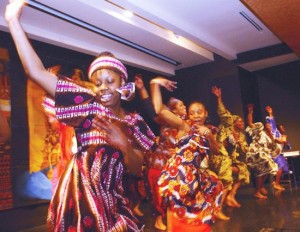
Music, food, good company and culture managed to bring people indoors on the sunniest day in Rochester so far this year. On Saturday, April 9, from 6 to 8 p.m., students, family and faculty, including Assistant Political Science Professor Valerie Sinclair-Chapman and Office of Minority Students’ Affairs Counselor Thomas Crews, sold out the May Room for the Pan-African Students’ Association’s second annual Afrikanza exhibition — a culmination to this year’s Africa Week. But Afrikanza was not merely a cultural showcase and gathering — it was a celebration and denunciation of prevalent stereotypes about the continent.
“Not only are we showcasing the richness of Africa and its culture, but we want to educate people about the real Africa by taking on stereotypes,” sophomore and PASA president Marius Kothor said in her opening statements.
This year’s Afrikanza was uniquely put together — the entire exhibition was a skit that was broken up into different performances, presentations and video segments. The storyline was centered on Anani Klemankhoti’s (performed by freshman Shaqull McCullers) visit to his grandmother, freshman Isia Nzikoum, in his native homeland, Oduwa. In case you find yourself frantically searching Wikipedia and Google, do not fret — the characters and village are fictional.
However, the message was real. Klemankhoti finds out that most of the stereotypes and images that were engrained in his head before his visit home were a poorly skewed representation of his homeland. His comical and rambunctious grandmother Nzikou shows him the true Oduwa in a trip around town.
Each trip and narrative broke into either a presentation or performance. From the Ethiopian dance group Axum, to a video of the Oduwa people’s overthrowing of dictator Kothor i0n their revolution, Klemnkhoti and the audience learned more about the true Africa.
The highlight of the night was when Klemnkhoti and Nzikou went to see a speech by a local leader — but, of course, a leader in real life. The keynote speaker, Dr. Moka Lantum, UR School of Medicine and Dentistry alumnus and current Director of Medical Services Business Operations Improvement at Excellus BlueCross BlueShield, directly engaged stereotypes about Africa with his presentation and commentary on Hans Rosling’s “The World is Catching Up” video clip, which was shown on CNN.
Lantum adamantly agreed with Rosling’s point that other countries’ economies are growing at a more rapid rate than America’s in the past decade—including African nations. He cited the fact that Kenya and Ghana won global recognition for the best development in information technology last year with the development of one of the first iPhone applications that allows users to navigate through album galleries and playlists.
“The notion of Africa as a Third World should no longer be,” Lantum said. “If you see building a single image of Africa, [Africans] as a needy people, who need us to save their lives, then you are doing significant damage to the image of Africa. Do not see them as countries of beggars, but [as] masters and competitors in the global economy in the coming years.”
Lantum concluded his speech by charging the audience to appreciate Africa through celebrations of the rich culture and humanity. The skit picked right up where he left off with a slide show presentation of city skylines, central entertainment centers and African business sectors in locations such as Johannesburg, Cape Town and Lagos — every single image was an extreme contrast to the pictures and commercial footage that have saturated American media.
By the end of the night, everyone got to see their classmates and friends strut the May Room catwalk while bedecked in traditional and modern African attire provided by the friends of family of PASA members.
Sophomore and PASA secretary Zoey Francis says that she hopes that the crowd — no matter what ethnicity or nationality they are — not only left with an appreciation of the rich and diverse African culture, but also with a greater understanding of the advancement of its nations.
“The show was geared both toward those of African descent, in its commemoration of the various cultures of which the continent is composed and to those who are not, in its aspiration to become a forum through which education of the diverse nations since independence can be achieved,” Francis said. “At the end of the night, I [hope] that people left with a sense of pride, whether or not they are African, and a better perception of the advances of the respective nations and Africa as a continent.”
Although Africa Week is over at UR, PASA is not done for the year — they will be venturing to our favorite neighbors at RIT for their Africa Week, from Monday, April 18 through Friday, April 22.
Nathaniel is a member of
the class of 2011.