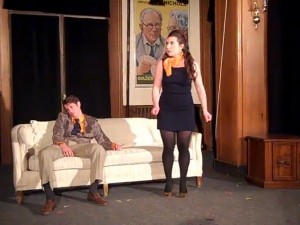
From left to right: Take Five Scholars Matthew Myers and Stephania Romaniuk act out a scene of desperation in the over-the-top musical “Life Is.” Photo courtesy of Bradley Plaster.
For a scientifically nerdy school, UR has a surprisingly superb drama department. Exhibit A: Last week’s One Act Play Festival. Featuring student actors, writers, directors and stage crews, the festival showcased the artistic abilities of a university community largely comprised of pre-meds and engineers, and served to remind the school that our humanities remain strong. The One Acts deserve additional kudos for the collective breadth of styles and themes exhibited over the course of the evening.

Opening the One Acts was sophomore Giulia Perucchio’s “The Freudian Suicides,” a clever, humorous look at Freudian psychoanalysis. That’s a high claim to make, but it’s Gospel truth: Through the actions of a dysfunctional family alternately motivated and bound by Freud’s controversial work “Suicides” pointed out the funny side of Freud. “Suicides” tackled his ideas with a dark whimsy, incorporating penis envy, the Elektra complex, Greek tragedy and suicide into a Freudian whirlwind.
“Suicides” had all the dramatic weight and richness of a full-length feature, and was the only play that demonstrated not only character, but also plot development as well. More than in any other One Acts, Perucchio’s work with senior director Brandon Plaster utilized the theatre to its full potential, with an elaborate set. Ever seen the dinosaur skeleton in Todd Union? Imagine it transformed into a giant bear in an overall technically astounding production. Closing with a musical number composed by senior Maxamillien Letaconnoux, and a fellow playright in the festival “Suicides” provided highbrow entertainment to the Festival.
Following Perucchio’s intellectual feat came “Say Hello” by senior Paul Alperin. This two-person play, centered on dialogue, addressed the emotional ramifications of civil unions versus legalized gay marriage. “Say Hello” focused on a gay couple struggling to balance their mutual wish for a ceremony to cement their union and personal convictions. The arguments of the couple served to illustrate the human side of the political debate, as the men discuss feeling “second-rate” or being perceived as a “monster” for being homosexual. “You can’t change the world” was a repeated theme of the play.
Like “Say Hello,” graduate student Catherine Bailey’s “Words Too Honest to Be Uttered” also tackled social issues; however, this play did so both more creatively and more broadly, encompassing a full spectrum of women’s issues. Although the play focused on females, the work was relevant to any audience member who has ever contemplated the stories of individuals briefly encountered.
The setting was a doctor’s office waiting room, where four women of varying ages and backgrounds — a middle-aged lesbian with breast cancer, a married woman with infertility, a high-school student wanting birth control and a young woman with an eating disorder — are drawn into conversing with each other. As the dialogue skirted around subjects that were possibly painful for the character to discuss, each woman would rise, as the scene around her froze, and perform a monologue, stating, “What I can’t tell her is …”
Although the play was ambitious in its undertaking and creative in its approach, and while the ensemble acting was some of the best exhibited in the festival, “Words” tried to accomplish too much in 25 minutes.
The monologues of the individual women did drive the play forward as a whole, but ultimately the conversations between women were where both the writing and the acting were most striking. These understated interactions — second to the emotionally powerful monologues — captured moments completely plausible in reality.
Closing the festival was the utter showstopper Letaconnoux’s “Life Is,” a 30-minute musical spectacular. Combining over-the-top characters, catchy music and hilarious lyrics, the comedy played off everything ridiculous (and fabulous) about musicals. The plot was classic musical fodder: a couple nervously attempting to impress the husband’s boss in the hopes of a promotion — nervousness inspired the unfortunate husband to imbibe copious amounts of some narcotic, rendering him unconscious.
Awkward sexual tension arises between wife and boss (truly meriting the duet “This is Awkward”), inspiring the jealousy of the boss’ wife, Agnes, impeccably portrayed in drag. Meanwhile, on the familial side of things, a crazy mother is locked somewhere in the house, supervised by a decadent nurse, and a party-hardy half brother crashes the ill-fated dinner and, through what can only be called drunk magic, manages to somehow save the day. The music from “Life Is” had all the gloriously addictive powers of Rebecca Black’s “Friday,” while actually being quality music. It’s hard to get a college crowd excited over a musical, but “Life Is” managed to through a combinatorial explosion of self-deprecating humor and dramatic skill, all while being acoustically pleasing.
McLaughlin is a member of the class of 2014.