1[caption1 id=”attachment_12898″ align=”alignleft” width=”300″ caption=” The Test “Billy” (Jonathan Lewit) threatens Camille (Gretchen Woodworth) with a gun and attempts to blackmail her out of her fortune, in the MuCCC production of “Deadly Murder,” playing downtown.”]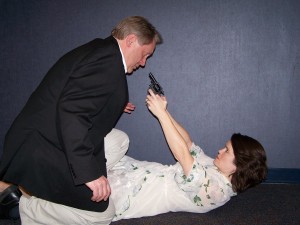 [/caption1-]1
When you go to see a play with the ridiculously inane title “Deadly Murder,” it definitely does not get your hopes up that it will be a high-quality production. I mean, what other kind of murder is there? Undeadly?[/caption1-]1“Billy” (Jonathan Lewit) threatens Camille (Gretchen Woodworth) with a gun and attempts to blackmail her out of her fortune, in the MuCCC production of “Deadly Murder,” playing downtown.
“Deadly Murder” was first produced under several different titles: “If/Then” and “Deadly Game” — definitely not perfect options, but at least sensible ones. The production that is showing in downtown Rochester at the Multi-Use Community Cultural Center, or MuCCC, certainly matched the expectations set out for it by its name. The casting, acting and most importantly the script, were all mediocre at best and mindless at worst.
The play tells the story of Camille Dargus (Gretchen Woodworth), a rich, Manhattan socialite, and her one night with Billy (Jonathan Lewit), a handsome young waiter who she picked up at a gala. Billy’s one-night stand with Camille turns out to be a planned-out scheme to hold her hostage and blackmail her.
The story twists and turns every few minutes, and not in a good way — the plot alternates between being cliché and horribly predictable. Camille’s security guard, Ted (Jeff Moon), is the third and final character in this play. He quickly reveals himself to be Billy’s accomplice, easily foreseen from the second that he steps on stage.
The rest of the show is littered with these absurd moments. David Foley, the creator of the abomination that is “Deadly Murder,” is certainly not the next Tenessee Williams — there are dozens of moments throughout the play where the character’s motives and actions are completely incomprehensible. For example, Ted unties Camille because of her “cries of pain,” which leads to her subsequent and quite obvious escape. These unsophisticated, cartoon-like characters and this writing is a quintessential example of Foley’s terrible playwriting skills.
The character development is slow and superficial as well. We have little emotional invotional investment in Camille or Billy — in the end I didn’t care whether Billy succeeded with his scheme or Camille escaped from his grasp.
Also, the majority of the second act leaves us without our leading man, and most interesting character, Billy.
We are left with the poorly written Ted and the often indecipherable Camille. The amount of cliché and predictability is brought to a whole new, almost awe-inspiring level of shit, leaving me wondering why MuCCC decided to produce this play at all.
The production, direction and acting were not the elements that dragged this play down. Instead, as I may have over-emphasized, it was the horrible atrocity of a play that Foley misguidedly brought into the world. The inadequacies of the production and crew, although not as great in number, were magnified by Foley’s putrid script.
First, the casting was definitely off. Our sexy, male protagonist was portrayed by a nerdy-looking, pot-bellied RIT alumnus. Throughout the play we are further reminded of Billy’s handsomeness and charm, and despite adequate acting by Jonathan Lewit, we never quite buy him as the beautiful and sinister Billy. As for the other two, the casting was a little more fitting — the acting, meanwhile, was not.
Camille, played by Woodworth, seemed to never change expression during the play, and her acting was often interspersed with an abundance eye-flutters. Ted Moon on the other hand, overdid his facial expressions, like a silent film actor, every chance he could get.
Even so, they were all actually fine at delivering their dialogue, however poor it was. They portrayed passion and emotion as well as one could hope for, from a local production.
What we are left with in the end with a play that feels campy, clumsy and predictable. The three actors are certainly on there way up, and with more time and plays under their belts, could become respected thespians.
Despite the scripts’ shortfalls, the pursuit of the arts should never be put down, and the effort and passion put into the production is laudable. I look forward to seeing other plays at the MuCCC, the theater is a quaint, homey-feeling space and the crew and cast put in a lot of hard work.
The play will be showing again at the MuCCC this Friday and Saturday at 8:00 p.m. and Sunday, Jan. 29 at 3:00 pm. All of the proceeds of “Deadly Murder” will go to Alzheimer’s research. The MuCCC is located at 142 Atlantic Ave.
Penney is a member of the class of 2012.