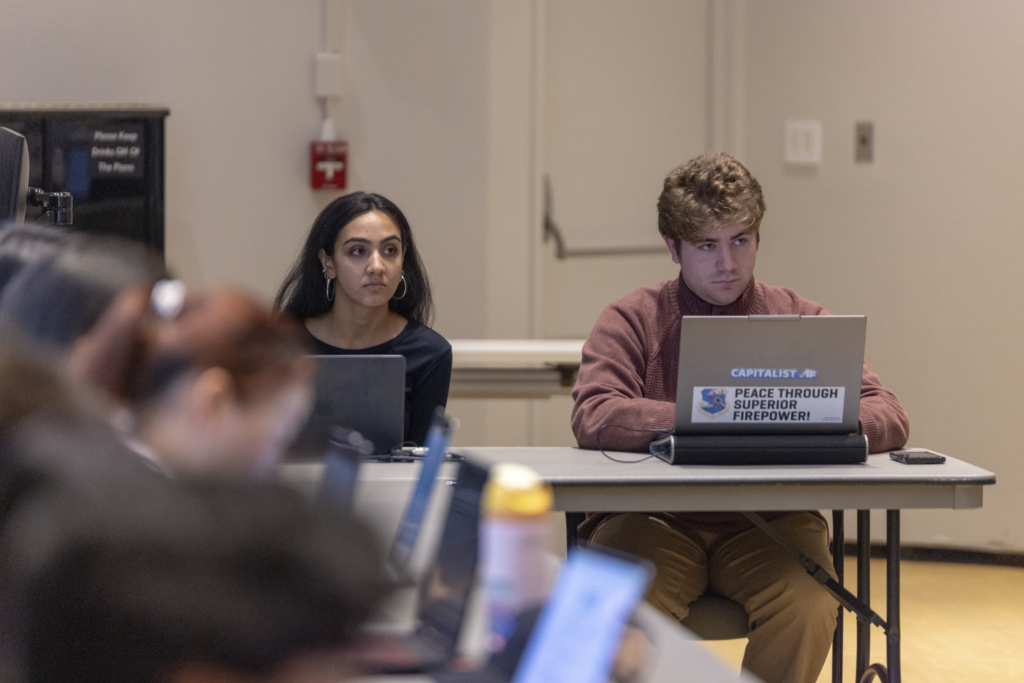
The first of a series of focus groups in which students are able to voice their opinions about what classrooms and technologies they would like to see upgraded in upcoming renovation projects was held last night in the Gowen Room.
“We know that we need some work on classrooms, and we would like to understand the concerns that students and faculty have when making these renovations,” College Teaching, Learning and Technology Roundtable chair Steve Manly said. “This is not just theoretical – there are going to be changes and we need to know where to put our effort.”
The panel consisted of six faculty members, each intending to to take into account students’ concerns about the current situation in each building on campus.
“There are not very many nice classrooms,” Senior Operations Officer Ovide Corriveau said. “This is a very old campus and we haven’t stepped up to the 20th century.”
After this comment, the crowd of about 40 students began suggesting specific classrooms that have problems with the ventilation, lack of lefty desks and desk space, broken chairs, poor aesthetics, heating issues, obstructed views and faulty technologies.
The faculty representatives took notes while each student addressed their concerns. The representatives were reassuring in stating that many of the major problems will be fixed when the $2 million renovation plan begins this summer. The money for the renovation is coming from the $26 million budgeted for operations.
“[President Joel] Seligman wants something done now,” Corriveau said. “We have money budgeted to renovate this summer but we didn’t get the go-ahead until late so now we are gong to look at what we can do.” The current goal is to start fixing the congested rooms first – among those students complained about are Harkness 115, Dewey 1-101, Gavett 301, Morey 205 and most of the downstairs rooms in Meliora, Bausch & Lomb and Hylan. The commission intends to make progress by the time the 2006-07 school year begins.
Beyond the classroom blunders, students also complained about the lack of technological advancements as of late. Complaints ranged from a lack of uniform technology in each classroom, confusing many professors who end up delaying class to call someone from Information Technology Services to help them, to the lack of wireless internet on the Academic Quad, which Meridian and sophomore March Bishop noted she was told to leave out of her campus tours.
“We are migrating toward a wireless campus, but none of the academic buildings are officially wireless yet,” Corriveau said.
In terms of uniform technology, representatives from ITS confirmed that they are trying to make the digital aspect of each classroom alike.
“We are trying to make the terminology consistent with the buttons in the same location in each classroom and so on,” Associate Vice Provost and Director of ITS Erik Fredericksen said. “We are also trying to improve the response time when there is a problem.”
Lastly, students addressed a lack of classroom space and acknowledged that this is hindering the workshop model that many professors are attempting in their larger classes.
“The limiting factor is that there are not enough classrooms,” chemistry teaching assistant and senior Sameer Godiwala said. “The workshop model is not as effective as it should be, and I believe that the benefits greatly exceed the costs in this case.”
Although Corriveau remarked that it costs $250 per square foot to build new classrooms, he assured that this is an issue that they are also looking into.
This is the first of many focus groups that the planning committee is holding to ensure that student’s concerns are heard in this renovation process. In addition, meetings are being held with faculty members as well to determine the environments that they wish to teach in.
“We have actual lists and things we need to know,” Manly said. “Now we need to find out what you think.”Paret can be reached at eparet@campustimes.org.