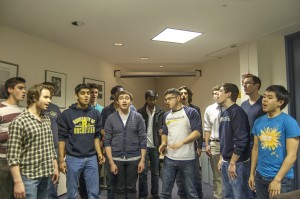
Aaron Schaffer, Photo Editor
A semester-long effort to raise awareness and support for research Friedreich’s ataxia, spearheaded by seniors Galen Dole and Sarah Gelbard, is in full swing.
The Friedreich’s Ataxia Research Alliance (FARA) defines the disease as a “debilitating, life-shortening, degenerative neuro-muscular disorder.”
The most common symptoms of include loss of coordination, fatigue, and aggressive scoliosis. The disease, which is quite rare, affects about 1 in 50,000 people in the U.S.
Gelbard, in the hope of leaving her mark at UR, had the idea to start an annual fundraising campaign for Friedreich’s ataxia, a disease that has profoundly impacted the lives of her best friend and friend’s sister, Laura and Sara Ferrarone.
After the passing of 26-year-old Sarah last November, Gelbard’s passion for the cause was renewed. In addition to her fundraising and awareness goals, Gelbard wanted to cheer up her friend Laura.
Gelbard reached out to Dole, hoping that the YellowJackets, of whom Ferrarone was an avid fan, would make a music video of Jason Mraz’s “I Won’t Give Up.”
Unbeknownst to Gelbard, Dole was a prime ally: Dole’s younger sister Marlise also suffers from the disease.
The potential for collaboration put Gelbard’s goals of fundraising and awareness within reach.
Both Gelbard and Dole shared the experience of watching the impact of Friedreich’s ataxia on people they care about.
Dole watched as Marlise progressed from a walker, to a manual wheelchair, to an electric wheelchair. Gelbard shared a similar experience with the Ferrarone sisters.
They both found hope in the fact that their loved ones’ struggle did not impact their personalities and positive spirits.
“It affects coordination but in no way affects the mind,” Dole said.
The pair began collaborating on awareness and fundraising efforts through the webiste GoFundMe.com and social media. They reached out to FARA to find ways to help support and expand the organization’s research, an important undertaking since many researchers do not want to spend the money to study such a rare condition.
“Little stitches make a quilt, [and] little bills will find a cure,” Gelbard explained.
While they saw a gradual response and contributions of “little bills,” they were looking for a way to reach a broader larger population.
Their second round of efforts began with a letter-writing campaign and plans for a benefit concert. Gelbard sent letters to celebrities and politicians ranging from local Rochester officials to President Obama. Dole, along with his fellow YellowJackets, decided to donate the proceeds from their second-semester show, “Concert for a Cure,” taking place Friday, April 5.
Their efforts so far have raised both the awareness and funds they were hoping for. Dole succeeded in getting Friedreich’s ataxia included as part of the biochemistry curriculum at UR. Their fundraising efforts have reached almost $8,000.
In recognition of their efforts, both Dole and Gelbard have been offered positions to work with FARA over the summer.
Dole is optimistic about the impact of their semester-long efforts.
“More people know, more people care, and more can be done,” Dole said.
O’Brien is a member of the class of 2016.
