Alex Kurland, Staff Illustrator
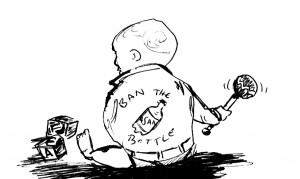
Roughly 16 universities across the United States and Canada have banned the sale of bottled water on their campuses, according to the “Ban the Bottle” campaign website. Team Green is hoping to add UR to that list.
The on-campus discussion has focused mainly on whether bottled or tap water is better, with Team Green conducting taste tests and some student surveys. Unfortunately, that is not the real issue at hand. The real debate is about whether or not banning all bottled water sales is the right decision for this campus.
It’s not.
Environmentally, it would seem that banning all bottled water would reduce waste, but there are unseen consequences. First, it takes much more energy to make reusable water bottles than it does to make recyclable plastic water bottles. A 1994 article in “Environmental Management” demonstrated that you would need to use a standard, reusable plastic cup over 200 times in order for its energy impact — including dish washing — to be less than that of foam cups. This same principle applies to reusable and plastic water bottles. Also, once those reusable water bottles have run their course, they usually end up in a landfill.
There has been no tangible evidence of sustainable success at other universities that have implemented the ban nor any theoretical research on a larger scale. Even if bottled water is a huge externality, an enormous social cost, a ban is not the way to minimize that. Since some students may value the convenience over the cost, a tax could be a possible solution. Banning it outright is not the economically or environmentally savvy choice unless you want students starting bottled-water black markets.
Banning the sale of bottled water will also drive up the sale of other bottled beverages including unhealthy sodas and sugary juice drinks. Director of Wilson Commons Laura Ballou said this would also pose a problem for campus events and student activities. If event planners cannot hand out bottled water, they would have to resort to less healthy options or use wasteful disposable cups because it can’t be guaranteed that every visitor will bring their own water bottle. Additionally, free bottled water is often donated from Coca-Cola, making the ban a large cost increase for student events. Similarly, a ban on bottled water sales would be a huge decrease in annual revenue for Dining Services in the amount of approximately $274,557, based on the 2011-2012 fiscal year measures.
Even if UR was to proceed with the ill-advised ban, the school is not equipped to handle it. Half of the buildings on the Residential Quad do not have water fountains and the ones in Wilson Commons are few and far between. What’s worse, adding new water fountains or improving existing ones is an extreme cost that Facilities says is too great right now.
There also seems to be a definitive lack of student support for the ban; most attendees of the recent panel discussion on Thusday, Feb. 7 seemed opposed. Just because “everyone else is doing it,” which isn’t even the case, is not a reason to move forward. The CT holds UR and its students to a higher standard than that of the bandwagon mentality.
Director of Dining Services Cam Schauf says that this conversation should happen now so that we can make a decision and move on. We think it’s time to move on. Students should be focusing on more important things such as actually researching the potential environmental or economic effects of a policy like this. Jumping to conclusions — let alone bans — is an irresponsible example to set for a University community that prides itself on rigorous research and intellectual pursuits.