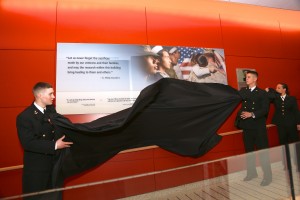
Courtesy of rochester.edu
A new memorial to honor the U.S Armed Forces was erected at the UR Medical Center on Tuesday Jan. 31. The wall was commissioned by Philip Saunders, a local entrepreneur and philanthropist.
The memorial was erected in the eponymous Saunders Research Building. After Saunders’ significant contribution to URMC, the building was named him.
His single 2011 donation of $10 million, directed towards neurosurgery research, was one of the largest gifts that URMC has ever received.
Saunders made it clear that his contributions to URMC, and the research conducted in the Saunders Research Building, are intended to honor the Armed Forces.
The building was designed in the hopes of creating a model of sustainability and scientific collaboration.
Research in the building focuses primarily on clinical work that includes a range of fields ranging from neurological disorders, cancer, and pediatric diseases.
At the building’s grand opening in 2011, URMC CEO Bradford Berk spoke of its purpose.
“This facility was created with the understanding that the future of medicine will be driven by institutions that assemble the teams and create the environment necessary to follow through on discoveries and make them relevant in terms of improving health,” Berk said.
UR President Joel Seligman emphasized that point, stating that “this building positions URMC at the forefront of a national movement to break down the barriers between the lab and the lives of people.”
While the building is home to research in a variety of fields, there is significant work that focuses on common veteran issues.
With substantial improvements to soldiers’ body armor and armored vehicles, there has been an increase in the number of head injuries for returning soldiers. Soldiers with newer equipment are surviving blasts that would typically kill them, leaving them with devastating concussions.
Associate professor of emergency medicine at URMC Jeffrey J. Bazarian has been investigating the link between hidden head injuries suffered in combat and PTSD.
In a 2012 study, Bazarian proposed that even brain injuries so subtle that they can only be detected through an ultra-sensitive imaging test can predispose soldiers to the possibility of PTSD.
Clinical trials are working towards improving the quality of protection of soldiers’ helmets to prevent these sorts of head injuries while soldiers are in combat.
The research is based on a study with the UR’s men’s football team, involving the placing of sensors in the helmets of the players. The sensor record information on the force of tackles. Brain scans are taken before and after the season to observe any observable differences.
Ultimately, Saunders’ hopes that his contributions will go towards continuing the work at his namesake and the rest of URMC, creating safer products, chiefly focusing on protecting soldiers. The focus of these products will be to limit head trauma in an effort to minimize any spikes in PTSD.
With close ties to those in the military, Saunders’ desire is that his gift in some way reflect the appreciation that he holds for the Armed Forces.
Smith is a member of the class of 2014.