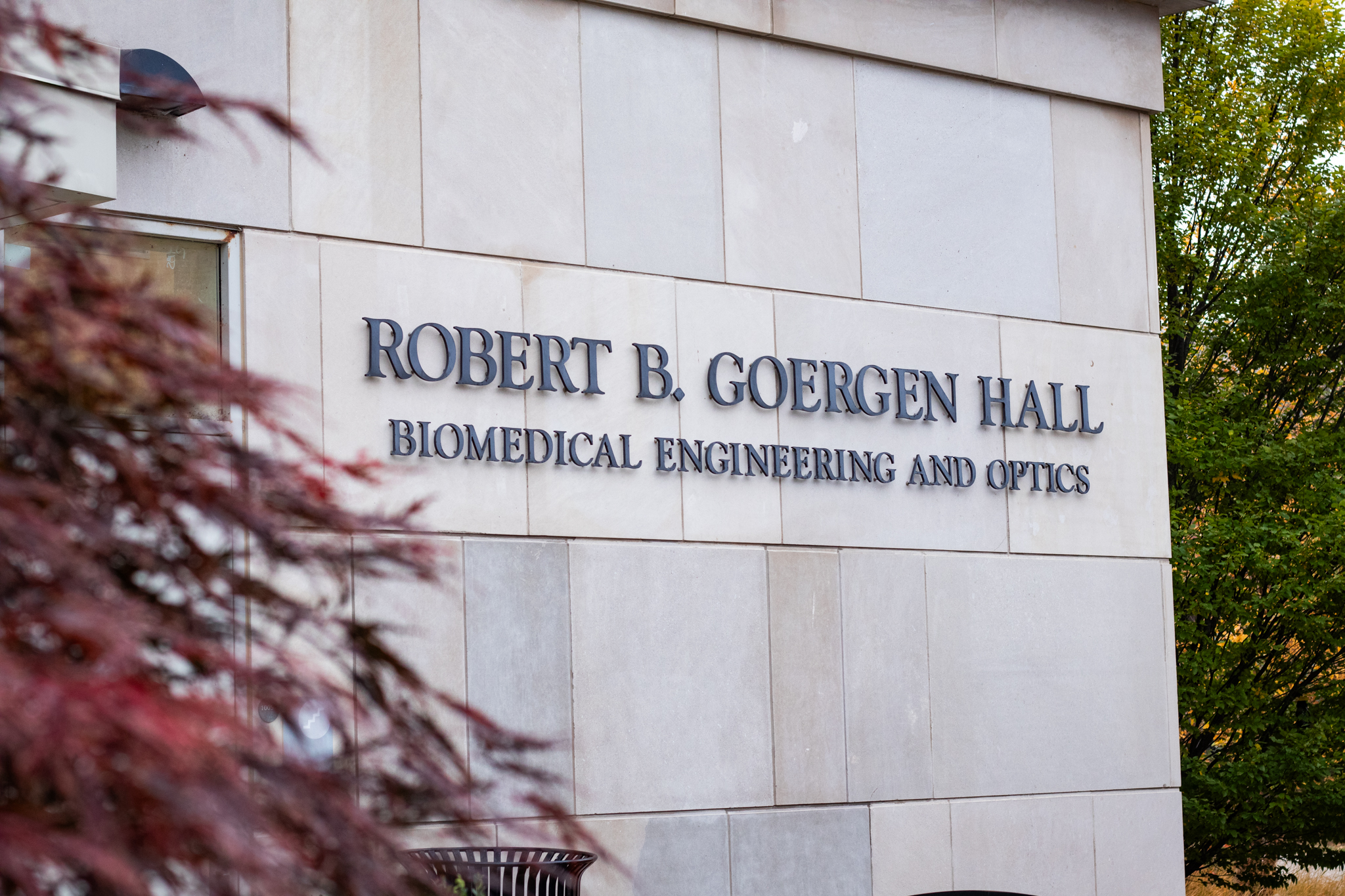
This past October, three professors in various fields of STEM were granted the Goergen Award in recognition of their teaching accomplishments and skills. Named after URochester Trustees Robert and Pamela Goergen, this award recognizes URochester faculty for their excellence in teaching. The Goergen Award is often awarded for top-quality classroom performance, but can also be granted for innovative approaches to teaching or creative use of classroom materials.
The Goergen Awards began in 1997, where three different categories, each with their own award, were presented to faculty and staff members who demonstrated various contributions to undergraduate education. Faculty and staff members could be nominated individually or as part of a group. In 2010, the program was redesigned to have larger awards that focused exclusively on individual faculty members’ accomplishments in teaching. The prize includes a placard with the faculty member’s name and $15,000 in cash. The Goergen Awards are given to three faculty members every year.
To determine who will receive the awards, URochester faculty department chairs or program directors within the School of Arts and Sciences, the Hajim School of Engineering and Applied Sciences, and the Eastman School of Music submit award nominations to the Office of the Senior Vice Provost for Academic Excellence. Department chairs and program directors include nomination letters that summarize the highlights of their nominee’s teaching achievements. They may also include supplemental material such as letters of support from faculty colleagues, teaching assistants, or students influenced by their teaching, and the nominee’s teaching statement and resume. They are submitted in June, at the end of each academic year. In October, the program directors or department chairs of the winning faculty members will notify them of their award and the winners accept their awards at the annual Goergen Awards Ceremony.
URochester Chemistry Professor Benjamin Hafensteiner is one of three STEM professors awarded the Goergen Award this year. Hafensteiner was specifically acclaimed for his interactive, rigorous, and supportive teaching environment when lecturing a large number of chemistry students.
As an undergraduate, Hafensteiner (’03) developed an interest in organic chemistry He began teaching in 2011, and currently teaches two classes here at the University: CHEM 132 and CHEM 203.His teaching style highlights the importance of students asking questions about the concepts in order to understand the “why” behind them rather than simply memorizing formulas.
For Hafensteiner, understanding the material translates to being comfortable asking questions in a crowded lecture hall.
“I want students to feel comfortable in a big class. That’s usually very hard to do because it’s very easy to feel anonymous in a 300-person lecture hall,” Hafensteiner said. “Some of my approaches [are] to try to make people feel like they’re seen and that they’re real people, [and] not just a number. And I think that can keep people more engaged with the material.”
URochester Biomedical Engineering and Neuroscience professor and awardee Laurel Carney’s teaching style also emphasizes the importance of learning about her students as individuals. Though Carney is currently on leave, she usually teaches courses such as Electric Circuit Theory and Speech on the Brain. In many of her courses, she underscores how important it is for her and her students to know each other as individuals and ask questions about the material to become engaged with it.
“I try to get to know the students as scholars] … [and] try to understand what questions they have and get to know their names,” Carney said. “I ask them a lot of questions [and] that helps me also know whether they are following what I am saying or if nobody’s following me, I want to know that and stop.”
Thomas Howard, who is a Professor of Computer Science and Electrical and Computer Engineering earned one of this year’s Goergen Award for his teaching methods that prepare students for the real world. Howard graduated from URochester in 2004 with degrees in Mechanical Engineering and Electrical Computer Engineering. His passion for these fields along with robotics led him to return in 2015 as a robotics professor.
Knowing that robotics itself is a complicated subject, one that is constantly changing with the advancements in technology, Howard described that teaching this subject requires students to practice solving complicated problems.
“Robotics is one of the hardest things that humanity tries to do,” Howard remarked. “It’s embodied artificial intelligence. It’s trying to deal with an uncertain, partially observed world and [making] decisions with a limited computing time. That is a super hard problem that is going to take a lot of people a lot of time to really solve.”
Howard described that many of his courses such as Mechatronics involve a lab component for students to apply their knowledge of the content while working on hands-on lab experiments.
“It’s important to deeply understand the theory, understand how things work at an analytical level, but at the same time, you have to get into the laboratory and actually do experiments, write code, do simulations,” he expressed. “You really need practice trying to apply those things, and it’s tricky to actually cover theory and practice in a single semester.”
Professors Hafensteiner, Carney, and Howard have all expressed pride and honor to win the Goergen Award as they continue to further develop their research projects and teaching skills, acknowledging that their students’ growth is the real reward of their work.
“I don’t think about these awards as some crowning achievement. It’s a recognition for effort put in and I’m happy to have it, and I’m honored to be in a long list of really great educators,” Hafensteiner reflected. “But I think I’m already looking forward to [teaching] the next class …I just want to thank all of the students …I wouldn’t be in a position for any recognition without the students that we have.”