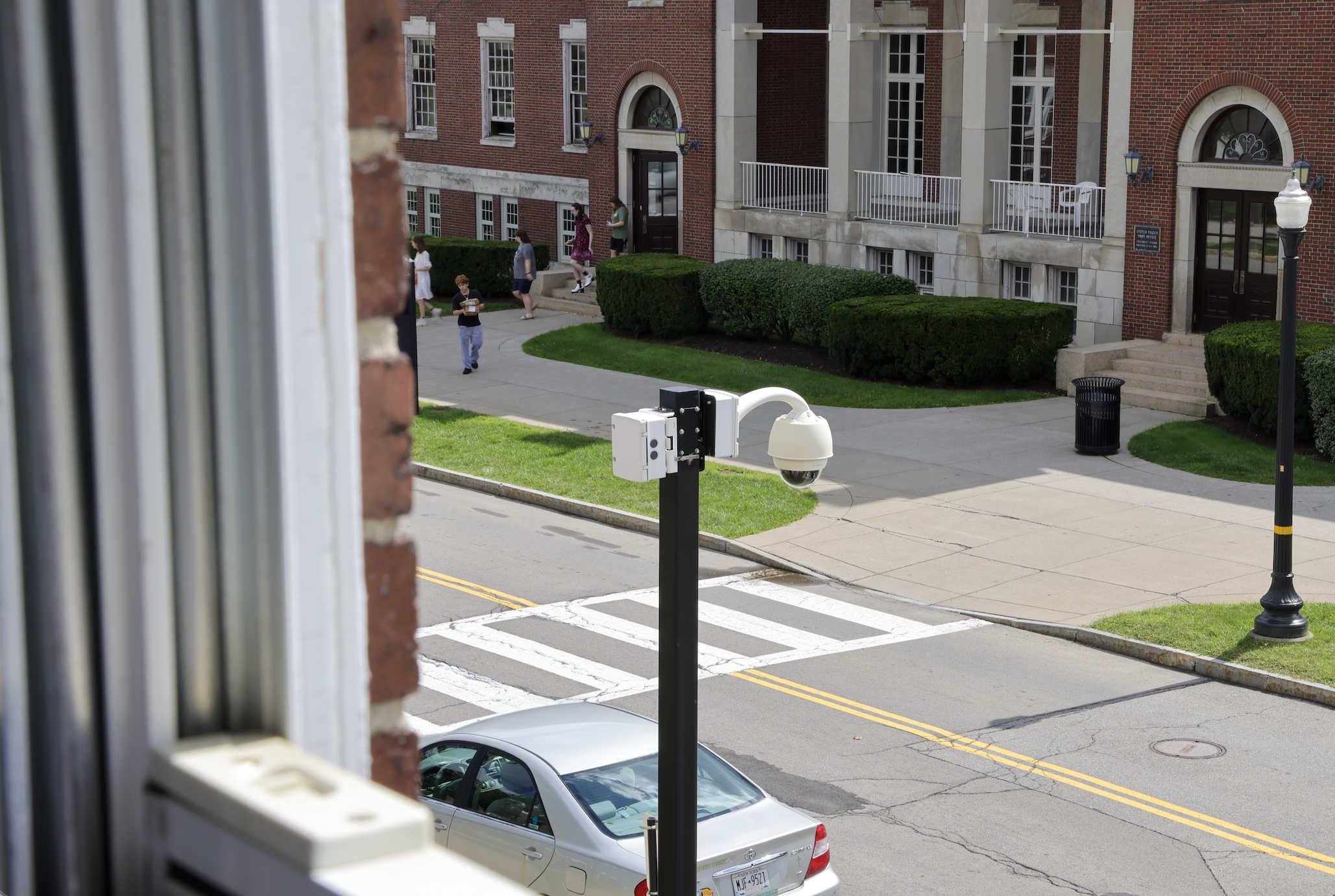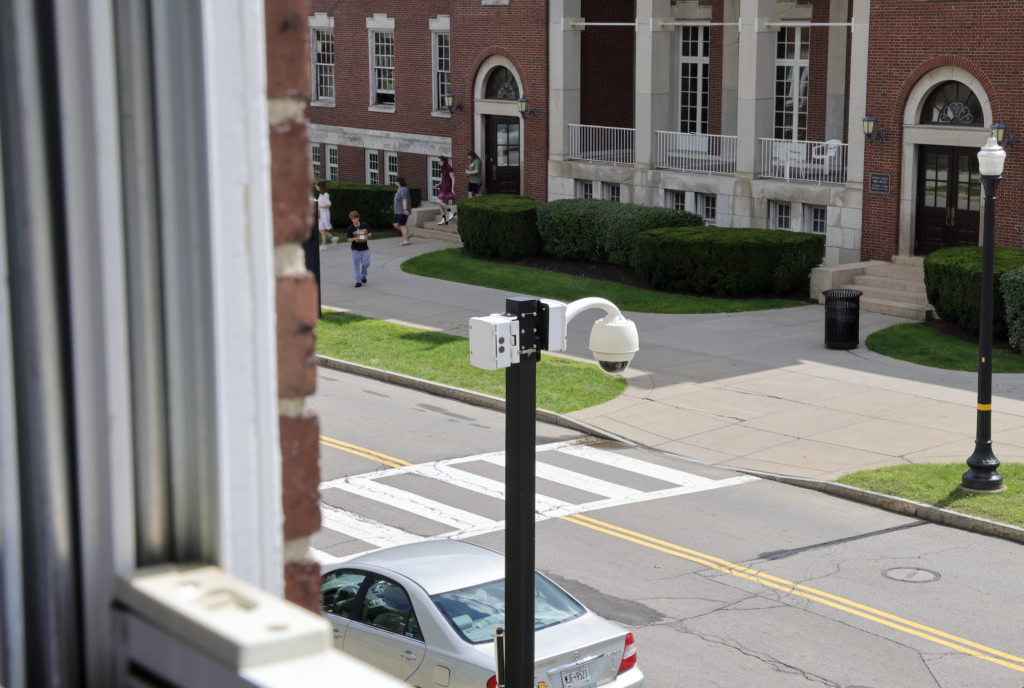
New security cameras have been spotted around campus this Fall — in common areas and outside residential halls — and some of the University’s choice in placement is sparking dissent among campus residents.
Some of the more noticeable security upgrades came to the Fraternity Quad. Each house now has a camera installed near the exits. Some residents expressed concern in particular that the camera attached to a pole on Fraternity Road outside the Psi Upsilon (Psi U) — formally Delta Kappa Epsilon — house appears to have a view inside the building’s bedrooms and bathrooms.
“[It’s] just an invasion of privacy,” senior Donovan Doles said. Doles’ room is on the second floor of the Psi U house and seems to be in the view of one of the security cameras.
Senior George White, who also lives in the Psi U house, raised questions regarding the University’s intentions regarding camera placement. “I’m not sure what issue it solves,” he said. “It feels pointless to me.”
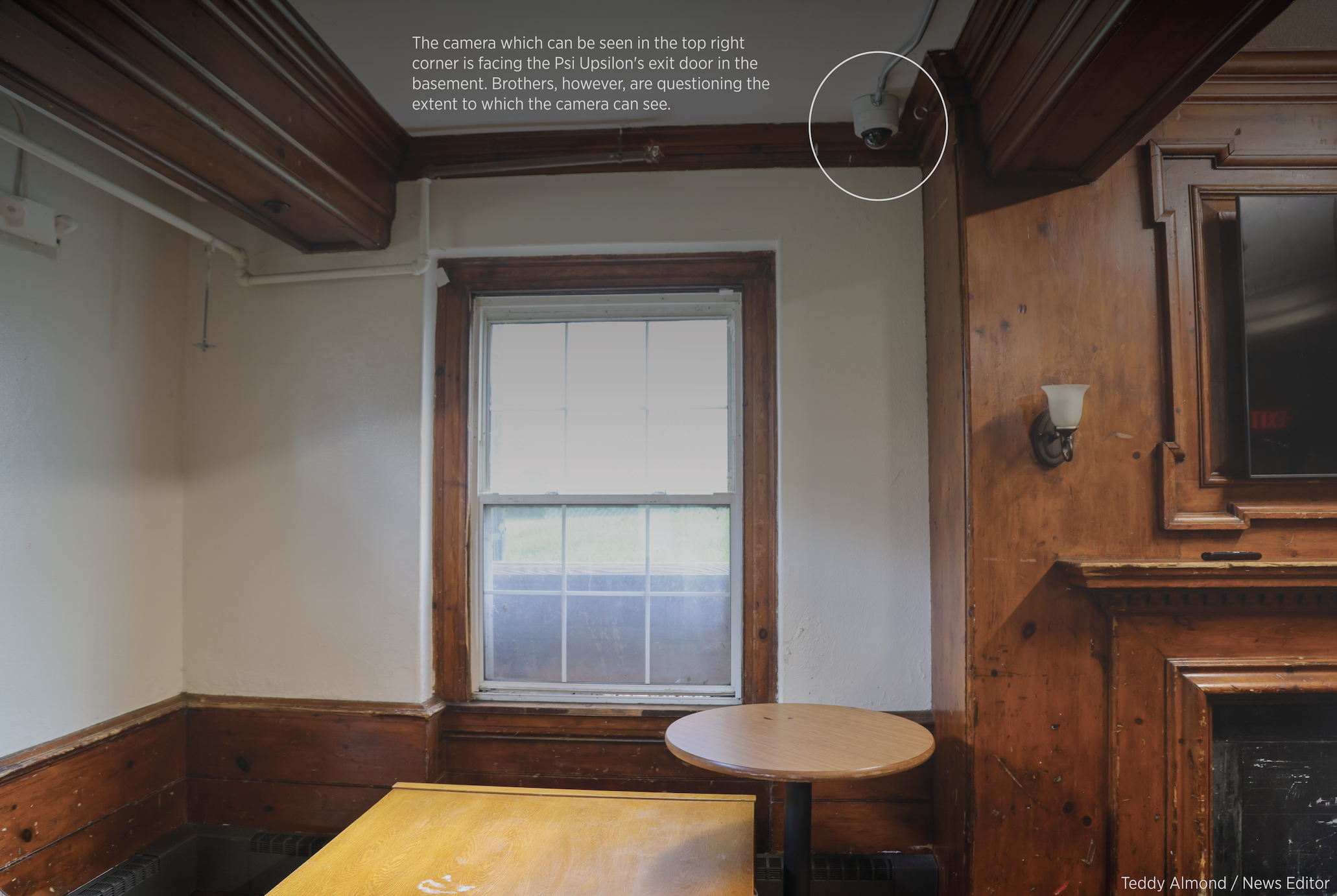
One of the cameras pointed towards the building’s egresses located in the Psi Upsilon basement. Brothers raised concerns regarding the extent to which the cameras can see in their common space.
Acknowledging student concerns, the University makes it clear that ensuring appropriate privacy is a top concern.
“Cameras near residential spaces use hardware-level privacy masking that restricts their view of designated residential areas and cannot be remotely overridden through software,” University Spokesperson Sara Miller said in an email exchange with the Campus Times. “This is our standard for protecting residential privacy.”
Miller explained that the cameras are intended to increase campus safety.
“Our approach to campus safety is centered on creating an environment where everyone can feel safe and secure,” Miller said. “Cameras at entrances, exits, common areas, and major travel routes are one part of that effort, helping us protect our community while remaining thoughtful about privacy.”
President of the Sigma Chi fraternity and junior Eddie Hoffman expressed concerns beyond those of just privacy, believing the move by the University to be a direct assault against campus Greek life.
“I think it’s a pretty simple, clear-cut invasion of privacy and just another way the school is trying to slowly and quietly push fraternities out of the Quad,” he said.
Hoffman anticipates that this will affect how chapter, the fraternity’s weekly meeting, will be conducted, as the basement where the camera is located is also their chapter room.
“The main problem isn’t the fact the school put the cameras in, they have a right to that. The problem is the lack of communication,” one fraternity housing manager, who requested to remain anonymous due to his work with the school, shared. “To have [cameras] inside the house, in common spaces where people are living, kind of feels totalitarian,” he said.
According to the Department of Public Safety’s (DPS’s) video surveillance policy, the University aims to curb crime while also maintaining students’ privacy: “DPS will not install security cameras in any area where there is an expectation of privacy in accordance with accepted social norms, such as locker rooms, bathrooms, private offices (without the request of the office occupant), dormitory rooms, or in direct patient care areas,” the policy read.
Additionally, all recordings will only be kept for 60 days.
These cameras have been installed across campus — including in other residence halls.
According to the policy, DPS officers are entitled to review both live and recorded footage from the cameras.
URochester is not the only campus to see an uptick in surveillance this year. The Wellesley News reported that cameras were placed in the common areas of one of their residence halls to capture people entering and exiting the building. However, after students reportedly raised concerns about the cameras’ ability to capture more than just the entry and exits, Wellesley opted to remove them.
Beyond video cameras, the University also employs license plate readers which are used “to better understand traffic patterns and parking utilization among University permit holders, and to enhance safety and security on roadways entering and leaving our campus community,” according to Miller.
These readers are not owned by the controversial company Flock and are instead owned and operated by DPS, Miller explained.
“Public Safety is not aware of any Flock cameras located on surrounding public roadways and does not have access to any such cameras.”