The phrase, “Water, water, everywhere, but not a drop to drink” comes from a section of Samuel Taylor Coleridge’s “The Rime of the Ancient Mariner,” in which the titular character describes the fate of his fellow sailors as they die of thirst surrounded by water.
When I wander the library stacks, I feel a kinship with Coleridge’s mariner. Rush Rhees alone holds more than 3 million books, but I have never once checked out a title from a University library with the intention of reading it for fun. This is not for lack of time or motivation, but rather lack of access — River Campus Libraries (RCL) doesn’t carry books intended for student recreation. You can find two distinct editions of “Lyrical Ballads,” the sourcebook for Coleridge’s famous poem, in the level B basement of stacks, along with half a dozen books criticizing and interpreting the text, but if you want to read Sarah J. Maas’ bestselling romantasy novel “A Court of Thorns and Roses,” you’d be out of luck.
Even when a promising new bestseller is in our collection, such as Suzanne Collins’ “A Ballad of Songbirds and Snakes,” it is shelved not alongside other YA novels, but instead between critiques and discussions of Collins’ work. This is vastly different to the genre-based organization of a traditional library, which allows readers to discover new books while searching for familiar ones.
Of course, this is not to say that RCL is doing something wrong. The chief role of a university library is to provide materials necessary for the academic pursuits of students and faculty. A student who checks out “The Hunger Games” to read before bed might be taking academic resources out of the hands of a scholar studying insurrection in literature. But a university library is more than just an archive. Often, it is a social hub for students — a space to study, to hold events, to promote student emotional health and wellbeing.
It’s no secret that reading for pleasure has been linked to a host of emotional and mental health benefits. With national readership plummeting across the past decade, a question arises: What role should campus libraries play in leisure reading?
Students have a lot to gain from access to recreational books. For short-term advantages — factors that will benefit students while we’re still enrolled — there’s overwhelming evidence that those who read for pleasure are stronger students. A 2024 educational research review found multiple studies supporting the idea that students who read for fun have broader vocabularies and stronger reading comprehension skills than those who don’t enjoy reading. The same survey also concluded that frequent readers often have improved social, emotional, and psychological well-being.
Reading for pleasure has also been linked to stress relief and decreased psychological distress, both benefits that are particularly relevant on our campus. In the 2024 National College Health Assessment, 78% of URochester students reported moderate to severe stress levels and 48% of our students reported that stress has negatively impacted their academic performance.
There’s also the emotional benefits: Today’s college students are lonelier than ever, so the benefits of reading are all the more valuable. Studies have shown that reading can increase empathy and decrease subjects’ (often harmful) need for closure.
Taking these factors into account, it’s clear that a campus that reads more is a happier, healthier community.
The benefits of reading for pleasure also extend far past graduation and, in fact, become even more important. According to a Pew Research Survey from 2021, 11% of college-educated respondents had not read a single book in the past year — for work or pleasure. While this figure is lower than the national average of 23%, it’s still worrying. Reading has been shown to reduce cognitive decline in older adults and a demographically-controlled study has even found that reading can increase life expectancy by up to four months.
Given that children and young adults who read frequently are more likely to read as older adults, access to recreational reading on campus could have benefits that stretch decades into the future.
So what is RCL doing right now for recreational reading? While some universities (like the University of Arizona and the University of Connecticut) have dedicated “leisure” collections or recreational reading spaces, I could find no information online about a similar space on our campus. It wasn’t until I spoke with Kristin Moo, director of collection strategies for RCL, that I learned the University even had a collection of popular reading.
The popular reading collection, which is curated by English and Black studies librarian Lindsey Baker, spans about four shelves of adult and young adult fiction. It’s located in an alcove of Lam Square to the left of the windows looking out onto Douglass and Wilson Commons. The perimeter of the nook is lined with elegant cabinets, each holding a few dozen books behind a decorative metal grate door.
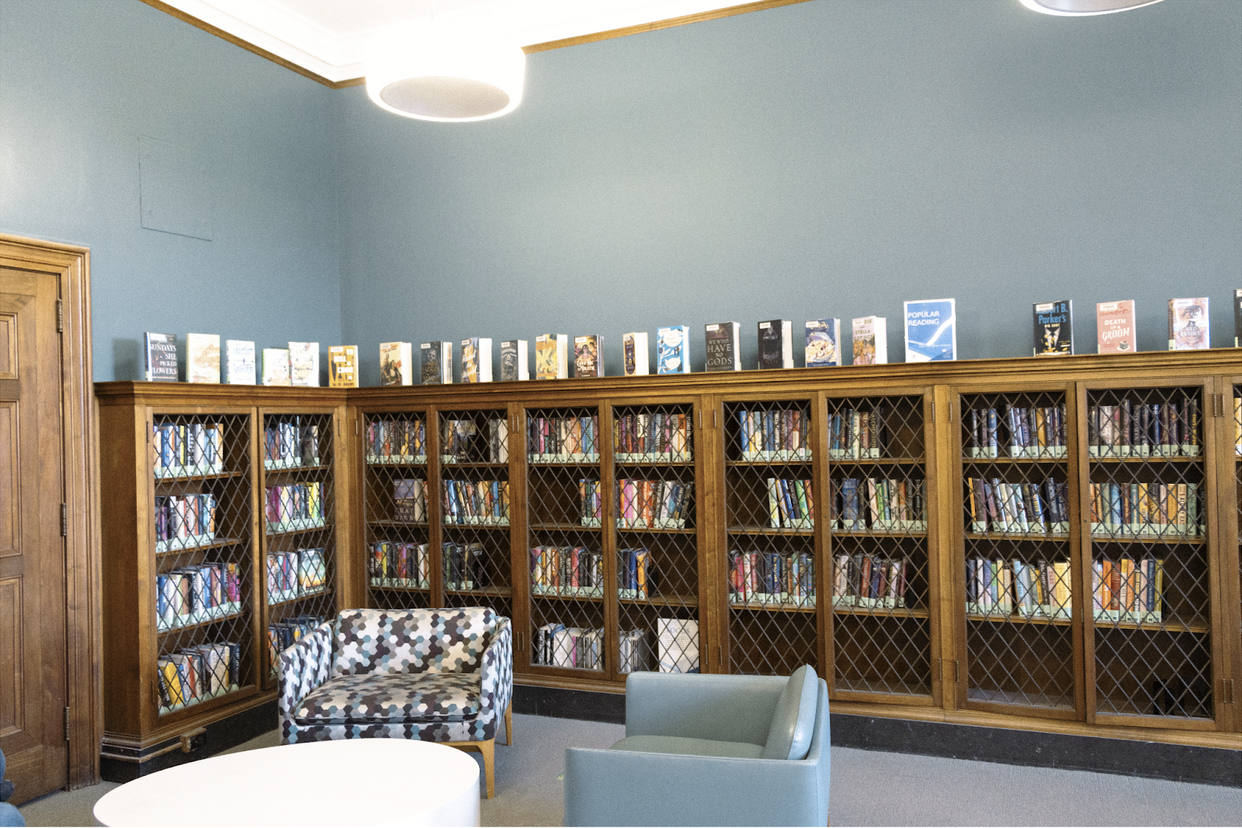
The popular reading area in Lam Square
According to Moo, the collectionsees a “fair amount of use,”despite not being promoted online. Along with the popular reading section in Lam Square, Moo also described a popular science section in Carlson, a wellness collection in the Welles-Brown room, and a large children’s and young adults’ section in the stacks.
“It’s kind of like a well-kept secret that [the popular reading collections] exist,” Moo said. “So I think if more people were aware, [they] might get a lot more use.”
Moo also endorsed the Rochester Public Libraries and the Monroe County Library System for their wider selection of books and extensive e- and audiobook collections. One of the easiest city libraries to visit from campus is Central Library, located a block from the Innovation Square stop on the Orange Line shuttle.
But even if RCL did want to push for more leisure reading awareness or availability on campus, there’s still a budget to consider. No library has infinite resources and one of Moo’s main responsibilities at RCL is managing the collection materials budget and working with librarians to make decisions on what the library needs most.
“Generally speaking,” Moo said, “there are lots of different needs for space on an academic campus, but also specifically within the library environment. And the first priority is always going to be in serving scholarly and academic needs of students and … the research needs for faculty.”
Still, the scope of a student’s “academic needs” isn’t necessarily limited to their course materials. RCL knows this too, given its sponsorship of programs like Paws for Stress Relief, the “Oasis” in Welles-Brown, and the many de-stress events hosted during finals week. Given so much evidence pointing toward the emotional and stress-relieving benefits of recreational reading, improving student awareness of and access to recreational reading is a worthwhile goal for University libraries moving forward.
So what might be good first steps towards achieving that goal?
If low readership is the problem, the main question we should be asking is “what are the barriers between students and reading?” According to a 2011 study published in the journal College & Research Libraries, 93% of polled students reported that they enjoyed leisure reading but almost 70% indicated “too much reading for class” as a barrier toward leisure reading.
Although librarians may not have the power to reduce students’ workloads, there are ways they can make finding books less difficult and time-consuming. The authors of the study would seem to agree: “Students may not find time to do much voluntary reading; but, if what they tell us is true, they do take pleasure in reading and would welcome efforts from libraries to help them discover reading material.”
The students in the study suggested several good ideas for improving access to books. For one, creating a dedicated space for recreational books. The popular book collection is a start, but it’s only a fraction of the fiction in our collection. Many students don’t know that academic libraries even have fiction books due to how they’re shelved, and others find the stacks confusing or unpleasant. And let’s be honest, if I’m already short on free time, I’d like to avoid spending any of it navigating a dimly-lit literary labyrinth.
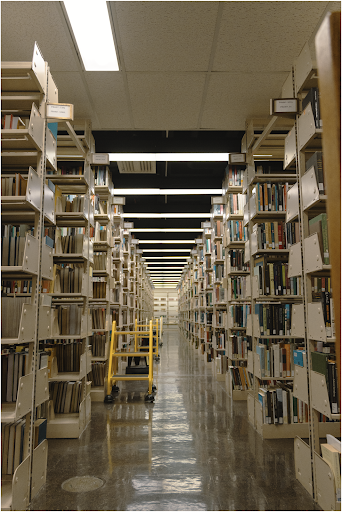
Level B stacks
We can also start by increasing signage and publicity, letting students know where they can go to find non-course books. Then, by bringing some classics and other popular fiction out of the stacks and consolidating with the Carlson nonfiction, students would have a physical space they know they can go to find a good book.
Another suggestion: creating separate sections within the recreation collection. This is a major problem within the popular book section as it stands. After I found out it existed, I went to investigate what it had to offer. When browsing, I quickly realized why bookstores and community libraries tend to shelve books by genre: It makes interesting books easier to find. In the University’s collection, I had no idea what any of the books were about. Without genre markers I found myself literally judging each book by its cover (well, spine actually) to see if I might be interested.
Having dedicated (and separated) sections of popular genres like fantasy, sci-fi, romance, and mystery, as well as for memoirs, biographies, and nonfiction could also help with choice paralysis. When choosing between fewer options, humans are more thoughtful in their decisions. Paradoxically, this means a smaller collection of books, sorted by genre, could lead to students being more adventurous when choosing their next read.
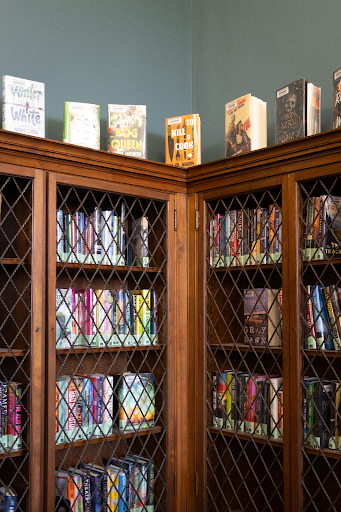
Books behind bars in the popular reading section
Finally, students in the study wanted guidance. Almost 36% of students polled wanted some sort of book display. More than 60% wanted a list of suggested books. Further cues could be taken from independent bookstores with “shelf talkers” (little notecards, usually under a staff pick, that explain why you should read a book) or grouped displays of similar books. At the very least, consider installing more obvious signage pulling student attention towards the existing popular reading sections. Finally, although I’m not sure whether RCL has control over this, perhaps we should reconsider the fact that the popular reading section is encased behind (admittedly beautiful) cabinetry. Although these doors likely are more for aesthetics than security, I still don’t think that, “closed cabinets with metal bars,” is the right visual signaling. Currently, the vibes I’m getting are
more, “deodorant locked up at CVS,” than, “books I can grab and take home.”
However the libraries might choose to encourage recreational readership, the benefits are clear: better mental health outcomes, reduced stress relief, and stronger students. For librarians, there’s the added benefit of getting students comfortable with using library resources. Students who are already used to checking out “fun” books may find the system easier to navigate when they need to check out books for classes.
As a student, I want to make it clear: I do want to read. And I want to read library books specifically. All I’m asking for is a little more help.