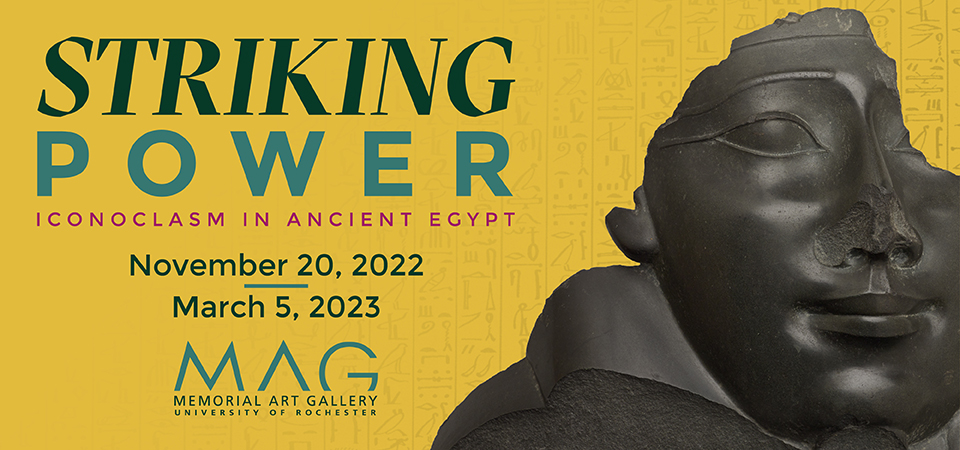
“Striking Power: Iconoclasm in Ancient Egypt” examines the patterns of damage inflicted on works of art for political, religious, and criminal reasons — the results of organized campaigns of destruction. The exhibit demonstrates how the interpretation of a statue’s damage can reveal who broke it and the reason why it was destroyed. It does so by juxtaposing damaged works with undamaged ones, such as whole heads with intact inscriptions to fragmented statues.
Numerous pieces, including headless statues of nobles and goddesses and busts of Egyptian kings with broken busts, are on display in the Striking Power exhibition. The exhibition started off with a piece that shows the feet of Sehetepibre-Aankh sculpted in a slab of ashy gray limestone, covered in red, earthy sand, and inscribed with a variety of hieroglyphics, many of which feature the evil eye and the sacred ibis. The once large rectangular base has now been reduced to a square. This might have been done to stop the spirit from moving, but it could also be an illustration of how the statue was transformed into a building block during the Islamic era.
Another notable work was the headless statue of a queen or goddess. A close-fitting draped garment with gradually dissipating pleats, covering the shoulders and knotted between the breasts, is worn by a striding figure made of smooth black limestone. Her right hand, which is holding a staff, is closed and her right arm hangs naturally along her body. A cornucopia is held in her left arm. The entire surface is pitted, and the head and feet have been removed. The tip of her thumb, the first finger of the left hand, the top and bottom of the cornucopia, and the left shoulder are all harmed. This suggests that the statue’s original function of distributing offerings to laborers when the temple was built was hindered by damage.
The exhibition comes to a breathtaking conclusion with a picture of Hatschepsut’s head. This Hatshepsut head was formerly a part of a sphinx, an imaginary animal with a lion’s body and a human head. It was thought that the uraeus, or upright cobra, on the king’s forehead, a representation of royalty and divine authority, would shield him. However, it was harmed in this sculpture, removing that defense. Both the beard’s removal and the destruction of a portion of the striped Nemes headdress removed other signs of royal authority. The damage to Hatshepsut’s nose made it impossible for her spirit to breathe.
The Striking Power exhibition examines the patterns of art vandalism committed for political, religious, and criminal reasons in ancient Egypt. It shows how a statue’s damage can reveal information about who broke it and why it was destroyed in a number of different ways. It is still unclear and debatable whether a piece was vandalized because of errors during transportation, retaliation against the deceased, Christian monks wanting to disable statues to drive out pre-Christian supernatural forces from tombs, or some other motive.
