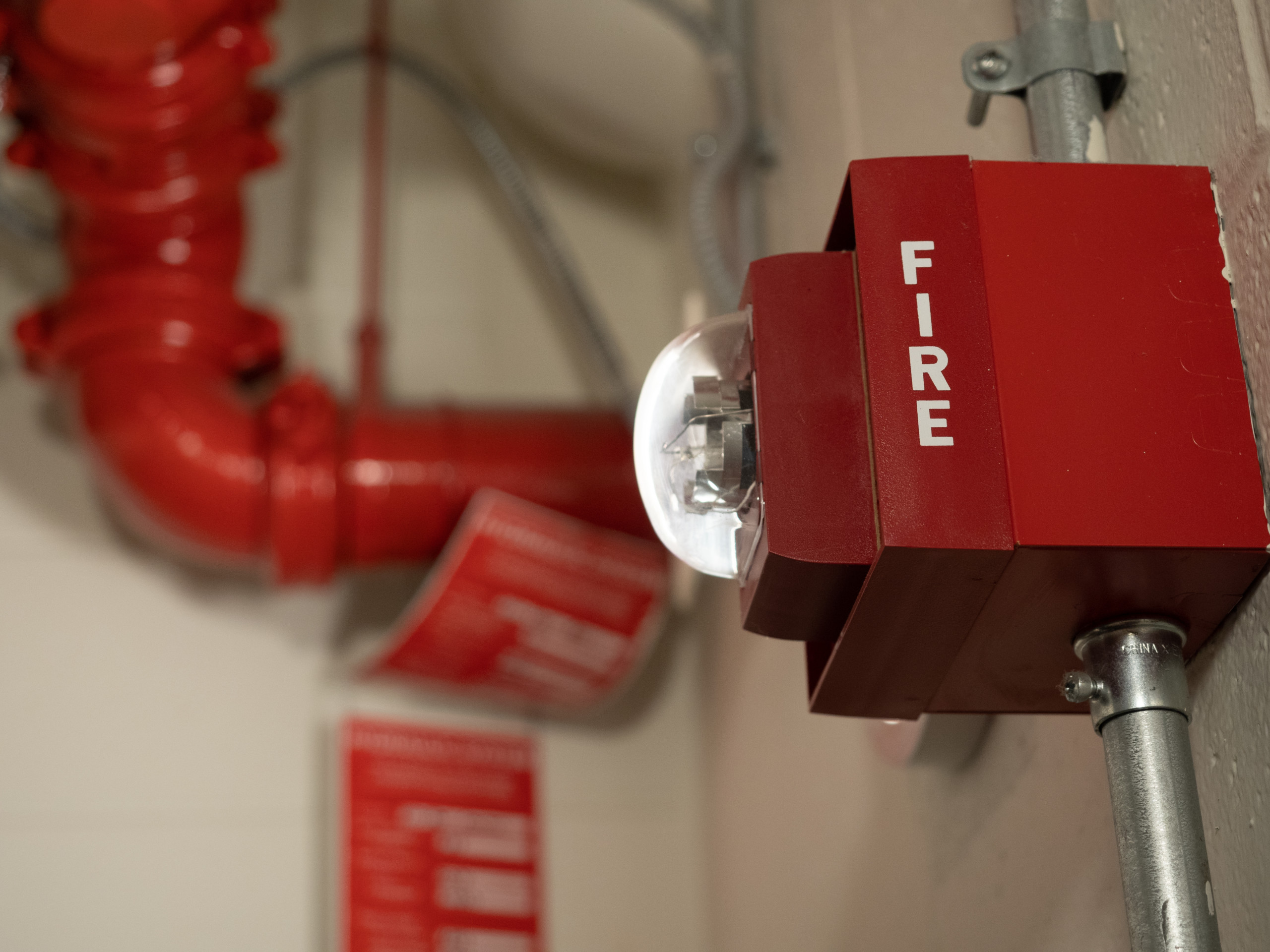
For most students “fire safety” conjures up memories of those late-night fire alarms caused by wannabe student chefs craving extra-crispy bacon at midnight. But there’s a lot more going on behind the scenes. The Environmental Health & Safety Department (EHS) at UR assiduously ensures that the worst aftermath of a fire alarm is nothing more than a mild inconvenience.
In an @Rochester email sent Sept. 28, EHS reminded the UR community that the only times a fire extinguisher should be used is when:
- The fire department has been notified.
- You have been trained on how to use a fire extinguisher within the past year.
- You know and understand the acronym P.A.S.S.
- There is a clear exit behind the person using the extinguisher.
- The fire is small, self-contained, and not spreading rapidly.
To know more about what prompted this reminder, the Campus Times spoke with Mark Cavanaugh, the Director of the Environmental Health & Safety department and UR’s Fire Marshal. Cavanaugh’s responsibilities include overseeing various programs such as Emergency Preparedness, Fire Safety, and Occupational Safety and Health Administration (OSHA) compliance, and coordinating fire and life safety inspections. He explained that the email was a general reminder covering some bureaucratic bases, and not in response to a recent event.
In part, they’d sent the email out to be compliant with OSHA, an agency of the United States Department of Labor created to ensure safe working conditions. OSHA’s Standard 1910.157(a) addresses fire equipment use. The gist of it is that employers should have an emergency action plan, and that all employees should evacuate in case of a fire. Only employees trained in the use of fire equipment can use extinguishers.
This brings us to the second reason: Students are expected to immediately evacuate instead of attempting to put out fires themselves. “I want all students to […] let our first responders take care of fire suppression,” Cavanaugh said. “Property can be replaced, someone’s life cannot.”
The evacuation procedure is summarized by the acronym RACE: Relocate anyone in the immediate area, Activate the fire alarm system, Close the door to the room of origin and all doors you pass through when you exit, and Evacuate the building.
According to Cavanaugh, the leading cause of fire alarms on campus is cooking. He stressed that people should not put something on the stove and leave it unattended. “Once they leave the area, they get distracted and forget about the pot of food on the stove that boiled dry, or they aren’t in the kitchen and [something] starts to burn, causing the fire alarm to activate,” he added.
To ensure safety in residential buildings, the EH&S website has a list of appliances and items that are fire hazards. One item on the list is often a source of confusion: upward facing lamps. Such lamps usually have an upward facing bulb with a bowl around it. The danger lies in flammable materials — such as fabrics — collecting in it, making contact with the hot bulb, and potentially causing a fire.
Students are advised not to keep such non-compliant items in residential buildings. EHS relies on RAs to help identify these items. According to Cavanaugh, improper use of extension cords and candles are the most common violation of residential fire safety guidelines.
Candles are prohibited in dormitories and the majority of River Campus buildings. In buildings other than residence halls, use of candles may be approved for special reasons, such as for religious purposes, and must comply with strict conditions.
The posting of fliers and posters on campus is another activity that has to comply with UR’s fire policies. Bulletin boards are everywhere on campus, and they can potentially exacerbate fires. The Wilson Commons Student Activities website lists several policies regarding poster and flier posting. According to Associate Director of Student Life Operations Eric Howard, the policy which reads, “Posters must be stapled in all four corners or they will be removed,” is there to ensure compliance with fire safety policies. The rationale behind this restriction is that the less air space there is behind the paper, the less risky it is.
Fortunately, fires are rare on our campus. Cavanaugh said, “I hope that is a reflection of a strong fire safety program and compliance by our students, faculty, and staff.”