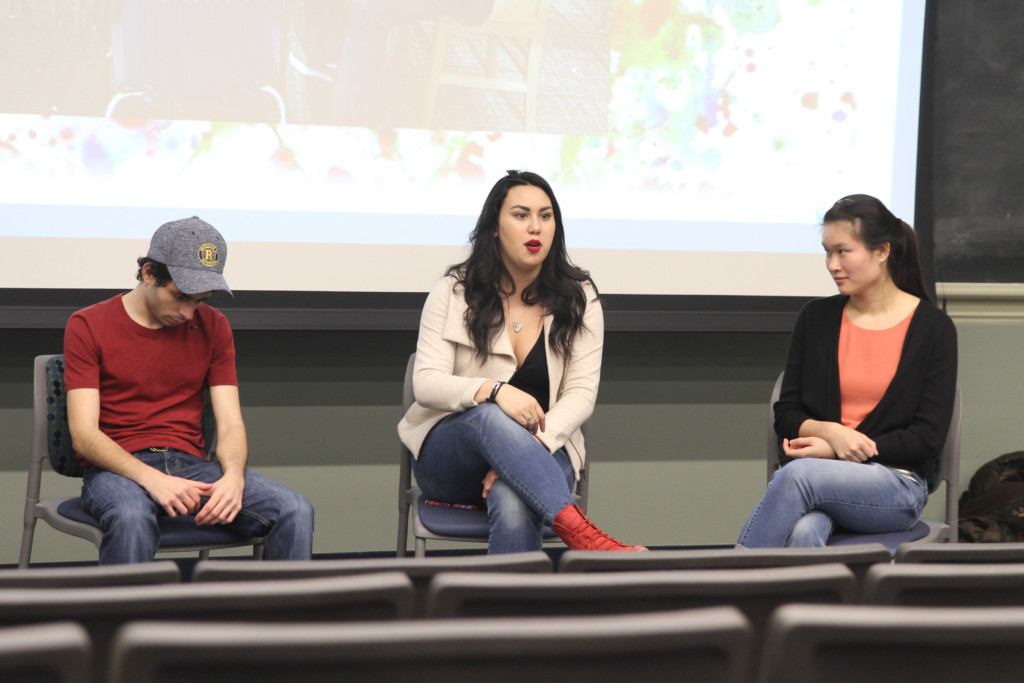
In honor of “Strike out Stig-Month,” members of UR Eye to Eye celebrated their learning differences and rejected the terminology of disabilities this past Wednesday at their “Share Your Story” event.
“We want to show people that it’s okay to talk about these things,” said senior and group president Macey Ellison of the inspiration behind the story-sharing event.
Senior Stephanie Mendez spoke first, sharing her story for the first time. She has an executive function disorder and confessed that she used to cheat on her elementary school math exams because “adding was pretty hard.”
As she explained her symptoms, which include trouble starting assignments, difficulty finding the right words to explain a situation, and poor short term memory, it became clear that the obstacles students with learning differences face are not unfamiliar to the average person. But they are magnified in a way that makes conventional education challenging.
That hasn’t stopped Mendez and others from accomplishing goals: She is the first in her family to attend college.
“I knew I was able to do things as well as other kids if I just had more time,” first-year Sarina Regehr, the second speaker, said.
Regehr, who is dyslexic, did not receive her diagnosis until her senior year of high school due to her high IQ and grades. Previous examiners did not consider those traits reflective of someone with a learning disability.
“I felt really alone,” Regehr said. “I didn’t know what was different.”
Junior Max Weismann studies engineering and has Tourette’s syndrome. In his story, Weismann expressed a tendency to feel overwhelmed and unable to understand his emotions.
His story also stressed the importance of allies in dealing with learning difficulties. Weismann emphasized the critical role his high school honors mathematics teacher played in helping him develop strategies for school when he considered dropping the class.
Growing up with learning differences resulted in many embarrassing situations for students.
Junior Catherine Waye shared memories of growing up with dyslexia and the horrors of reading aloud in class. One particularly embarrassing experience for her was when she repeatedly read “Palestine” as “Pakistan,” because she truly could not tell the difference.
Senior AnnaSerena Baum poked fun at herself as she recalled the effects her language processing disorder had on her childhood. Her disorder left her unable to process phonics, which limited her ability to read and learn new vocabulary.
“Whenever I didn’t know what a word meant, I just assumed it meant nice,” Baum said, eliciting laughter from the crowd.
Ellison, who suffers from dyscalculia, dyslexia, and auditory language processing disorder shared her story last, explaining that she did not speak until she was two.
After getting a 17 on her ACT test, she revealed, she did not expect to make it to college. Now, she will graduate in the fall, after four years of being actively involved in leadership and community organizations on campus.
“Having a learning difference is challenging,” Waye said. “But it’s part of who I am and I wouldn’t change a thing.”