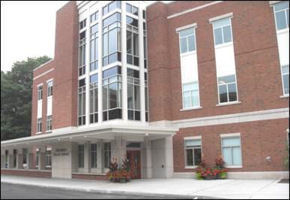
The new University Health Services building, completed in 2008. Source: http://www.rochester.edu
In the 2007-2008 academic year, UR constructed a new University Health Services building to replace the significantly smaller UHS that was in Susan B. Anthony Hall. Despite the appearance of this new building, a nice facility does not mean that the office is without its problems.
There are some major issues regarding the UHS workers, most of which seem fairly simple to fix. These problems primarily arise from the miscommunications and the ineptitude of the UHS employees. Many complaints could be resolved with better training and communication within UHS. One such concern is confusion as to at which UHS location students’ appointments are scheduled — even when specifically being told an appointment is in one location, somehow UHS can manage to wrongly convey this information. So, as if it isn’t difficult enough to get an appointment at UHS, it occasionally, due to poor training, is tough even to know which building you should be going to. Not only does UHS struggle to manage basic appointment times and locations — its employees are also painfully uninformed on their own policies. Disconnects between the employees during the H1N1 scare last Fall led students with perfectly healthy hearts and lungs to receive the vaccine while students with asthma and heart problems were denied the shot. These decisions seemed to be made based on who made the appointment and who was administering the shot, rather than on any sort of acknowledged standard.
Additionally, the UHS employees are ill-trained in the University’s health insurance policy. It is understandable for them to be unaware of how external insurance providers will cover students, but there is no excuse for them to be unaware of their own insurance policy. At times their ignorance regarding this has led them to misinform students about where to get prescriptions. There has also been great confusion between UHS staff members and faculty members regarding the policy of issuing notes.
These problems are almost all caused by a lack of proper interaction between all those involved in UHS. The staff doesn’t communicate with the doctors or with the patients and sometimes, when they do, their information is erroneous. The current receptionists are in need of better training, and the staff as a whole needs to find better ways to relay information to one another.