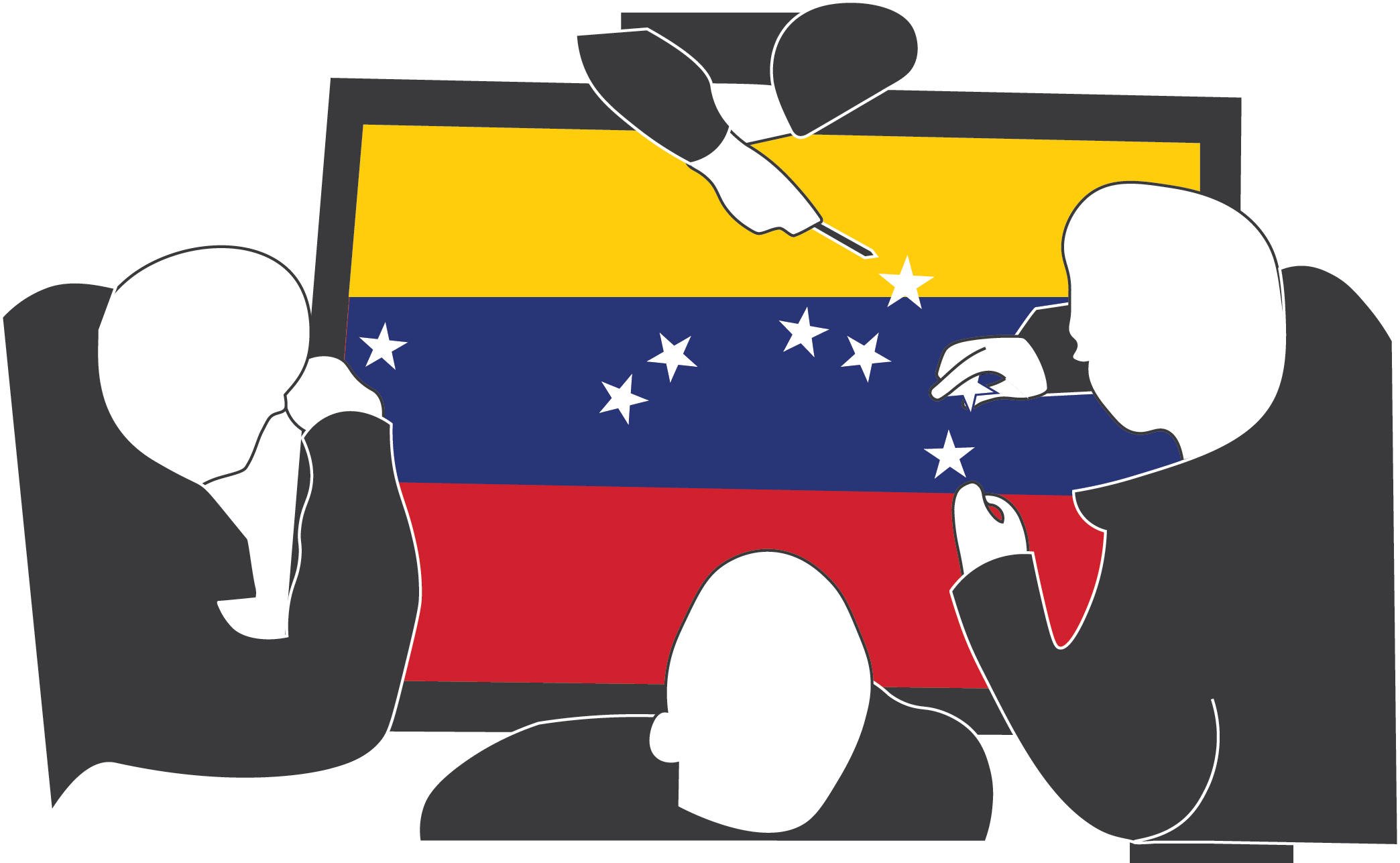
The Latin American, Caribbean, and Latinx Studies (LACX) major hosted “What Now? Venezuela in the Wake of US Intervention” Feb. 20, a roundtable on the implications of the Jan. 3 U.S. military actions in Venezuela that resulted in Nicolás Maduro’s capture. Professors Hein Goemans (URochester), Gabriel Hetland (SUNY Albany), and Steven Schwartz (Boston University) panelled at the event.
I, a born-and-raised Venezuelan, was in the audience and left disappointed by the essence of the discussion.
Goemans and Hetland were quick to point out that the Jan. 3 operation in Venezuela “violated international law,”using their opening remarks to let the audience know how “contradictory” and “harmful” this operation was — “a dangerous precedent for world order” as Goemans called it. They didn’t bother explaining how exactly this violated international law, but it’s likely that they refer to Article 2(4) of the UN Charter that “prohibits the threat or use of force and calls on all Members to respect the sovereignty, territorial integrity and political independence of other States.” Alternatively, they could be referring to the less-institutionalized convention that grants active heads-of-state immunity from international courts.
I agree that both principles are essential for the protection of regular, functioning states. Venezuela, however, requires more nuance than the panelists allowed.
Venezuela is a hijacked country. We lost our sovereignty when Cuba, Russia, and Iran started dictating our politics. We lost our territory and resources to groups like the Colombian National Liberation Army (ELN) when the regime handed them our mining rights. Our political independence was violated when the dictatorship clung to power through falsified electoral results despite losing the 2024 election in a 70-30 landslide. These are only examples of how the “sovereignty, territorial integrity, and political independence” Article 2(4) tries to protect no longer exist in Venezuela. Entire books explore the Venezuelan state’s politically-motivated abuses of its people.
As a sidenote: I was shocked that the panel ignored the 2024 election. The experts were so caught up with international law, sovereignty, precedent, Trump and Marco Rubio, ideological battles, the Essequibo and Guyana, Iraq, oil, Cuba, and Chavez, that they forgot to mention the most egregious violation of our sovereignty and popular will to date. Wow. Just as triggering was Goemans’s vulgar suggestion: instead of breaking international law, “the only way the masses can overcome a repressive elite is if they successfully organize.” As if the election wasn’t enough. As if hundreds of thousands didn’t take the streets in 2014, 2015, 2016, 2017, 2018, 2019 and 2024 only to be systematically killed, imprisoned, or tortured. As if we didn’t exhaust every legal channel and beg for international cooperation. But no, I see, we just haven’t successfully organized enough, I see.
Goemans and Hetland’s interpretation of Jan. 3 is oversimplistic and reinforces a rhetoric that protects the interests of Maduro. It uses our own violated sovereignty against Venezuelans, providing an excuse to keep an illegitimate elite in office. As the facade for a criminal organization, Venezuela shouldn’t be treated as a regular state protected by Article 2(4). Removing the head of this organization isn’t a dangerous precedent, and our sovereignty wasn’t attacked (in effect, we were already not a sovereign state), and no legitimate head-of-state was removed (Maduro, having blatantly faked his victory in the 2024 election, was not our legitimate president). I don’t buy the argument that this opens the gate for countries to take over legitimate governments — that’s not what happened in Venezuela.
The complacency toward tyranny shown by international law toward the dictatorship over the past decade, is a far more dangerous precedent.
Goemans and Hetland were also very concerned with the management of our country, smugly noting that Trump doesn’t really care about democracy in Venezuela, that his motivations remain unclear and the regime is still in place. Again, I’m stunned that only now are they worried about who runs our country, failing to recall an eternity of patronage, corruption and abundant oil subsidies to Cuba and friends —all while sinking up to 90% of the population into poverty. Hetland also framed Cuba’s potential fall — due to the termination of these subsidies following Jan. 3 — as a tragedy. Our views are radically different: I will not mourn the fall of a seven decade long dictatorship that helped bulldoze my country.
I’m confident their concern with Trump’s motivations does not resonate with most Venezuelans — because we know. We’re well aware that the pretext for this operation wasn’t purely democratic. We know Trump’s motivations remain unclear, and we know Maduro’s regime is still in place, even with him gone.
But we also rejoice in the undeniable significance of Jan. 3.
Venezuela had become a forgotten cause, a failed country, and Jan. 3 marked a possible new beginning — the first real consequence this regime has faced. The first time it was genuinely shaken.
Goemans kept describing a prisoner’s dilemma at the international level: what’s stopping other countries from attacking one another? But what about the new dilemma that now exists for the Venezuelan regime? Jan. 3 marked the regime’s first credible threat in decades and may now create incentives for cooperation. For the opposition — the overwhelming majority of the country — this represents a critical window to continue building momentum internally. In fact, the effects of Jan. 3 are already evident: the release of key political prisoners, the return of previously shuttered news channels, the reignition of protest movements, and the reopening of the U.S. embassy and international flights. Goemans and Hetland cleverly called this a, “regime change without a change of regime.” They’re right: there are plenty of battles still to be fought. But they missed that none of these battles would even exist without Jan. 3.
We made a historic mistake in 1998 by voting Hugo Chavez into office. A former coup leader, he dismantled Venezuela’s democratic foundations over 15 years and appointed Maduro to lead the encore to that disaster. I believe most Venezuelans are optimistic about having an opportunity to amend it — no matter the price. If tight American tutelage is what it takes to steer the country back into normalcy — if oil brings the potential of democracy — we will take it. Even amid uncertainty and unclear motivations. We’d much rather gamble with the prospect of a new chapter than remain crushed by the regime. We’ve lived oppressed for way too long.
So, no, we’re not getting tricked by Trump. Don’t worry so much about our oil. We’ve been giving it away to authoritarian regimes for a while, and we’re glad it might now be useful to spark some change.
Goemans and Hetland approached Jan. 3 through a rigid ideological lens: they overlooked the textures of the Venezuelan context and used this historic moment to take a swing at Trump. Don’t get me wrong: swinging against him is justified. I, too, am concerned about the president and his authoritarian tendencies. It was just disappointing to see the complex Venezuelan cause reduced to a convenient backdrop for domestic political critique.
Another sidenote: an ideological approach to Venezuela is obsolete. Our party system was destroyed by the regime, and politicians have a clear distinction—either they’re with the dictatorship or they’re against it. Hetland insisted on an ideological discourse: Maduro “wasn’t a leftist leader,” “Machado has a problematic far-right history,” “that true leftist parties are oppressed in Venezuela,” which I refuse to entertain. We’ll have to wait for democracy to discuss ideologies. Hetland also participated on a podcast episode of “The Dig” where the terms left/right wing, anti-communism, imperialism, neoliberalism, and Trumpism were mentioned before the regime’s crimes against humanity and election fraud. Hetland’s priorities are remarkably distant from mine.
I didn’t intervene in the panel. The format doesn’t favor debate (only Q&A), and I didn’t feel much curiosity for Goemans and Hetland. There were several Venezuelans in the audience and they didn’t care to explore their sentiment. It’s clear that Venezuelans should spare ourselves from explaining our history, our lived experience, to everyone — especially to lecturers only interested in using us for political discourse. Maduro’s capture has sparked a momentum we’ve craved for years, and I refuse to accept a vision of international law that preserves “order” by sacrificing Venezuelans.
“El desprecio a tus opresores no debería llevarte a defender a los míos.”
(Your contempt for your oppressors should not lead you to defend mine.)
—Famasloop (Jan. 6 on X)