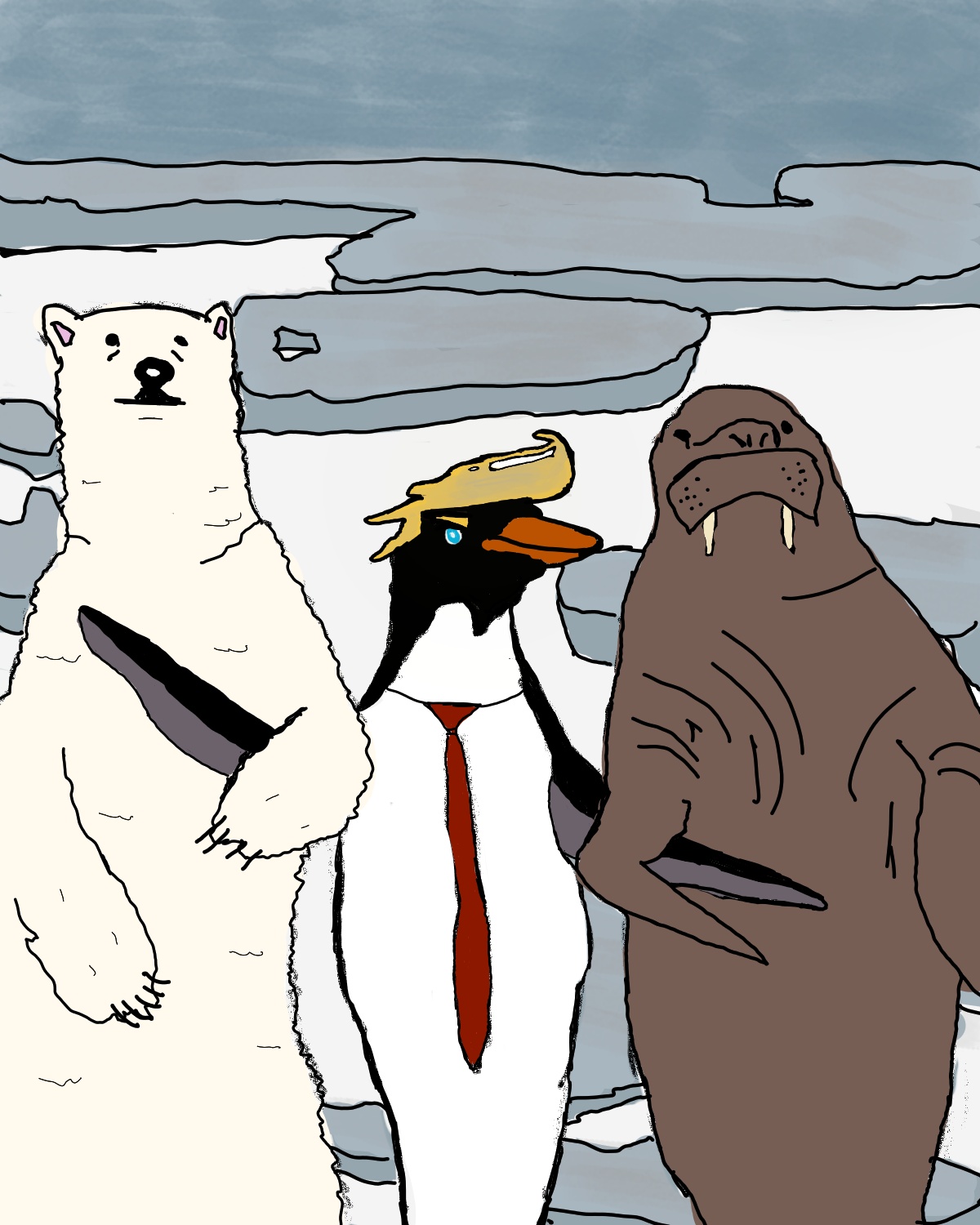
Most people hear “Greenland” and think of a remote Arctic territory, a place where polar bears roam and scientists drill ice cores. A piece of geography that rarely makes the news unless someone proposes to buy it.
But Greenland is not just a place. It is a planetary thermostat. What happens there over the next few decades will shape coastlines, weather patterns, and human migration for centuries.
Greenland’s ice sheet contains 90% of the Arctic’s land ice which is enough frozen water to raise global sea levels by more than seven meters if it all melted. That ice sheet is currently losing roughly 280 billion tons of ice every year. A 2022 study found that recent climate conditions have already guaranteed at least 27 centimeters of sea level rise, regardless of what we do next. The melting ice is not waiting for policy debates to conclude.
Ice is a clever tool that the Earth uses to regulate the global temperature. It reflects sunlight back into space, mitigating heat, especially compared to ocean water, which absorbs it. As Greenland’s ice retreats, more heat gets trapped in the atmosphere, which melts more ice, which exposes more water, which absorbs more heat. Scientists call this a positive feedback loop. Once the loop accelerates past a certain point, returning to equilibrium becomes extraordinarily difficult. The ice sheet also regulates ocean currents. As Greenland melts, massive amounts of freshwater pour into the North Atlantic. Freshwater is less dense than saltwater, so it disrupts the sinking motion that drives the Atlantic Meridional Overturning Circulation (the ocean conveyor belt that distributes heat around the planet). Weakened circulation means significantly colder winters in Europe, shifting monsoon patterns in Asia, and unpredictable weather across the Northern Hemisphere. The effects ripple outward in ways that climate models are still working to capture.
And then there is the methane.
The Arctic is warming four times faster than the global average. As temperatures rise, permafrost — ground that has remained frozen for thousands of years — begins to thaw. Locked inside that permafrost are enormous quantities of organic material. When it thaws, microbes break it down and release methane, a greenhouse gas 30 times more potent than carbon dioxide. More warming causes more thaw, which releases more methane, which causes more warming. Another positive feedback loop, layered on top of the first.
This is not a hypothetical future risk. It is happening now. This would only be made worse with the so-called “newly accessible” Arctic resources. These resources are only accessible because the planet is destabilizing. The warming that reveals these resources is the same warming that threatens coastal cities, disrupts agriculture, and drives extreme weather. Mining and drilling infrastructure accelerates permafrost degradation. Oil well pads on Alaskan permafrost have been shown to accelerate local thaw rates even after remediation efforts. Some will say these resources are essential for the clean energy transition. Rare earth elements power batteries and wind turbines. Critical minerals are necessary for electric vehicles. But Greenland’s rare earth deposits are co-located with uranium, which complicates extraction. The harsh Arctic environment makes mining extraordinarily expensive, 5-10 times costlier than operations elsewhere. Infrastructure is also virtually nonexistent: Only one small mine currently operates on the entire island. The economic case for expanded mining is weaker than it appears.
Greenland’s government has looked at these trade-offs and made a choice. In 2021, they banned new offshore oil and gas exploration, citing climate concerns. The same year, they banned uranium mining due to environmental and health risks, effectively blocking development of one of the world’s largest rare earth deposits. A country of 57,000 people, seeking economic independence, decided that some resources are better off frozen than extracted.
Meanwhile, the United States has proposed opening 1.3 billion acres of coastal waters to offshore drilling. Federal protections have been stripped from millions of acres of wetlands and streams, narrowing Clean Water Act coverage to just 19%of the country’s wetlands. Environmental review timelines for fossil fuel and mining projects have been dramatically shortened. Requirements for public input on drilling and infrastructure projects have been eliminated.
These policy choices represent a fundamentally different approach to environmental protection. If Greenland’s resources were developed under a regulatory framework, also known as under U.S. control, that prioritizes speed and extraction over environmental review, the consequences for a fragile Arctic ecosystem could be severe.
Protecting Greenland is not about locking away resources that someone might want. It is about recognizing that some places matter more as they are than as they could be converted into. Greenland’s leaders understood something important: The ice sheet is not a barrier to the island’s value; it is the value. Every policy decision that adds stress to that system, whether through extraction, infrastructure, or weakened environmental review, accelerates a process we cannot reverse.
The question is simple. Do we, like Greenland, make the right decision and treat the Arctic as a system worth protecting? Or do we force Greenland to empty its resources and accelerate the ice sheet’s death?