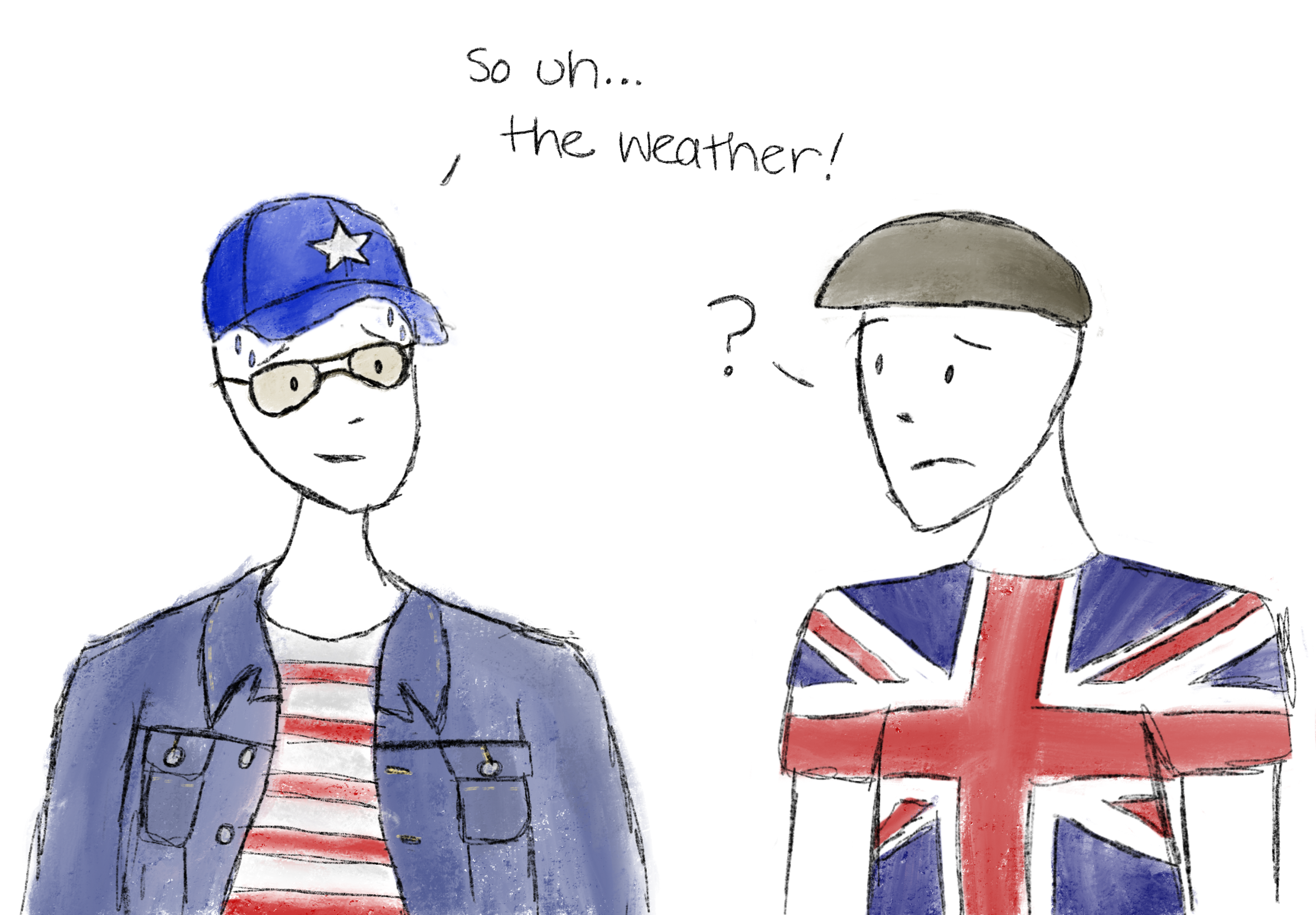
Last Saturday, I took it upon myself to continue my assimilation into American culture. I trekked along motorways in harsh heat and burning sun to experience the uniquely American joy of endless breadsticks at a real-life Olive Garden. Instead, I felt like I was being beaten with one of the doughy wonders by our overly chatty waiter.
Upon introduction, equipped with those dazzlingly all-American white teeth, he noticed my friend’s Steelers jersey. Thus died any idea of a lunch spent exclusively between friends — we were now not a trio but a party of four. It became apparent to me that we had just stepped unwittingly into the bear trap that is Small Talk: a facet of life in the U.S. that perpetually perplexes foreigners such as myself.
I’m sure the nearly 4,000-strong community of international students at the University of Rochester join me in my perpetual dread of American small talk. It appears inescapable; at every turn I’m faced by an uncommonly natural jollity and a bright interrogation of my health and my day’s activities. Upon every such inquiry, I find myself summoning my highest and sunniest voice, betraying every British urge inside me to be politely curt. I acquiesce to a conversation five times the length necessary and hear the words, “I’m great,” tumble from my mouth.
What I want to say is:
“Actually, I have three different articles for the Campus Times due by EOD on Friday that I volunteered to do, poems and stories to write, and a deep sense of existential dread to combat.” Don’t get me wrong, at home I would reply with a simple:
“Good, thanks. You?” They would reply alike, and we could both go on our way, unimpeded. Here, there is no such brevity.
Why is the stoney politeness of my homeland considered rude and unfriendly here? Why has it become necessary for me to factor “talking time” into my travel plans? And why, for the love of Christ, do I now need to enter into a biographical interview with every Uber driver just because the concept of a “walkable city” seems to be too much of a challenge for American urban planners?
My expert theory: Americans suffer from a deep and tangible sense of loneliness, and so must capture each other with a net woven from chit-chat. It seems to me, as someone from a left-leaning country, that this country lacks a culture of caring for other people. It has portrayed the idea of collectivism as Communism and trained its people to prioritize the self above all. Friendships in America suffer from a focus on “the grind,” and even if friends discuss their personal issues, they lack empathy for each other. The American Dream teaches that if you work hard and build your wealth, then you can achieve whatever you like. But with only so much wealth in the world, that ideology doesn’t leave much room for people to rise alongside you. Struggling to receive the care and connection that a society so built on individualism lacks, your average American could be turning quotidian interaction into full blown conversation to claw their way back to a sense of community. The culture’s fear of the “Socialist threat” has led to a deep sense of isolation that pushes care for each other off a corporate skyscraper.
As you hear the screams of Community and Social Conscience fade below you, it is undoubted that someone will begin to tell you about their terrible and psychologically damaging childhood, or the death of their beloved so-and-so.
This is the continuation of the phenomenon of American small talk, the next generation of a generational curse: the Chronic Oversharer. In a time when everyone is so focused on their own issues and social media appears to be disguising as self-care an agenda that actually pushes selfishness, the people of this country lay out their intimacies for the world to see.
On the bus back from Wegmans (not “Wegman’s”, as a kind professor recently informed me), a small man interrupted my friend and my conversation with his opinion on my chips or, as he graciously and generously corrected me, fries:
“I don’t like those fries, they make me gassy.” Having already had my ear talked off in Olive Garden about a sport my country doesn’t play, I was not in the mood to hear any more about this odd little fellow’s gripes with Burger Bar–induced flatulence. At home, a smile and nod would have slid me nicely back into my own conversation. I swiftly discovered that, far from fending off the conversation-hungry man, I had essentially cut off my arm and hung out a “PLEASE EAT ME” sign in shark-infested waters. My escape only presented itself when the bus got back to campus and we finally had a polite excuse to leave.
Are Americans really so starved of attention and attentive conversation that they must inflict the trials and tribulations of their digestive tract upon poor, unsuspecting strangers? Have social media and extreme self-prioritization cost the citizens of this country their ability to differentiate between information told over a blood pact with your nearest and dearest in the middle of the night and that which can comfortably settle upon the ears of your peers without the weight of it dragging them from Rochester to Tampa?
American small talk is something that, for their survival, any foreigner must learn to appreciate and even enjoy. But a word for any Brit preparing for their first American interaction: Remember, what seems obtrusively friendly to you is just their way of being polite.