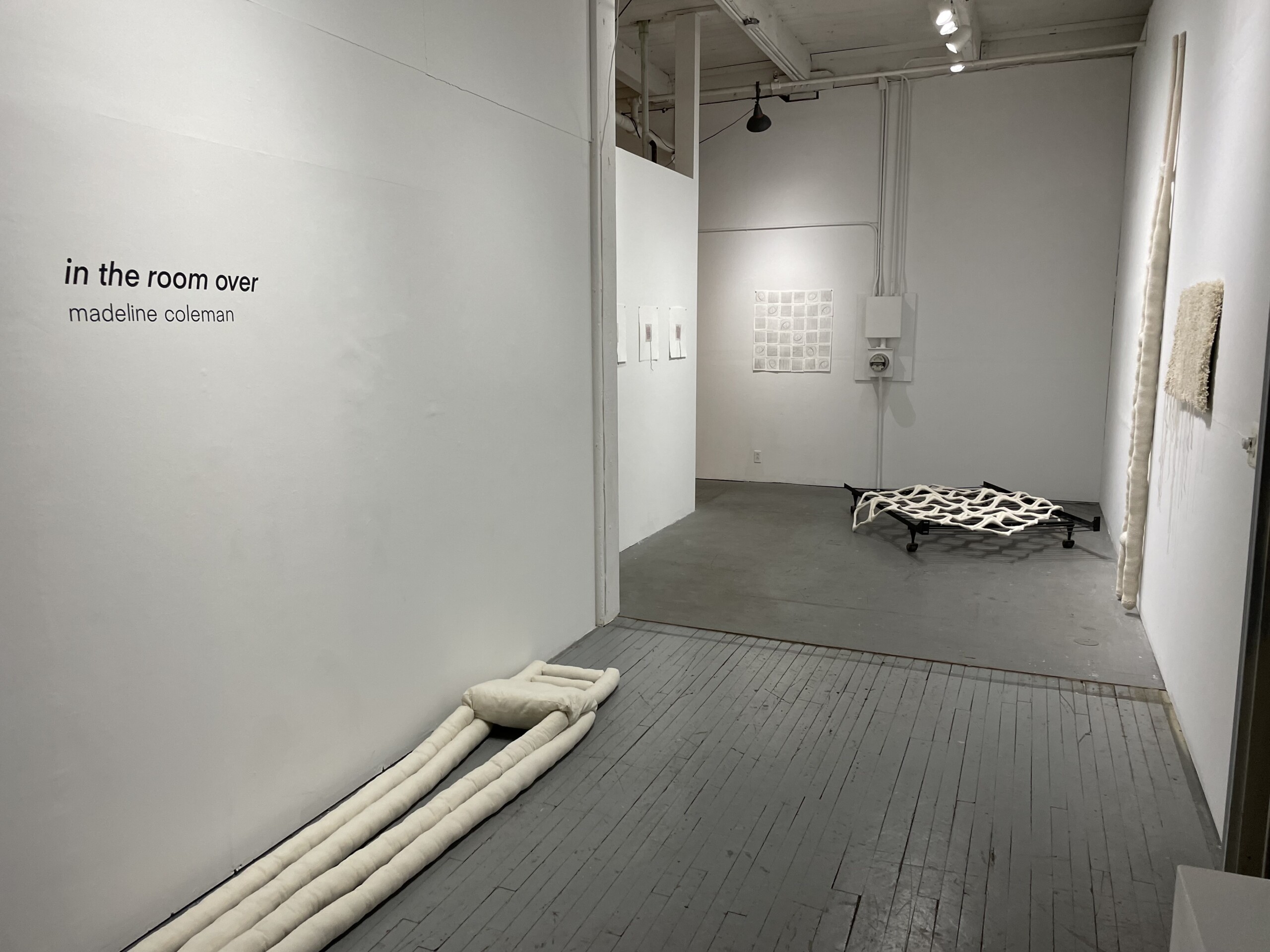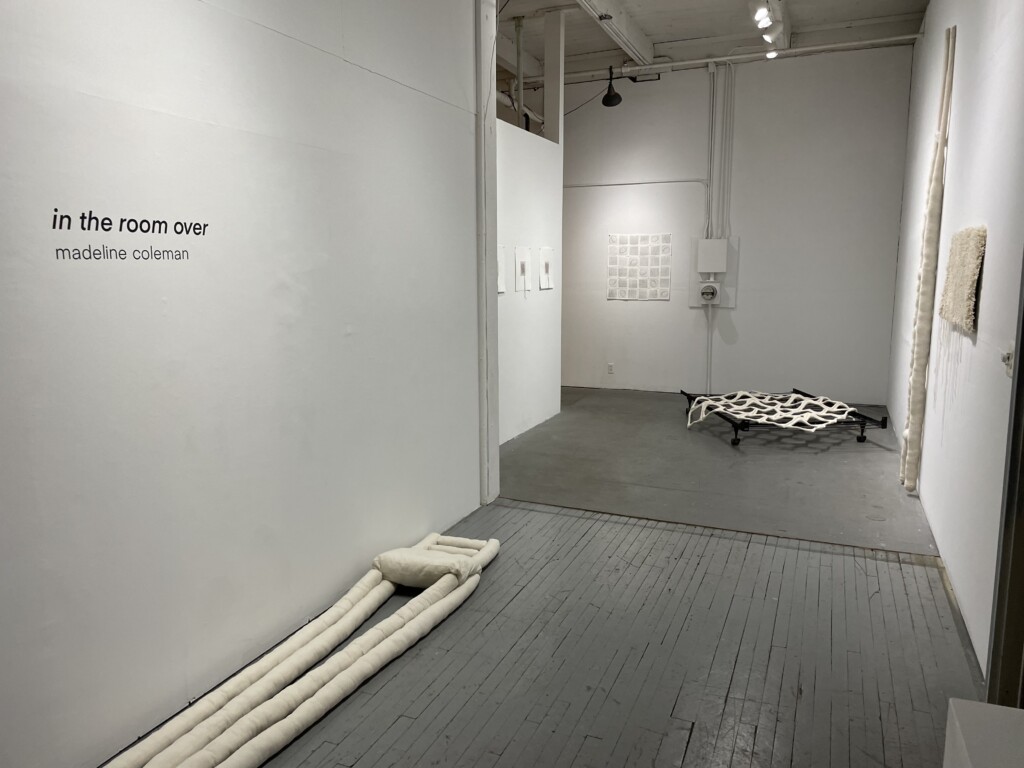
Have you ever wondered what it would be like to have your own art exhibit? For senior Madeline Coleman, that question has become reality. Her first-ever solo exhibit, “in the room over,” is open for viewing. This exhibit is a combination of Coleman’s new and past works, which explore the themes of non-functionality and mental health. The Campus Times sat down with Coleman to discuss her artistic process, as well as her feelings towards this exhibit.
What first made you interested in art?
Art serves many purposes for different people, and every one is valid. It’s a great way to pass the time, to find joy, et cetera. I think everyone in the world should make art — there is always something in art that can provide something for each person. After going through a mental health crisis, I realized the purpose of art in my life — there were things I needed to say that I struggled to otherwise express. And I needed my feelings to feel seen and validated — even if I was the one doing it for myself.
Through art, I found a way to express things I was going through, and separate them from myself into a physical form that I could look back at and identify with. While art began for me as something to do, it became something I needed to do. I make art because I must.
What’s going to be featured in the exhibit/what type of art?
My work explores non-functionality and my personal experiences with mental illness. I take an everyday object and through manipulation of its variables (such as its materiality or scale), I strip it of its intrinsic purpose and function. I reduce objects to a faulty and personified (and thus relatable) state. For instance, when bedridden from depression, you experience a very physical bodily heaviness — lifting even a limb is a task. You feel absurd and purposeless and wish to be able to even just sit up. In the exhibit there is a soft sculpture of a chair, laid flat on the ground, with exaggeratingly long legs that fruitlessly reach out — this chair is the embodiment of these feelings: heaviness, recumbence, absurdity, non-functionality, and yearning.
The exhibit is composed of such objects; it’s a room full of feelings. Instead of writing statements (which I feel can over-explain and overdirect a viewer), when you enter the exhibit there are catalogs that you can grab that have a poem that I wrote to accompany each piece. As my work falls under the genre of conceptual art, the core of my pieces and understanding them is understanding the thoughts and concepts that I have infused within them. Rather than negating your personal perspective, these poems (due to their abstraction) hint and suggest as to why my objects exist as they do. I highly recommend you grab a catalog to read as you move around the space.
What did the process of getting an exhibit space off campus entail/how did you set it up?
My professor connected me with Colleen Buzzard, back in spring 2022, as I was looking to intern for a local artist. She has a wonderful studio in the Anderson Arts building, and has converted the front half into an exhibition space for artists. At the conclusion of the internship, she generously offered to reserve it for this February so I could have my first ever solo exhibition. I am so grateful to have gotten to know her, and for the opportunity to pour my brain into her space.
Do you want to pursue art as a career?
I hope to make art every day until my hands stop working. My goal is to attend graduate school in the next few years, and get my MFA so I can become an art professor. I am so thankful to the professors at Rochester — they inspire and motivate me to constantly make. They’ve taught me the skills I need to express things that can be so hard to say, all while creating an environment wherein I feel safe and welcome to do so. They are not only excellent professors, but also just amazing humans — I hope to be like them one day.
How do you feel about having your own exhibit?
It’s the most exciting thing ever! In the weeks before the exhibition opened, I was creating for around four hours every single day outside of classes — literally calling it a night when my fingers started to go numb. Getting to have conversations with visitors has been the best reward for all of that time and effort.
Sometimes when you make such personal work, it can feel a bit selfish — I cope with difficult feelings and get catharsis through the process and the final products. But then, due to the exhibition, I now get to hear how these personal objects resonate with other people. And now both the viewer and I feel less alone — there is no greater reward.
What does the name of the exhibit, “in the room over,” mean to you?
The majority of my pieces are inspired by everyday objects that I have distorted or altered to faultiness. With this in mind, while I like to imagine these objects once existed normally in a normal room, through alteration they now exist in a different space — in the room over.
Simultaneously, all of these manipulations have been made to represent my personal experiences with mental illness. So they are the physicalized thoughts and feelings in my head — the “room” over my body.
Anything else you would like to share regarding your exhibit?
The closing reception for the show will be on Feb. 25, from 2-4pm in Studio 401 at the Anderson Arts Building (250 N Goodman St). I would love to see and chat with everyone!
Until then, it is by appointment only. Anyone who would like to stop by before then is welcome to reach out to me through the contact page on my website .
From April 25 to May 6 I will have my thesis exhibition in the Frontispace gallery on campus. Many things are in the works right now — I am so excited to keep creating!
If you’re interested in visiting Madeline’s exhibit, more information can be found on her Instagram.