Since 1934, UR students have traveled back to Medieval England for a night to attend the Boar’s Head Dinner.
But the festive function that we know today was a men’s only affair until the 1970s. The dinner originated in the Men’s College of UR almost 90 years ago and was exclusively for male students, even after River Campus became co-educational and the female students moved from the Prince Street Women’s College.
Although the women had their own Christmas-themed dinners, their own version of the Boar’s Head Dinner was short-lived according to archives at the Rare Books and Special Collections Library.
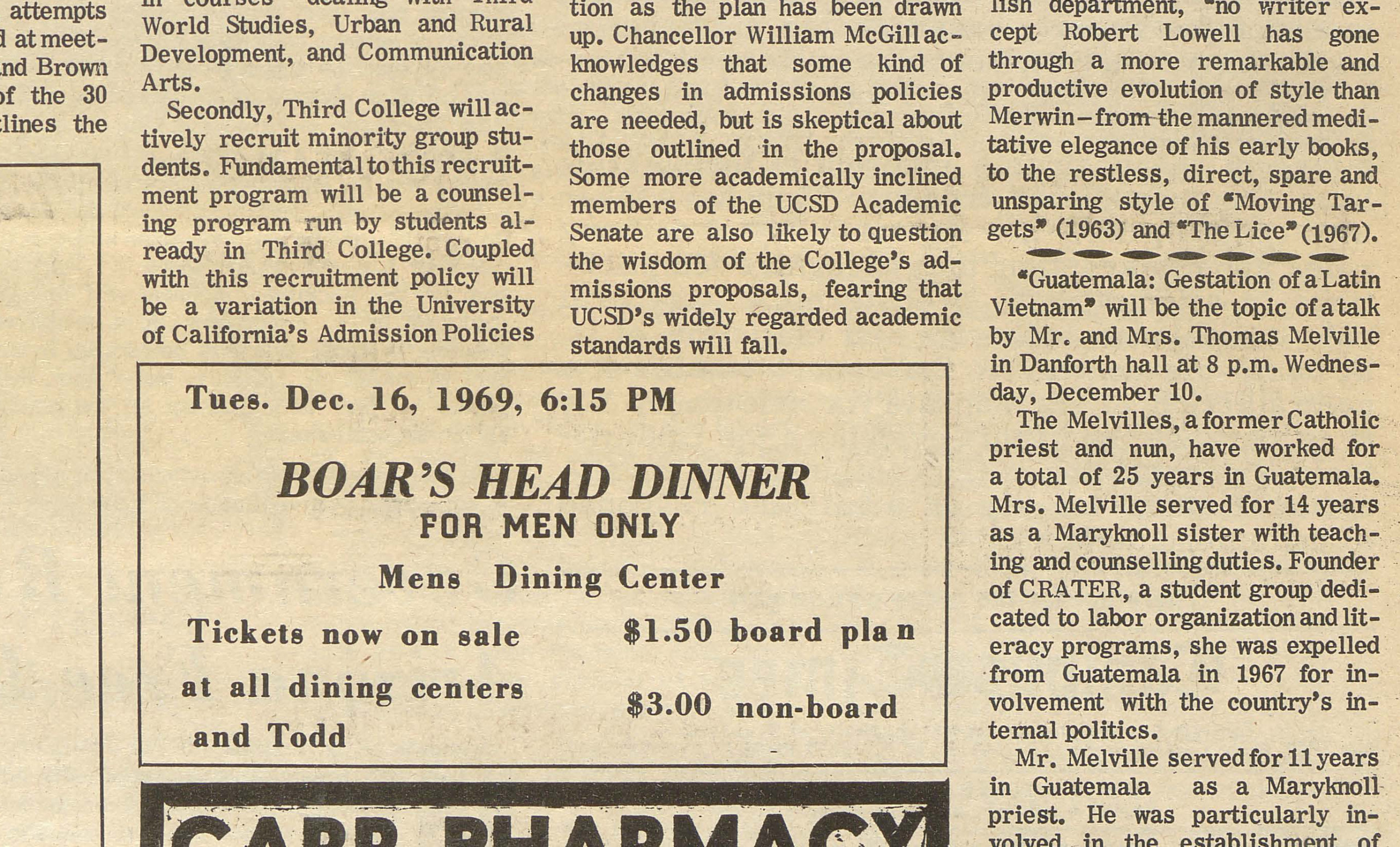
In 1969, an advertisement for the Boar’s Head Dinner declared that the dinner was “FOR MEN ONLY.” The following year, a CT article stated that the dinner would allow women to attend, but only as “beermaids” who would serve mead “to thirsty singers and guests alike,” according to F.T. Clark, the chairman of the Social Activities Board (now Student Programming Board) that oversaw the planning of the dinner.
According to Melissa Mead, John M. and Barbara Keil University Archivist and Rochester Collections Librarian, the presence of women at the Boar’s Head Dinners was limited to the spouses of senior faculty members.
It was only after 1972 that female students were explicitly invited to the dinners, and that can be credited to the protests led by the Women’s Caucus in 1971.
On Dec. 13 of that year, the Women’s Caucus published a Letter to the Editor at the Campus Times titled “Women Point to Sexist Implications,” regarding the position of female students at the Boar’s Head Dinner. “Last week, in an attempt to find out the history of the Boar’s Head Dinner, we were continually put off by various members of the Students’ Association,” said the letter. “They were extremely reluctant to divulge any information, even something as innocuous as historical data. They were immediately suspicious of our intentions, imagining all sorts of devious schemes.”
The letter clarifies that it’s not necessarily the organization’s intention to have the dinner include women as well, but to examine the implications of having female students dress up as beermaids and serve at a men-only event.
The Women’s Caucus peacefully protested at the Boar’s Head Dinner the day after the letter was published by distributing leaflets.
“We are not condemning the Boar’s Head Dinner as an all-male gathering,” the letter stated. “The primary role that women have in this dinner is that of barmaid. We find this role degrading because it reinforces a typical stereotype.” Put in context of the 1970s Women’s Rights Movement, in a time where women were struggling to be seen as equals to men, female students being dressed as barmaids reinforced the notion that women were subservient and expected to serve men. It’s important to note that the servers included men as well but they were not dressed as beermaids.
“In a time when women are struggling for recognition as intelligent people and not just as bodies or servants, the Boar’s Head Dinner is a real obstacle to human liberation,” the letter stated.
The leaflet concludes with a dry, “Enjoy your pig.”
Carol Adams ’72, one of the members of the Women’s Caucus who penned the letter, later reflected on the events of 1971 in her book, “The Pornography of Meat.” “The Boar’s Head Dinner, ostensibly a celebration of the winter solstice, was not, in our view, an innocent enjoyment of male camaraderie,” wrote Adams. “With a ritual carrying on of the head of a dead boar, it symbolically represented to us male dominance.”
That summed up the sentiment of the Women’s Caucus when protesting the position of women at the event. “We did some consciousness raising and we were looking for ways to kind of change the conversation, to change the discussion,” said Adams.
Given that the letter was published in the last fall edition of the CT before winter break, there is very little student response recorded. However, the Jan. 7, 1972 CT includes the following note in the “Classified” section:
“I WOULD LIKE TO APOLOGIZE to all those people who, like myself, were offended by the Boar’s Head Dinner. Michael Kaye-SAB.”
The Boar’s Head Dinner Collection at the Rare Books and Special Collections Library notes that after 1972, female students began to be welcome as guests.