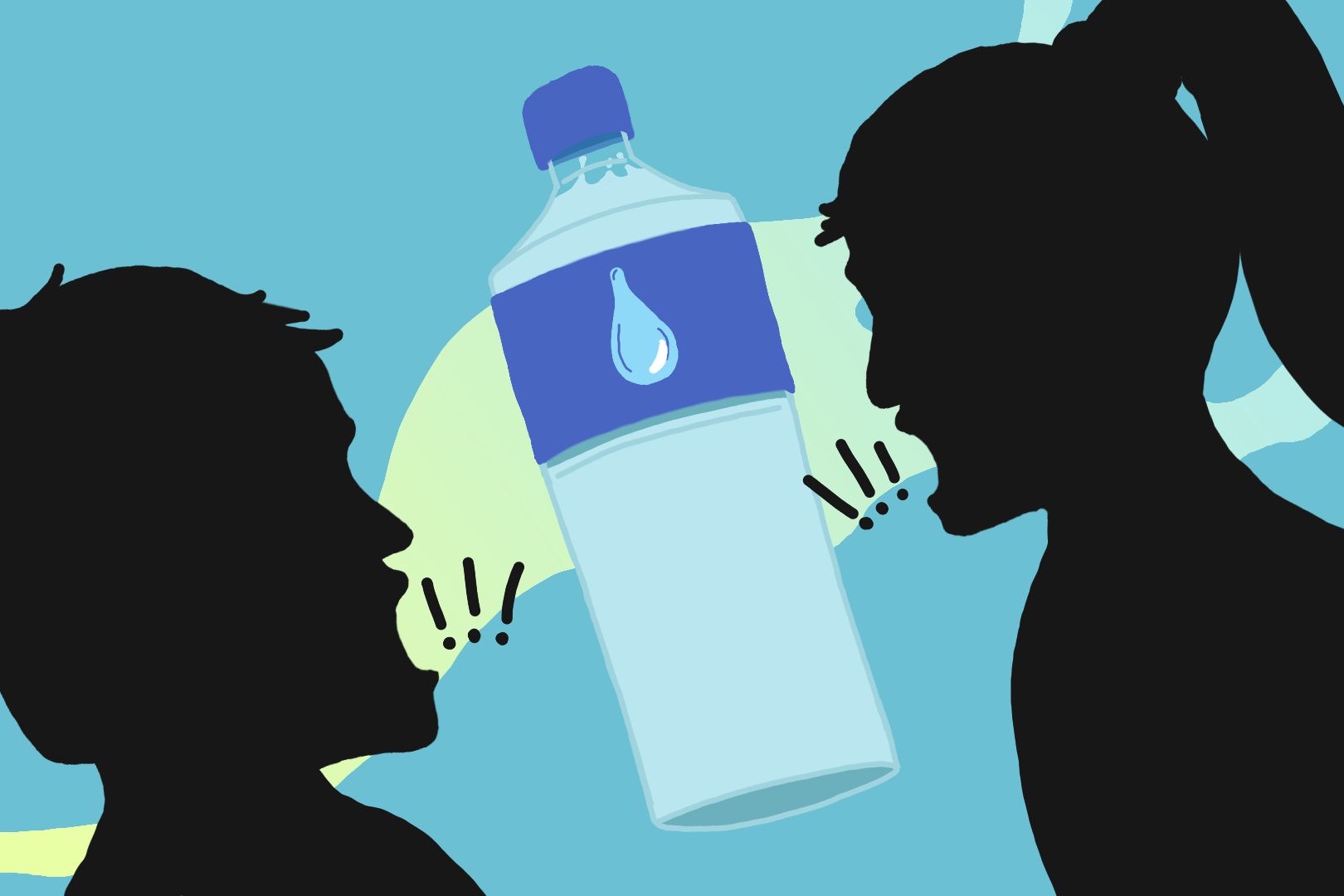
Two years after a movement by eco-minded students failed, UR is considering becoming one of only nine American universities to ban single-use plastic bottles on campus. Dining Team Green, a student-led group committed to sustainable dining practices, was the driving force behind UR’s ban-the-bottle campaign. They — along with UR’s debate team — held a public discussion on Nov. 14 to gauge the student body’s opinion.
The debate was held in iZone and monitored by Dr. Karen Berger, an Associate Professor of Earth and Environmental Sciences. Five speakers, three on the proposition team and two on the opposition team, were given six minutes each to present their arguments, followed by a four-minute cross-examination by the other side.
The opposition’s principal focus was how the ban negatively impacts consumer choice. The first speaker argued that a plastic bottle ban would limit student beverage choices on campus by eliminating certain drinks that only come in plastic bottles. This would force students to buy their favorite beverages off-campus. He also stated that UR does not have enough leverage to influence Pepsi, its beverage supplier, to produce aluminum or paper containers rather than plastic ones. The opposition also emphasized the disproportionate impact that the ban would have on low-income students and students with disabilities. Ultimately, they argued that the plastic bottle ban would be ineffective because it did not address more pressing sustainability issues at UR, and it unfairly placed most of the responsibility for change onto students rather than the University itself.
The proposition began by walking the audience through the life cycle of a single-use plastic bottle, beginning with petroleum mining and ending with marine microplastics. They cited two colleges in the U.S., Washington University in St. Louis and the University of Vermont, which have had campus-wide plastic bottle bans since 2009 and 2013, respectively. Both universities were successful because they clearly communicated when and how the bottle ban would be put in place. This allowed students and faculty to adjust more gradually by making behavioral changes before the ban’s implementation. The proposition rebutted claims that a plastic bottle ban would limit consumer choice, stating that many of the same beverage products were available in aluminum cans. They emphasized that aluminum can be infinitely recycled and nationally has a much higher recycling rate than plastics. They claimed it was elitist to propose taking no action against climate change when most of its direct impacts fall onto low-income communities.
Finally, they emphasized that students have historically been drivers of change. In the past, UR pressured its food supplier, Harvest Table, to provide more local options, and the company complied with student demands. Given this and many other examples, they said, it was ignorant to assume that student action had no power.
After both the opposition and proposition presented their arguments, Berger made some closing remarks addressing the importance of open discourse, especially about the climate crisis. She stated that we have a moral responsibility to consider both the long-term effects of our actions and their broader environmental impacts. In her opinion, the banning of single-use plastic bottles would be most effective as part of a larger educational campaign that raised the student body’s awareness of pollution and single-use materials. She then opened the floor to audience discussion, and a few students brought up their concerns. Some thought that an incentive-based recycling program would be more effective, while others were concerned that plastic bottles were not the most pressing sustainability issue on campus. All audience members were encouraged to fill out an exit survey rating their feelings on the bottle ban. This debate and survey were the first steps to assess the student body’s attitude toward the ban, and they will ultimately influence Dining Services’s decision for or against plastic bottles.