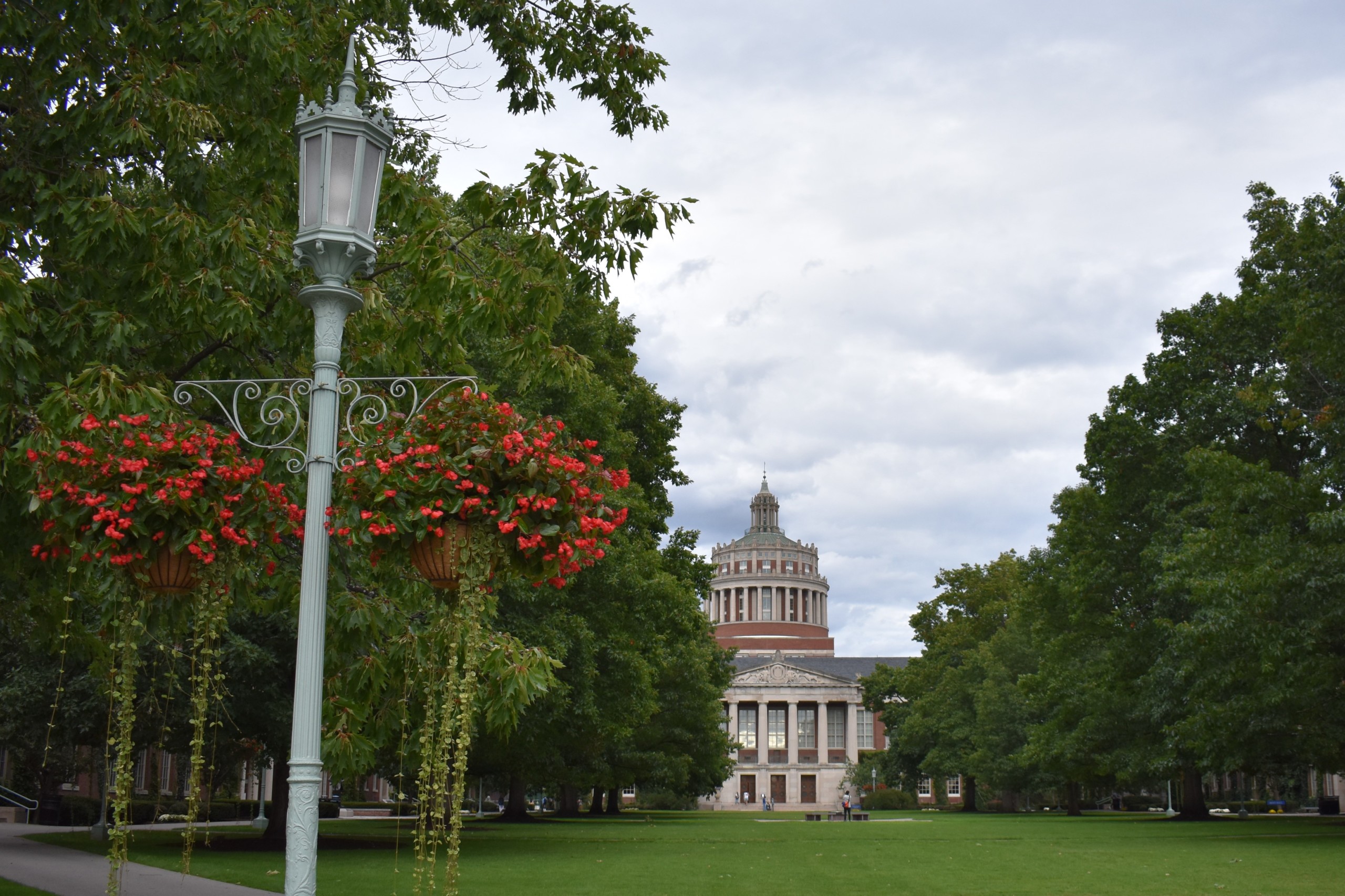
If you’ve been on campus the past few Sunday evenings, you might have heard the iconic chiming of the carillon bells as student musicians kicked off our in-person semester with an evening concert series. Students Claire Janezic and Kayla Gunderson have performed at all three concerts so far this semester, and I had the amazing opportunity to ask them what it’s like to play inside the bell tower of Rush Rhees.
Janezic is a Take Five Scholar studying art of incarcerated people and double majoring in History and Music with an AME minor. Gunderson is a junior majoring in American Sign Language and Brain and Cognitive Sciences. Both students have played the piano and the clarinet from a young age and were involved in their high schools’ bands. Neither anticipated learning to play the carillon, but they were both introduced to it once they arrived at UR. Gunderson first heard about carillon players from her campus tour guide, and Janezic heard the bells while walking around campus their first semester.
So, what is a carillon exactly? According to Hopeman Carillon’s Facebook page, the University’s instrument includes 50 bells in the dome of Rush Rhees Library. Though carillons can have a minimum of 23 bells, the largest one in the world, the Hyechon College Carillon in South Korea, has a grand total of 78 bells, according to the Guinness Book of World Records.
How does one make music with over three tons of metal? Simply put, the musicians play an oversized keyboard with their fists. These keys are connected to a wire which in turn is connected to the clapper of a bell through a series of cranks and roller bars. Since the wire is connected directly to the clapper of the bell, performers have a greater dynamic range for their playing and can add more variation, like they would with a piano or organ.
For students looking to practice without the whole campus hearing, there is a practice instrument in Spurrier hall, and another in Dewey Hall. They both prefer the Dewey instrument because it is electric, using carillon sounds recorded at the University of Chicago. However, both students go up into the tower a couple of times a week for concerts, lessons, and “open tower time.”
According to Janezic, “We try to learn pieces […] at some level when we’re on the practice instruments, but you kind of need to play the main instrument to really know how to play a piece because the weight is different, it feels different, there’s actually different notes on this instrument [than the one in Dewey].”
Janezic said their favorite piece to play is probably “Lament and Alleluia” by Alice Gomez, but in terms of recognizable music, they also enjoy Leonard Cohen’s “Hallelujah.” Gunderson’s favorite piece is “Burlesca” by Ronald Barnes, but her most recognizable song is probably Andrew Lloyd Webber’s “Phantom of the Opera.” Both students laughed when I asked if it was nerve-wracking to play for the entire campus, and they explained that since people don’t usually know who is playing, it takes a lot of pressure off the performer.
It’s really no wonder that spectators can’t see the musicians since our carillon players sit over 180 feet in the air. If you stand on the Eastman Quad and squint up at the top row of windows lining the dome of the Rush Rhees Library, that is where Janezic and Gunderson sit to play. “It’s the best view on campus for sure,” said Gunderson, and Janezic agreed, adding that you can see the airport when the weather is nice.
I attended the second carillon concert in the Hopeman Carillon’s Sunday concert series, but there will be one every Sunday from 5:00 to 5:30 p.m. throughout the semester. Audience members can sit on the Eastman Quad to listen, or if you live off-campus like me, you can tune into the live stream posted by @HopemanCarillon on Facebook (this will also be a great option once the infamous Rochester winter strikes). The Hopeman Carillon posts programs for each concert on their Facebook page, and you can even request a song for students to play. I, for one, can’t wait to hear what Janezic, Gunderson, and the rest of our talented musicians decide to play next.