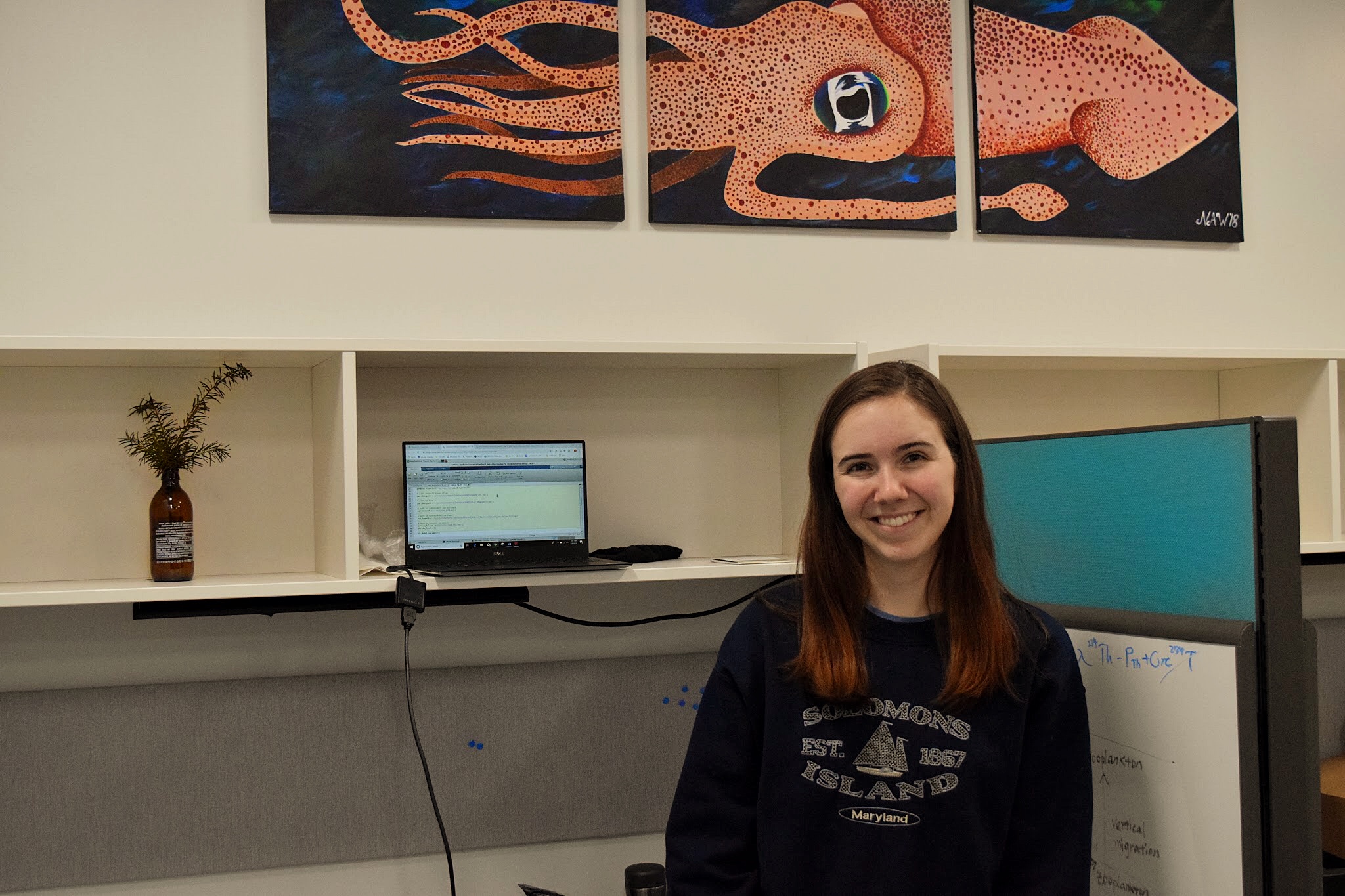
Environmental science major Lillian Henderson got her start in research cleaning glassware in John Kessler’s oceanography and climate science lab. Now Henderson, a senior, has modeled Californian undercurrents and worked on a data-collection cruise down the Atlantic coast. The cruise — with Kessler’s research group — was a transformative research experience for her. “I ended up being on the night shift collecting gas samples from the surface,” she said. “It was awesome.”
Upon returning to Rochester and taking a course with Thomas Weber she decided to pursue an important question in the realm of oceanography. “I’m working on predicting iron fluxes from marine sediments,” Henderson said. The project is based in Weber’s UR ocean biogeochemistry lab, and has implications for the climate.
Phytoplankton need iron to photosynthesize, so fluctuations in oceanic iron concentrations may contribute to climate change. “When phytoplankton photosynthesize, they take carbon dioxide out of the atmosphere,” Henderson said.
Nitrogen and phosphate were traditionally considered the major regulators of global photosynthesis, but iron has recently been highlighted as a key nutrient for photosynthetic organisms. When oceanic iron concentrations fall, photosynthesis decreases, and more carbon dioxide — a greenhouse gas — accumulates in the atmosphere.
Historically, fluctuations in marine iron concentrations correlate with dramatic climate change. For example, iron was especially abundant in the ocean during glacial times. The sources of this iron include dust, sediments, and hydrothermal vents.
“[We want to] have a way to predict, under different conditions, how much iron would come out,” Henderson said. Understanding how this works could be pivotal to climate control research.
To accomplish this, Henderson and Weber are developing a model based on current iron cycling. “The one limitation to the research is that the data we have is very sparse,” Henderson said. Instead, the model uses carbon oxidative rates and oxygen concentration to predict iron fluctuations with the ultimate goal of mapping out the whole globe.
This experience has equipped Henderson with coding skills more so than any course she has taken at UR. “Figuring it out for yourself helps you remember things better,” Henderson said.
By graduation, Henderson will have completed a senior thesis based on this project. She hopes to pursue a Ph.D., possibly continuing to work with trace metals like iron. “After my first summer of research, I knew that’s what I wanted to do,” Henderson said. “I got so lucky with that research cruise.”