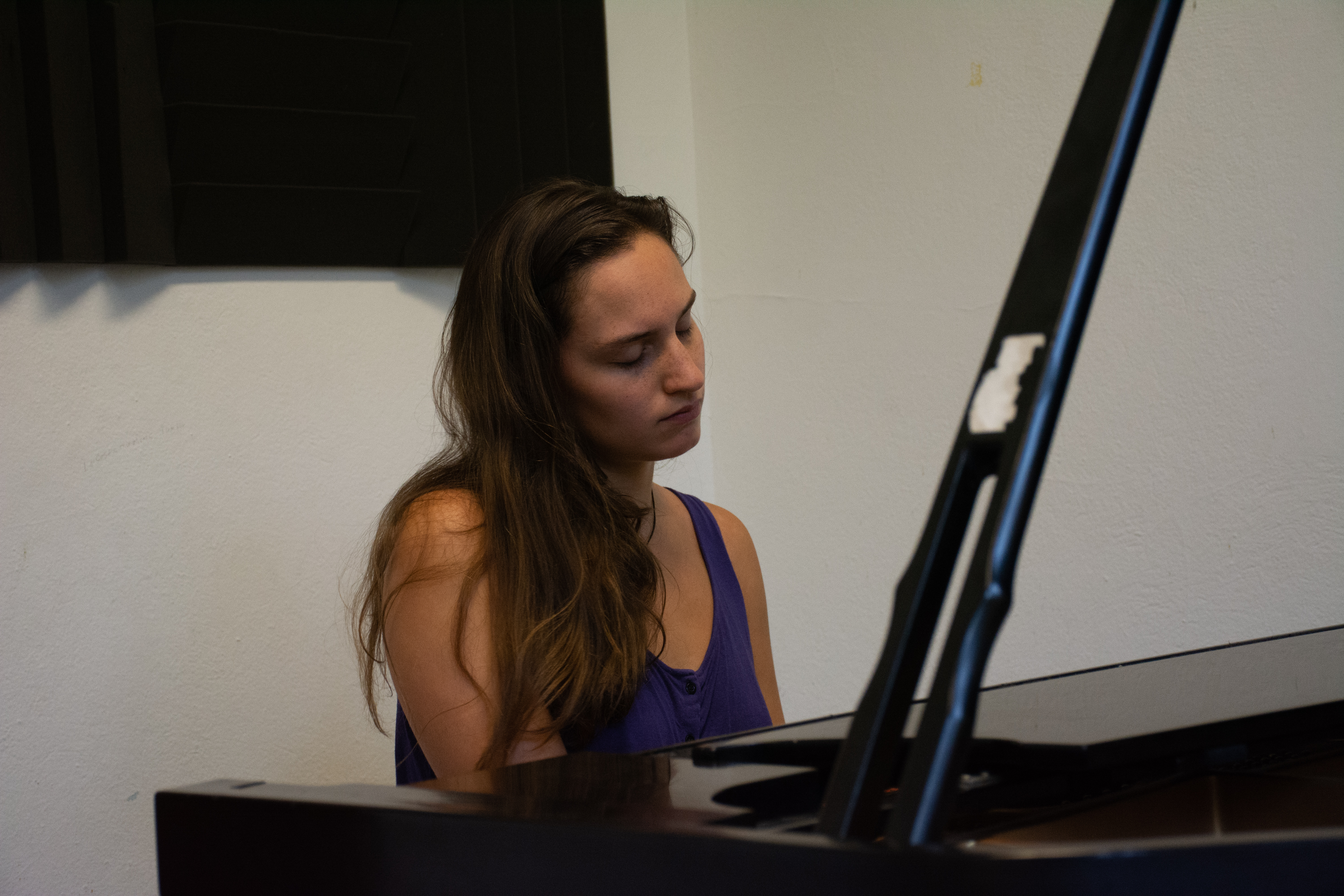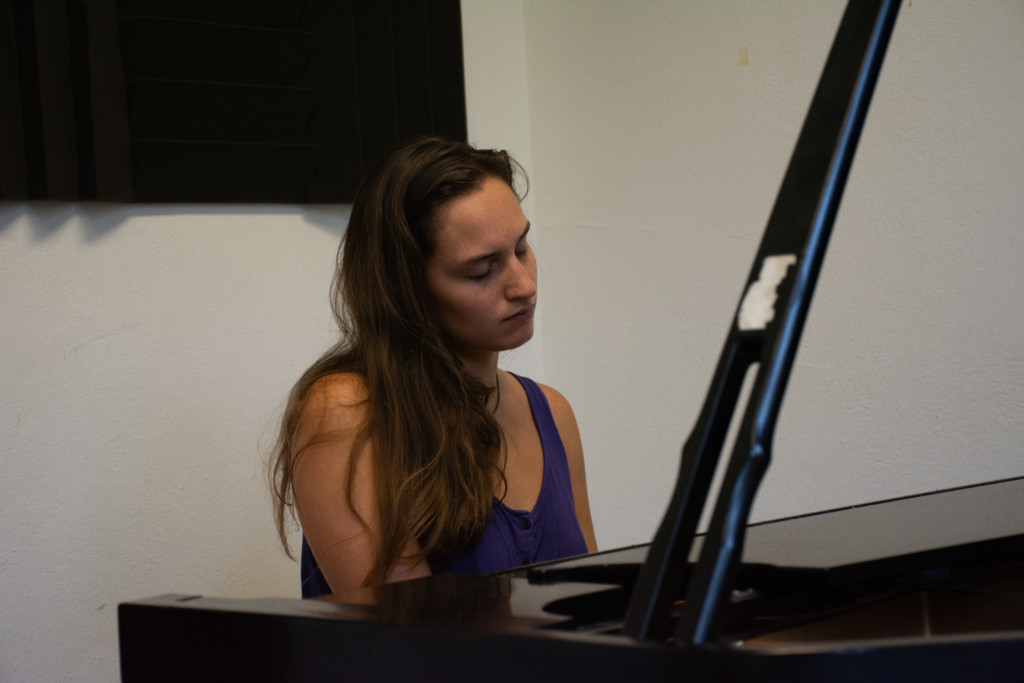
Senior Siena Facciolo was 14 when she wrote her first song about a “little fling” she had at piano camp. That song, “Morning,” is featured on singer-songwriter Facciolo’s debut album, “Dear House,” out Sept. 29.
Facciolo, now 22, has been actively putting the album — recorded in Rettner — together since January. She first arrived at UR in fall 2017, a transfer student from McGill. After a semester as a member of UR a cappella group Trebellious, Facciolo left to work on her own music.
The centerpiece of “Dear House” is Facciolo’s voice and piano, but her departure from Trebellious was not a rejection of collaboration. The album features drummer Chris Palace (Facciolo’s boyfriend), graduate student Jordan Rabinowitz on bass, UR graduates Ryan Hecht ‘18 on guitar (and, briefly, vocals), and Teddy Rycroft ‘18 as mixing engineer, piano arrangements by junior Tom Mariano, and cellist Kathy Lewis. “Dear House” is the first time Facciolo has involved so many others in her music.
On the evening of Sept. 10, Facciolo, Palace, and Rabinowitz were rehearsing at Rabinowitz’s house for a gig in three days at Brooks Landing. Facciolo’s delivery for “We Cry,” one of her more brooding songs, was appropriately stern and dramatic. It was broken by the occasional mistake or laugh, but Facciolo would quickly shift back into performance mode again.
In between songs, though, the mood seemed jovial. One of Rabinowitz’s housemates provided homemade french fries. Rabinowitz and Palace discussed the different means of producing “hype” with drums and bass. Rabinowitz insisted that the sound they were looking for at one point in one song could be described as a “jello wall.” But they remained on task, with Facciolo deciding which songs to play next and at one point giving some background on one of her songs, “Latest Mistake.”
The line “Eight years have passed and I have forgiven you,” Facciolo explained, was originally “Four years have passed and I’m still in love with you.” With each year the number grew, until it hit eight years, when she decided to change it for good.
The personal nature of Facciolo’s songwriting is deliberate, and she is particularly interested in how it connects her to her audience.
“Each time I sing a song about my own life, I get pulled back to that moment and am able to sit in that experience along with the audience,” Facciolo told Campus Times in an article earlier this month. She added, “This lets the song breathe and speak for itself, so it acts as a shared space between the audience and me.”
Facciolo described how these interests were embodied by a church service. On a road trip last winter that brought her to New Orleans, a trumpet player invited her to his baptist church, where he played the organ the next morning.
“Everyone was on their feet, like, singing and clapping and everything,” Facciolo remembered. “And I’ve never had that religion mixed with community mixed with music experience and it was incredible.”
“It was probably the most passionate music that I’ve ever seen in my life,” she added. “And it was the style that I’d been […] wanting to manifest in my own music.”
When Facciolo returned from the trip, which also included stops in Nashville and Memphis, she finished work on “Love Me Right,” a seductive song, is in no way religious but strong jazz and blues influences. (The song does have one religious element, though — Mariano, who arranged the piano, was inspired by “Gethsemane” from the musical “Jesus Christ Superstar.”)
Facciolo guessed that “Love Me Right” is her most popular song in Rochester, but for her family, her first song, “Morning,” is a favorite.
Family is a recurring motif in Facciolo’s musical life. She said that her grandmother is usually first to hear any new songs she writes. The final song on the album, “All of These Years,” is a love song to her sister. The first time she played it for her, Facciolo said, they both cried.
The melody of the album’s newest song and namesake, “Dear House,” is rather somber. Facciolo acknowledged it was a melancholy way to begin an album.
“I love melancholy. I think melancholy is interesting and I love exploring it,” she said. “I think there’s a lot of value in people giving time to their melancholy feelings.”
The lyrics do not tell a story or refer to any specific person, but are instead more poetic.
“These wooden floors have held our weight/ they’ve heard our fears/ and the love we create lines the ancient doors/ which tend to be so near,” the song begins.
Facciolo said she has always been confident in her ability to write poetically due to writing from a young age, and to her fourth grade teacher, Newton Baker, who encouraged students to keep daily writing journals.
“I have a row of so many journals lined up on my bookshelf full of poems and philosophising and tidbits of my life, starting from 2003,” Facciolo said.
Facciolo’s openness in her songs is noteworthy. “Meteor” for example, is about a bonding experience with a friend watching a meteor shower on the Genesee Riverway Trail bridge.
“She has this, like, great vulnerability; […] not in the weak sense, but in that open, raw sense,” fellow Trebellious alum Ava Sauer ‘18 commented. “It’s really powerful because she’s, like, really putting it all out there, but there’s nothing weak about it.”
If not confidence, Facciolo does struggle with one thing: rhyming.
“Sometimes I have […] the perfect line, and then I don’t know how to rhyme it so I just have to change it,” she said. “Rhyming kind of sucks.”
Facciolo will be performing at 8:00 p.m. at the Little Theatre on Sept. 29 in celebration of the album release.