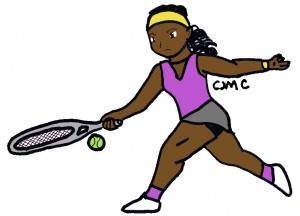
Christian Cieri, Staff Illustrator
The Australian Open came to a close on Sunday when top-ranked Novak Djokovic captured his fifth title in the land Down Under, beating Andy Murray in four sets in the men’s singles final. Also victorious was world number-one Serena Williams, who beat Maria Sharapova for the sixteenth straight time to claim her 19th grand slam singles title.

In men’s doubles, the unheralded duo of Simone Bolelli and Fabio Fognini came through the draw to unexpectedly win their first Grand Slam title. Legends Martina Hingis and Leander Paes, both of whom have been playing professionally for over two decades, added another trophy to their collections by claiming the mixed doubles title. The women’s doubles result was a shocker, with first-time partners Lucie Safarova and Bethanie Mattek-Sands coming out of nowhere to win the event.
Mattek-Sands’ triumph is particularly notable because of her Rochester connection. The win makes her the first Rochesterian—Rochester, Minn., but who’s counting?—to win a Grand Slam title.
While the winners all deserve recognition for their accomplishments, perhaps the most important storyline to come out of the event was Andy Murray’s outspoken defense of women’s tennis and the overall role of females in the sport.
Murray is unique in that his journey to the upper ranks of professional tennis has been heavily influenced by women. Murray’s mother coached him as he grew up, and she continues to frequently travel with him to tournaments.
Last year, Murray shocked the tennis world when he took the unprecedented step of hiring former Australian Open and Wimbledon champion Amelie Mauresmo to serve as his coach. The decision to hire a woman was met with a heavy dose of skepticism and criticism, with many players, coaches and tennis journalists doubting whether a woman could help Murray succeed in men’s tennis.
While Murray mostly let his tennis do the talking last week to prove the doubters wrong, he also commented on his decision, “A lot of people criticized me working with her, and I think so far this week we’ve shown that women can be very good coaches.”
To understand how progressive Murray’s statements truly are, it’s important to understand that male players more commonly speak dismissively and negatively of the women’s game. Consider what one of his competitors, Australian Marinko Matosevic, said last year when asked if he could ever work with a female coach: “For me, I couldn’t do it since I don’t think that highly of the women’s game. It’s all equal rights these days: Got to be politically correct. So, yeah, someone’s got to give it a go. It won’t be me.”
Murray also noted the success of nineteen-year-old American Madison Keys, a rising star who had her breakthrough tournament in Australia, reaching the semifinals. “Madison Keys…had her best tournament and is coached by [former world number one] Lindsay Davenport,” Murray remarked. “I see no reason why it can’t keep moving forward like that in the future.”
Although Andy Murray’s performance in the final against Djokovic was somewhat disappointing, losing his last nine games, his tournament was overall an indisputable success. He silenced those who doubted whether he could still seriously contend for grand slams, and perhaps more importantly, he proved that the flak he took for hiring a female coach was entirely unwarranted.
In a broader sense, however, Murray used his influence on court, in the press room and on social media—he tweeted #MoreWomenInSport during the tournament—for women’s equality, a noble cause that deserves nothing but praise.
Shaprio is a member of
the class of 2016.