Parsa Lotfi, Photo Editor
The first time you walked into the Commons this semester, you probably noticed that something was a little different. The line for chicken fingers wasn’t as long. Only a few people circled the salad bar. Instead, a mass of students flocked to the bright fluorescent lights where you would expect to find Zoca, the Mexican station, butthenyourealizeditwasn’tthere anymore.
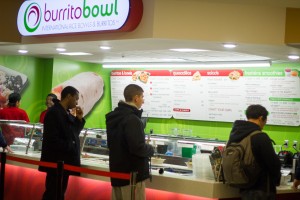
Behold Burrito Bowl, the newest addition to the Commons and the home of international rice bowls, burritos and salads.
In a Dining Services survey, students expressed that they wanted healthier dining options oncampusandtheirrequestwas delivered. While students and staff were home for the holidays, BurritoBowlissetupforthestart of the semester.
“Zoca was pretty rough, to be honest,” sophomore Maggie Curtis said. “The only decent thing I got there was a cheese quesadilla. It also didn’t have awesome smoothies.”
Overall, most students agree with Curtis and are impressed with the new station, and say that it’s definitely better than its greasy predecessor and the ingredients are much fresher.
“It’s great!” senior Allison Eberhardt said. Eberhardt is a vegetarian and says that Burrito Bowl has a lot more options for her to put into her bowl or burrito.
Sophomore Colin Woods would agree that it’s one of the better options for food on campus, but said that “it’s definitely not Chipotle.”
The difference between Chipotle near College Town and the Burrito Bowl at the Commons also took sophomore Sarah Elderkin by surprise.
“I was a bit confused by it because of the combinations and ingredients. I expected it to stick to actual southwestern style food because that’s the implication of a burrito restaurant, so having all sorts of different types of food styles seems odd,” she explained. “It doesn’t make sense to me, but variety is nice I suppose.”
Despite not being quite comparable to Chipotle, Burrito Bowl has seen an immense increase in sales relative to Zoca.
In an email sent out on Jan. 23, Dining Services claimed that, within the first week alone, burrito bowl sales tripled, burrito sales doubled, 15 times more salads were sold and over 2000 smoothies were bought.
This can easily be backed up just by taking a trip to the Commons and seeing the line of at least 15 people that’s nearly ever present at the station. Yet the line can sometimes deter people from choosing it over other options.
Anna Parker, a junior, hasn’t even tried Burrito Bowl yet because the line has always been too long. “I’ve only gotten the smoothies,” she said. “People tell me the food is good, but not exactly worth the wait.”
Sophomore Sam DeSantis agrees, saying it took him nearly 20 minutes to get his food, a chunk of time not a lot of college students often have.
However, Curtis doesn’t think the long lines will last long.
“I think that it will remain busy for the first half of the semester sinceitisanewamenity,”shesaid. “After a while, however, I think the rage will die out and it will settle back into a decently popular station, but not as crazy.” However, even with the line,
Burrito Bowl remains ever popular. The ratings and opinions of Burrito Bowl seem to be in high standings. It’s definitely the busiest place to grab some grub on campus at the moment and has made quite the improvementinthefreshandtasty ingredients department.
“The food is really good,” Curtid said, “so I think students will definitely go there consistently.”
Listro is a member of
the class of 2017.