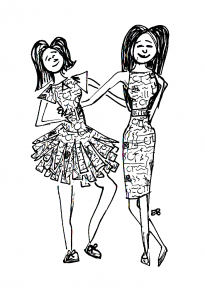
Liz Beson, Illustrator
An internal Campus Times poll conducted campus-wide has revealed “startling” information about the changing nature of news in the 21st century.
According to the poll, the majority of the wearership of CT issues comes from the sororities and fraternities on campus. According to anonymous sources, members of an unnamed sorority enjoy “getting crafty and dressing up, with their outfits consisting merely of the brittle, ink laden paper of the CT.”
The large circulation of Campus Times, roughly estimated to be four million pages per semester, is having a mixed impact on underground fashion. Creativity is blossoming. However, Campus Times issues are increasingly becoming a part of underage drinking on campus, with students not only wearing issues but also incorporating them into their drinking games. One such game is “Shots of Seligman,” in which every time Joel Seligman is quoted in the paper, you must take a shot of alcohol.
Referencing the Humor Section, the Campus Times Editor-in-Chief noted, “This page is meant to cover up your cleavage—or not.”
UR President Joel Seligman was not available for comment.
Schaffer is a member of
the class of 2016.