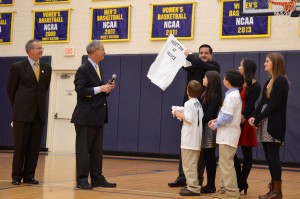
President and Chief Executive Officer of ORIX USA Corporation and UR alumnus Brian F. Prince has donated a large sum of money to go toward renovating and expanding Fauver Stadium and other outdoor athletics facilities.
President Joel Seligman announced the gift during half-time for the basketball game against Case Western Reserve this past Friday, Jan. 17.
The multi-million dollar project will create the Brian F. Prince Athletic Complex in honor of Prince’s parents, Richard and Christine Prince.
“I believe that athletics, whether varsity, intramural or recreational, are an important component of University life. [They provide] a unique opportunity for all members of the University community to experience and enjoy the benefits of intense competition, teamwork, leadership, and sacrifice,” said Prince, as quoted from a Friday press release.
“These things don’t happen everyday. This is really transformational,” said Director of Athletics and Recreation, George VanderZwaag.
Construction will begin this summer, starting with the expansion of the outdoor complex. VanderZwaag said that they hope to get new fields, lights, and fencing, which will be the most visible part of the project.
The outdoor expansion will occur around Fauver Stadium, the Lyman Outdoor Tennis Center, and the north field practice area. These changes will create a more attractive campus, according to VanderZwaag.
The most substantial change will be the renovation of the inside facilities, namely locker rooms and training rooms on the ground floor.
“It’s in the areas that are less visible to most people,” VanderZwaag said.
Fauver Stadium was built in 1930 to house all-male programs, so many facilities are out-dated.The expansion of the athletics program since then has created a higher demand for space and locker rooms for visiting teams. Visitors and their coaches have in the past had to use a separate building and then walk over to Fauver for games.
VanderZwaag commented on the impact the construction will have on student life, “Varsity teams that have locker room space in Fauver are directly [and] positively impacted,” VanderZwaag said. “I think all students are impacted by the fact that the field work we have done has given us more usable field space…”
Summer construction will also affect summer sports camps. VanderZwaag said it will be dealt with in the best way possible, but downsizing these programs until after construction may be inevitable. The project is still in the planning phase, and the timeline and engineering plans have yet to be drawn out.
Freshman Alberto Carillo expressed his reservations about the large donation. “I think it’s a lot of money, and it’s great that the sports teams will enjoy it, but I feel like there are other parts of the university that could also enjoy it,” Carillo said, referring later to classrooms and artistic facilities that could be renovated.
Senior Amanda Lardizabal expressed more positive views of the donation. She commented that the athletic facilities do need some updating.
“The turf just got redone, which is nice… and it sucks that there’s only a one-side stadium, but I also feel bad for the baseball team because I feel like they don’t have a locker space,” Lardizabal said.
VanderZwaag said that the significance of such renovations to the general student population is to reinforce the impression created that students here are at a “high-quality institution.”
Seligman expressed appreciation for Prince’s support.
“One of the things I really admire about Brian Prince is his commitment to D3 sports and the student athlete model.”
Seligman commented on the importance of sports on college campuses, especially at institutions like UR that do not have a reputation for athletics.
“We believe in the student athlete,” he said.
Seligman continued to define why a focus on sports at UR is different from that of a Division One and Two university.
“I think what we have is far more precious. We have a unified campus where every student is valued, and we never lose focus of our core academic values.”
He described sports on the UR campus as being “totally clean” and supporting an environment in which athletes and non-athletes alike can discuss their academic goals with sincerity.
“I’ve just been thrilled by our athletic programs,” Seligman affirmed.
VanderZwaag also noted the positive effects of a strong athletics program that is made possible by Prince’s donation.
“For us , it’s clearly an educational endeavor.”
According to VanderZwaag, UR’s faculty wishes to create programs that reflect the needs of the student population. He defined the goal of UR as helping students grow. A balance of education and athletics, he said, is a good way to encourage that growth. VanderZwaag used Bob Georgen as an example of another alumnus who helped UR back in 2000.Bob Georgen’s donation was responsible for the renovation of Georgen Athletic Center.
“None of these things happen without the support of people like Bob Georgen and Brian Prince.”
Further examples of alumni generosity are Rettner Hall and Lechase Hall. VanderZwaag said donations like these are not uncommon.
“This is who we are and what we do, and this is what makes projects like this possible,” he said. “Nothing that you accomplish in your life is really just a product of you alone […] You give back because it’s part of what made you who you are.”

McAdams is a member of the class of 2017.