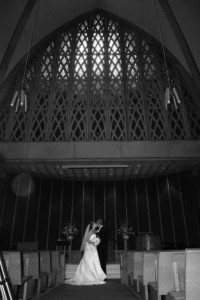
 Getting married is probably the last thing on an undergraduate’s mind. Having that wedding take place on campus is even more foreign. Yet interestingly enough, many weddings actually take place in UR’s very own Interfaith Chapel.
In 1970, Gilbert McCurdy, whose generous donations helped build the chapel, made several stipulations during its construction, decreeing that no civil ceremonies could be preformed, no alcohol could be served except for religious reasons, and no for-profit organizations could hold events in the Chapel.
Chaplain’s Office Administrator Eileen Bruton explained that since the 1970s, about 50 weddings take place in the chapel each year.
“Fifty percent of the weddings that we have at the chapel are part of the UR community,” Bruton said. “Forty percent of the weddings are people in and around the greater Rochester area, and around 5 percent are students or recent graduates.”
Bruton explained that the majority of the weddings at the chapel are protestant, but surprisingly, one-third are fittingly interfaith.
Director of the Catholic Newman Community Reverend Brian Cool said that interfaith marriages are fairly common in the chapel as interfaith couples often struggle to find a religious building that will accommodate their conflicting beliefs.
“Some people want to be in an environment where having both religions is welcome,” Cool said.
Bruton, a chapel employee for 13 years, also spoke to the chapel’s support of couples with different sexual orientations, declaring the chapel’s continued encouragement even though “we had more civil unions in 2000 than we do now.”
Denise Yarbrough, director of University Religious and Spiritual Life, said that from spring to fall, weddings are booked almost every weekend, sometimes with more than one per day. During the academic year, weddings are only booked on Saturdays but can otherwise be booked on Saturdays and Sundays alike.
“One of the reasons why so many people want to have weddings here is because the chapel is prized for its beauty,” Yarbrough said. “The fact that it is an interfaith space and it’s located by the river, which is a beautiful backdrop for photographs, really attracts people to hold their events here.”
Yarbrough also said that many of the chaplains at the chapel are available to officiate at the weddings, and that the chapel “serves the whole community, not just people with an affiliation with the University.”
Vice President for Advancement and Alumni Relations Kevin Wesley said that alumni weddings on campus are really great for the University.
“Having a place on campus where many couples met can be a meaningful and dominant connection for alumni,” Wesley said. “The chapel can be a powerful place to celebrate and affirm love that often blossomed while students were at UR. ”
Wesley added that alumni use of the chapel affirms that the University continues to be an important part of their lives even years after graduation.
“We want alumni to come back to campus and share it with friends and families,” he said.
In regards to cost, the Interfaith Chapel is a real bargain when compared to other venues, which can cost thousands of dollars. The chapel has an event coordinator to assist couples with planning for their ceremonies. For someone outside the community, a wedding costs around $725, and for someone with relations to the University, a wedding costs around $625. For a current full-time student, whether undergraduate or graduate, a wedding at the chapel costs $225.
Despite the cheap prices for their ceremonies, weddings are a steady source of income for the Interfaith Chapel, Bruton said.
“Most people think that not a lot of activity goes on at the Interfaith Chapel, but you would be surprised,” she said. “We are a very active community, and we hope to be even more active in the future.”
Teitelman is a member of
the class of 2016.