Alex Kurland, Staff Illustrator
Fortunately for serious minds, a bias recognized is a bias sterilized.” Such are the words of Benjamin Haydon, 19th-century painter. When watching, reading, or listening to the media, Haydon’s “serious mind” is vital. Bias is human: the communication of information from person to person often comes with subconscious personal additions that do not necessarily constitute fact.
Extracting information from the media is a challenge in and of itself; the naïve listener simply believes what is heard and the rash one ignores the full extent of information, but the wise one evaluates and weighs the matters discussed at hand, maintaining a firm awareness of the presence of bias.
Unfortunately, the wise listener is rare. The polarizing media commands a great and frightening influence on how Americans receive their information. The populous possesses such strong faith in the media’s ability to broadcast information that many believe all they see.
There exists some relief in the media’s broadness: several news television stations, newspaper and magazine publications, and radio stations cover many of the same topics from different angles. Essentially, they compete to captivate the viewer with an efficient and compelling layout of the news. The true problem arises, however, when the listener relies on only one source for news. When one exposes oneself to a single source for information, one runs the risk of indoctrination. As a result of the prevalence of bias in such cases, the listener unknowingly absorbs the matters of the world through a narrow scope.
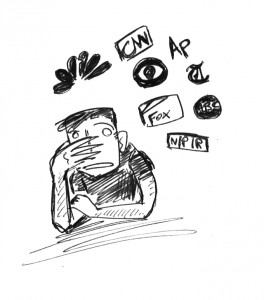
Certain publications and shows demonstrate heavy bias when relaying the news. Fox News claims to maintain no bias in favor of conservatism; however, the Wall Street Journal, a renowned and prestigious newspaper publication, deemed Fox news “a network sympathetic to the Bush cause and popular with Republicans.” Several news stations attack Fox for its clear bias against liberals and its supposed endorsement of certain conservative politicians. Just as there are arguably pro-republican news stations, there are also stations that demonstrate bias in favor of democrats. Critics bash MSNBC for its clear catering towards left-wing viewers and its overwhelming endorsement of Democrats. MSNBC anchor Chris Matthews says “he sees his job as a journalist as doing everything he can to make the Obama presidency a success.” Moreover, The Washington Post asserted that MSNBC “has tried to position itself as a left-wing alternative to Fox News Channel.”
The sheer volume of news sources coupled with the inevitable presence of media bias makes learning the news a meticulous trial. If we are to gain a clear understanding of present day affairs, the usage of news sources is encouraged but cautioned. We should never delve too deep into the opinions of others, lest we stray too far from fact. Once bias is “recognized” and “sterilized,” the means to develop one’s own opinion follows.
Charugundla is a member of the class of 2016.