Courtesy of UR Communications
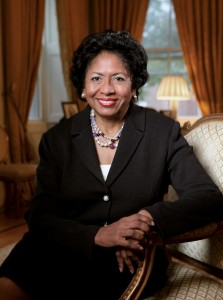
For the first time, the process of selecting this year’s commencement speaker — president of Brown University Ruth Simmons — was conducted without input from students or from the 2012 Class Council.
In years past, the senior class council provided a list of names with short biographies for review by the College Dean’s Office and the President’s Office, according to Director of Wilson Commons Laura Ballou. As this process was conducted at the beginning of senior year, it was often too late to actually have the names approved and then formally ask the individuals. The process was therefore changed to have the junior class council compile the list during the second semester of junior year.
In restructuring the process this year, the senior class council was consulted and was in agreement, in large part because UR does not pay its commencement speaker; the individuals favored by students therefore often do not gel with the realities of the kind of speaker UR can actually host, Ballou said.
“This year we felt that it would be a waste of our time to propose a list of speakers if they weren’t feasible, so we were not involved in the process,” 2012 Class Council President and senior Lucas Piazza said. “We didn’t want to project the image of choice to the student body and then suffer the consequences when a high profile speaker was not selected.”
Ballou, who has been a part of the process both before and after there was a formal student voice in the process, believes that the ultimate choice of a fitting speaker will be unchanged by eliminating student input.
“The end result seems to be a very high quality academic speaker regardless of student involvement,” Ballou said. “Since UR does not pay for a commencement speaker, I do think there usually will not be a high name recognition speaker chosen, which is usually what the majority of students are looking for.”
Piazza believes that although the fact that UR does not pay its commencement speaker limits the possibilities of speakers, it also ensures that UR attracts “speakers hoping to educate and disseminate wisdom rather than benefit financially.”
Paying for a commencement speaker seems to be fairly typical of institutions comparable to UR. Only about 30 percent of all colleges pay their commencement speakers, according to an article published last May in “Inside Higher Ed.”
Senior Ben Bovarnick said he is not surprised about the change in the process this year given the fact that UR does not allocate funds for speakers.
“In my experience, looking for speakers within the school’s budget is often complicated by the wide gap between what students perceive they’re worth and are therefore willing to pay, and what the market perceives they’re worth,” he said.
Student reaction to the choice of commencement speaker varied from puzzlement to excitement.
Senior Leigha MacNeill said she was initially “a little thrown at the idea of having another university’s president address us at graduation.” But after reading about Simmons and “thinking about what kind of presence she might have at Rochester,” she realized that Simmons is in fact “an agent for a lot of what our own school stands for,” specifically the “ever better mentality,” she said.
“Not only is she a remarkable academic, but it seems that she’s acquired myriad of experiences that testify to how one should live her life as a whole,” MacNeill said. “Everyone has a story to tell, and as long as she can deliver a colorful address that inspires us and shapes a new understanding of what is to come, then it will be in all of our interest to hear her words — no matter what her official title may be.”
Senior Belinda Weinberg also said she found it “a bit strange” to learn that the speaker would be the president of another university.
“The fact that Simmons does not directly have a tie to UR or to the Rochester area, via Xerox or Wegmans, as with the past two commencement speakers, I feel is a valid issue,” Weinberg said, adding that after reading her background, she began to feel “interested in hearing what she will have to share with us.”
Weinberg, who was unaware that UR does not pay its commencement speaker, said she feels that the main issue with soliciting student input is that it turns into an “opportunity for elevated and unrealistic expectations,” especially given misconceptions that arise about the process after students hear of famous individuals giving the commencement address at comparable schools.
Making students aware of the fact that the speaker is not paid and having students provide feedback in some way would “quell the letdown that many students feel when they do not immediately recognize the commencement speaker by name,” Weinberg said.
Buletti is a member of the class of 2013.