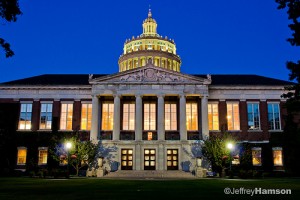
Courtesy of http://farm3.static.flickr.com/

UR is widely recognized for the numerous educational facilities it has to offer. In addition to the Omega Laser Lab, the Medical Center and the Hajim School of Engineering, UR’s various libraries host a wealth of information for the undergraduate, graduate and faculty populations alike. Rush Rhees Library alone holds over 3 million volumes, which doesn’t even include additional libraries such as Carlson Science and Engineering Library, the Physics, Optics and Astronomy Library (POA) and the Sibley Music Library at Eastman.

With all of its resources, however, the libraries on campus have reduced hours on weekends, a system that affects all students’ abilities to use these resources to their fullest potential. While it might seem laughable to suggest that students would be disappointed to not spend much time in a library during the weekend, everyone who has ever had to endure the crunch of a stressful course schedule knows that any and all library time can be much appreciated.

Although UR encourages its students to stay on campus during the weekend and to utilize the research materials offered to them by the University, there is a paradox in that students who wish to study in the library on weekends, or  as a resource for extensive research, can be closed out of the library in the largest block of spare time they might have. Although one can argue that students should have plenty of time to peruse the library during the week, schedules are restricted by classes, extracurriculars and school works. Also, some students have jobs that run all throughout the library hours offered, thus further restricting research time into a fairly small window of availability, or to no window at all.

While it may be less efficient to pay librarians or student workers on weekends, it would be very helpful for UR to recognize that extended weekend hours are as beneficial to stressed students as late weekday closing hours.


Library hours insufficient

At my home university, and at most universities in the U.K., we have to cook for ourselves because we have access to kitchens that are more than tiny boxes with tiny ovens and stovetops. Read More

Library hours insufficient

Traffic mitigation, the main goal of the congestion relief program, has been an inarguable and impressive success. The major bridge and tunnel crossings into the tolled area of Manhattan saw an astounding 23% average decrease in rush hour travel time, ranging from 6.7% on the Manhattan Bridge all the way to 51% in the Holland Tunnel. Read More

Library hours insufficient

This creates a dilemma. If we only mandate what is easy for companies to implement, emissions keep rising. If we pretend everything can be decarbonized quickly, climate policy collapses under its obvious failures. A serious approach has to accept two tenets at once: we need full decarbonization everywhere that it is possible, and  we need honest promises from sectors where it is not. Read More