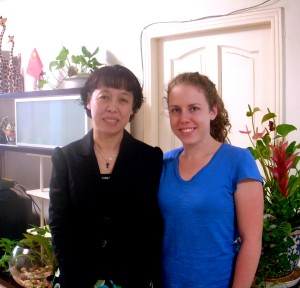
Courtesy of Natalie Peterman
When I left Rochester last December, I knew I would be spending my next two semesters in China and Peru. I also knew I could speak both languages and was familiar with the lifestyles in these countries. What I didn’t fully appreciate, however, was that the relationships I established would bring me closer to both cultures.
The study abroad orientation course — required for all UR students interested in going abroad — describes the stages of culture shock; the process of adjusting to a foreign culture. It seems the most drastic transition is from the honeymoon stage to the distress stage.
No matter how excited I am or how well I think I speak my host country’s language, there arrives a moment of internal panic that goes something like, “What part of me thought it would be a bright idea to leave everything I know for four months and come here of all places?” This is the distress stage.
In Beijing, this moment occurred at baggage claim carousel two. What had looked like a reasonable amount of luggage in my living room in Los Angeles suddenly looked like much, much more — and was twice as heavy.
Luckily, Yu Laoshi, who would be one of my Mandarin language teachers, noticed my dilemma. She helped me half-drag, half-carry my bags as I continuously apologized and thanked her, trying to think of some witty excuse to explain them.
“Did you bring bricks with you?” she asked. Yu Laoshi was the first of many teachers who would bring me into their Chinese culture.
A week later, I found myself with 20 other students awaiting the arrival of the host families we would live with for the next four months. We all sat in a circle, and one-by-one the families walked through the door.
I will never forget the first time I saw my host mom, whom I called “ayi,” which means “aunt” in Mandarin. She seemed relaxed and at ease for what was a nerve-wracking situation to me. This same calmness carried over into our relationship.
In our dinner conversations during the months that followed, I learned some of the most intimate details about her life, and the gender expectations she had grown up with.
For example, women should not smoke or drink, and a career in politics is too strong of an occupation for a woman. By my last month in Beijing, our conversations had moved from me asking vocabulary questions to her venting about her life and me about mine. The day I left, she made me my favorite breakfast — fried, green onion pancakes (they’re delicious) — and we walked out to the taxi. We hugged, and with tears in our eyes said goodbye, which in Mandarin literally means “see you again.” We keep in touch, and I will see her again, as I’m planning to move back to China after I graduate.
I’m currently in the middle of my experience in Peru, which started with another panic moment — this time in-flight when the woman next to me didn’t speak Mandarin.
She did, however, re-introduce me to my first love, Spanish, and patiently listened as my brain switched from Chinese to a combination Chiñol to Español.
Some of the more obvious cultural differences here include commuting on 15 person mini-buses that usually hold 30 and seeing a recap of Peru’s most popular soap opera follow an update about Peruvian politics on the nightly news. But, I realize that my experience here will be defined by the people bringing me into their Peruvian culture.
The core of what I learned and am learning from my relationships is that people are people, no matter where you go. Of course, this was something I had already known, though I have been experiencing it in a more profound and intense way.
Individuals from other cultural systems pulled me from both of my panic moments. They found our common ground, and from there showed me what I hadn’t seen about my new surroundings.
While language and culture certainly impact a person’s identity and create distinct cultural systems, you learn and accomplish much more if you use similarities to experience another world view.
Peterman is a member of the class of 2012.