Last weekend, at a three-day conference in Washington, D.C., senior Naomi Ahsan and sophomore Grant He discussed how to go beyond religious tolerance and use faith as a unifying force to make a difference in the community.
The conference, held by the Interfaith Youth Core (IFYC), was attended by 100 college students from all 50 states. It is a part of the IFYC’s “Better Together” campaign, which seeks to unify people of different religious backgrounds under the common goal of community service.
“I believe that faith and religion in general are very powerful concepts,” He said. “The idea is that instead of the divisive force that they’re portrayed as in the media today, they can be used as a way of bringing people together and helping people.”
Ahsan agreed, adding that individuals who don’t practice any specific faith should have a spot at the table as well.
“People who don’t have an identifyable religion are often-times still very interested in this kind of service,” she said. “Morals exist outside of any one religious identity.”
The conference started out with an introduction at the White House by IFYC founder and former head of President Obama’s Faith-Based and Neighborhood Partnerships Council Eboo Patel. Throughout the event, delegates also heard talks from individuals of various religious backgrounds on how their faith motivates them to serve their communities.
Student delegates participated in a wide range of activities and workshops over the weekend, with the goal of learning how to create and maintain faith-based community initiatives. According to He, much of this training fell under three main categories: “speak out,” which taught delegates how to effectively advertise their organizations and help them grow, “mobilize” — which had to do with gathering support for events — and “sustain,” which helped delegates assess how to keep their initiatives running once they leave college.
To Ahsan, one of the most important aspects of the conference was getting to build networks with the other student delegates.
“For people who are working on the same kinds of things in different places, it’s really useful to have connections to people who might encounter some of the same issues [as we are],” she said.
Ahsan also mentioned that learning skills related to advertising interfaith community service opportunities was a major point of conversation. She cited topics such as using social networking as a tool to get the word out and identifying the right places on campus to advertise as examples.
Grant He pointed out several useful skills he picked up at the conference as well. For one, he learned how to specifically quantify resources that might be helpful through asset and network maps. He also emphasized choosing good committee members for future leadership and the power of storytelling as key topics of the conference.
“Telling stories has much more of an impact on people than just statistics or figures,” he said.
UR’s Students for Interfaith Action – an organization of which Ahsan is the president and He is a member of the executive board — is already beginning to formulate ways to use the skills learned from the conference to make a difference in Rochester. According to Ahsan, the organization is looking to potentially use either service work in the Rochester City schools or disaster relief to encourage interfaith cooperation.
Ahsan recognizes, however, that achieving the ideals of the IFYC at Rochester will be a significant undertaking.
“I think that we are a very diverse group,” she said. “That said, I think there’s a lot of fragmentation [due to different] academic cultures, career interests, etc.”
Still, Ahsan looks positively on the University’s progression in terms of cooperation between religions on campus.
“Are we integrating the diversity?” she asked. “Are we going beyond tolerance to try to work based on the differences between students? I think we’re really far along that road compared to a lot of other places.”
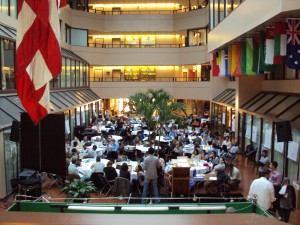
Delegates from all 50 states discussed how to use faith as an engine for community improvement.